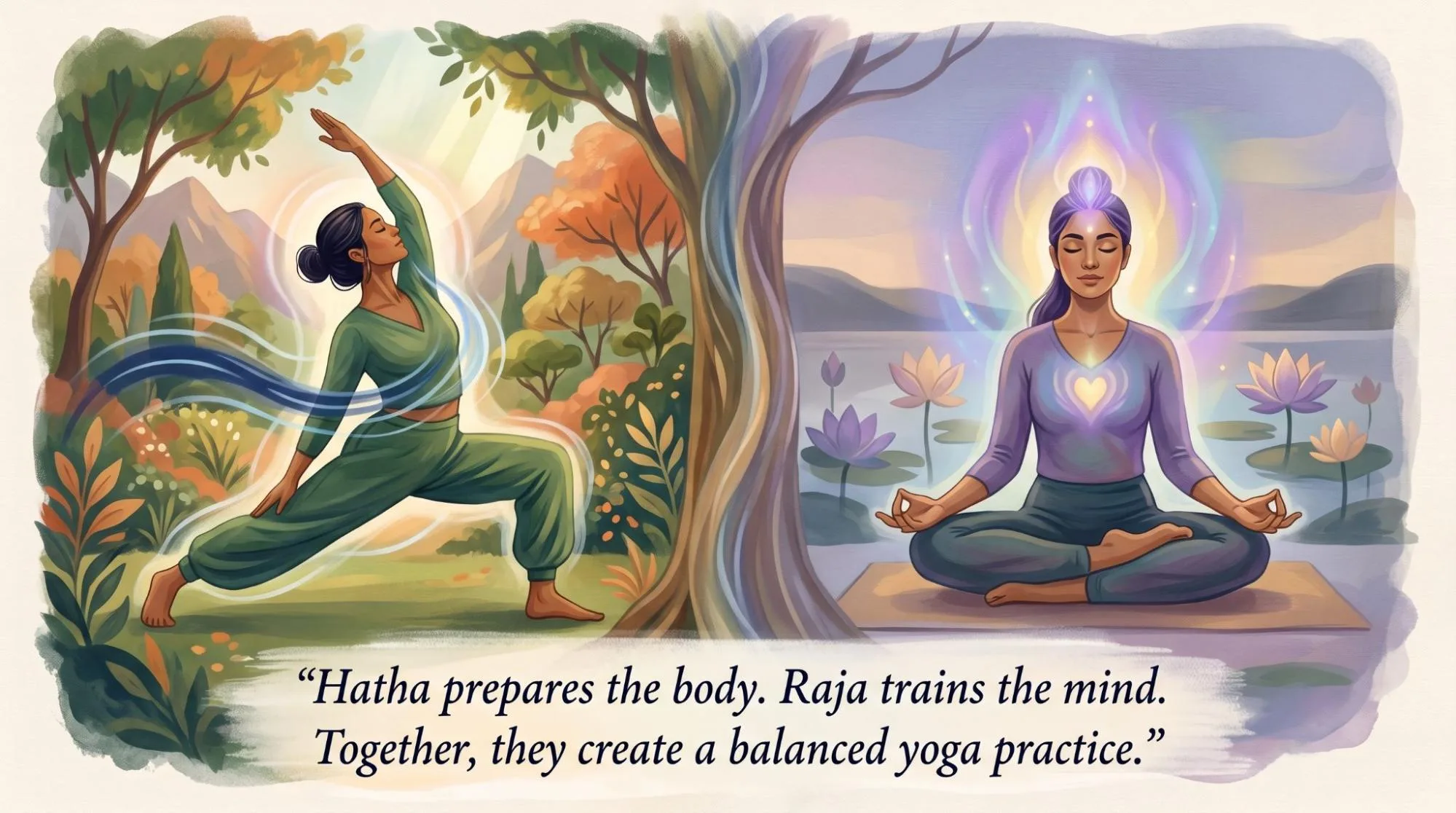
Many beginners search for the difference between hatha and raja yoga because both paths sound similar, but they do not focus on the same part of yoga practice. In reality, they are connected, but their focus is different.
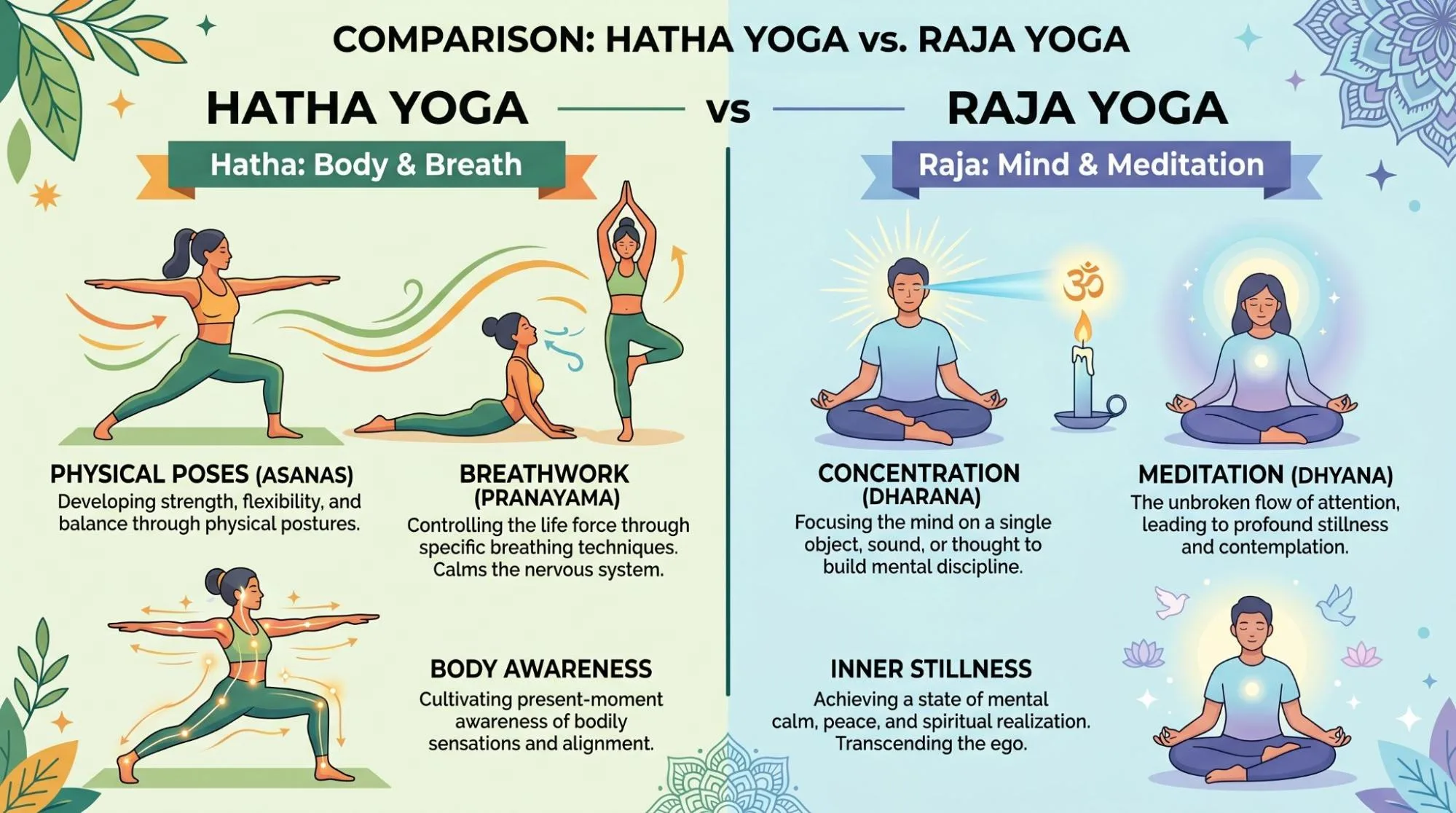
The simplest difference between Hatha and Raja Yoga is this: Hatha Yoga works mainly through the body and breath, while Raja Yoga works mainly through the mind and meditation.
Hatha Yoga prepares the body and energy system. Raja Yoga trains the mind toward deep concentration, inner peace, and higher awareness. Both can support a serious yoga practice, but they begin from different doors.
What Is Hatha Yoga?
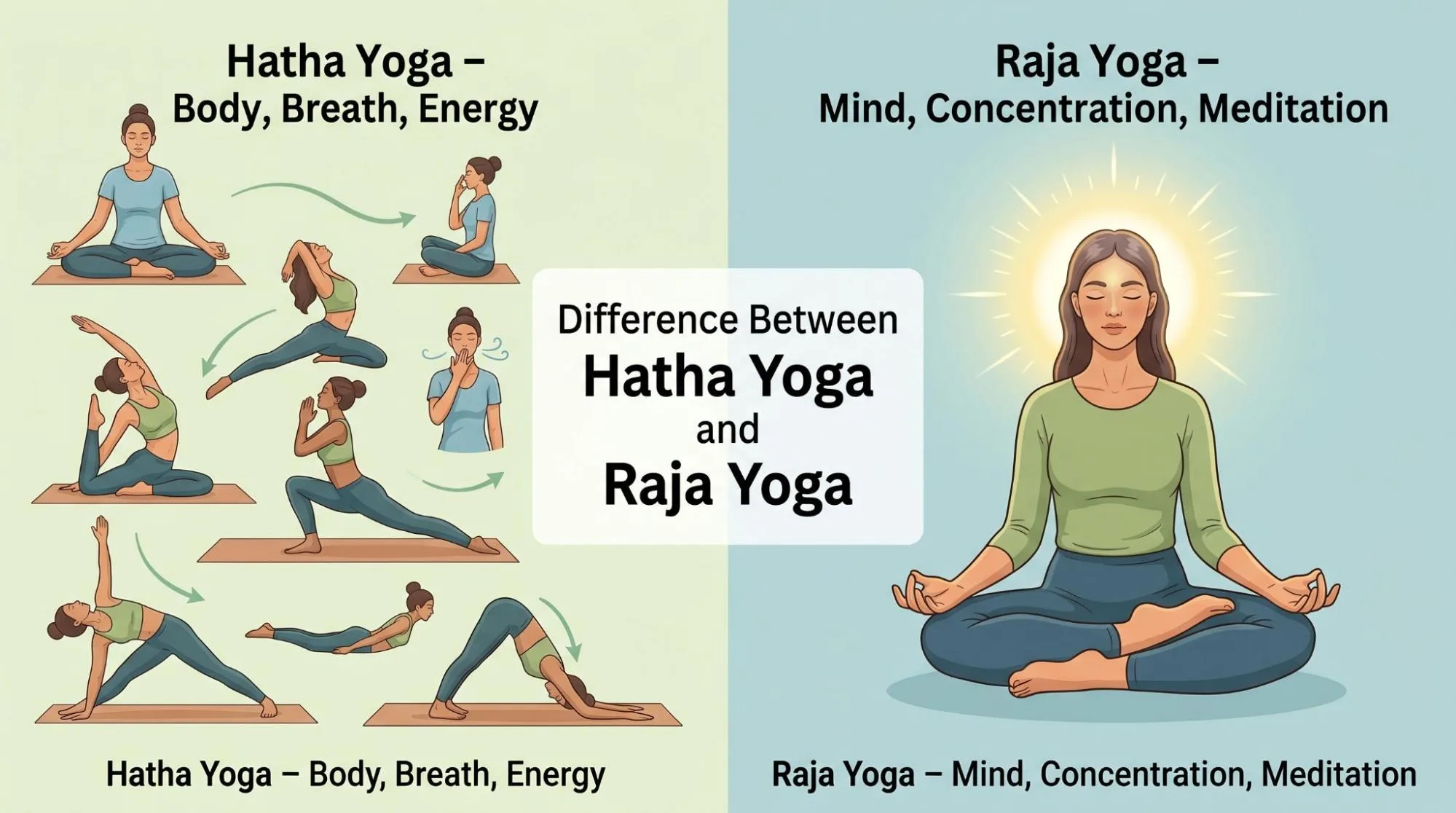
Hatha Yoga is the path of yoga that uses the physical body, breath, and energy practices to create balance. Most modern yoga classes are influenced by Hatha Yoga because they include postures, breathing, relaxation, and body awareness. To understand the difference between hatha and raja yoga, it helps to first know that Hatha Yoga begins with the body, breath, and energy.
The word “Hatha” is often understood as the balancing of opposite energies. It is not only about stretching or fitness. Traditionally, Hatha Yoga was used to make the body steady, healthy, and ready for deeper spiritual practice.
Main Focus of Hatha Yoga
The main focus of Hatha Yoga is the body and vital energy, also called prana.
It helps the practitioner build strength, flexibility, balance, and control over the breath. When the body becomes calm and stable, the mind also becomes easier to manage.
In simple words, Hatha Yoga starts from the outside and slowly moves inward.
Main Practices of Hatha Yoga
The main practices of Hatha Yoga include:
- Asanas – physical postures
- Pranayama – breath control
- Mudras – symbolic body or hand gestures
- Bandhas – energy locks
- Relaxation – calming the body and nervous system
- Cleansing practices – used in traditional Hatha systems
Asanas pranayama practices are especially important in Hatha Yoga. The body is trained through postures, while pranayama breath practices help control energy and calm the mind.
Learn More : Patanjali Yoga Sutras for Beginners
What Is Raja Yoga?
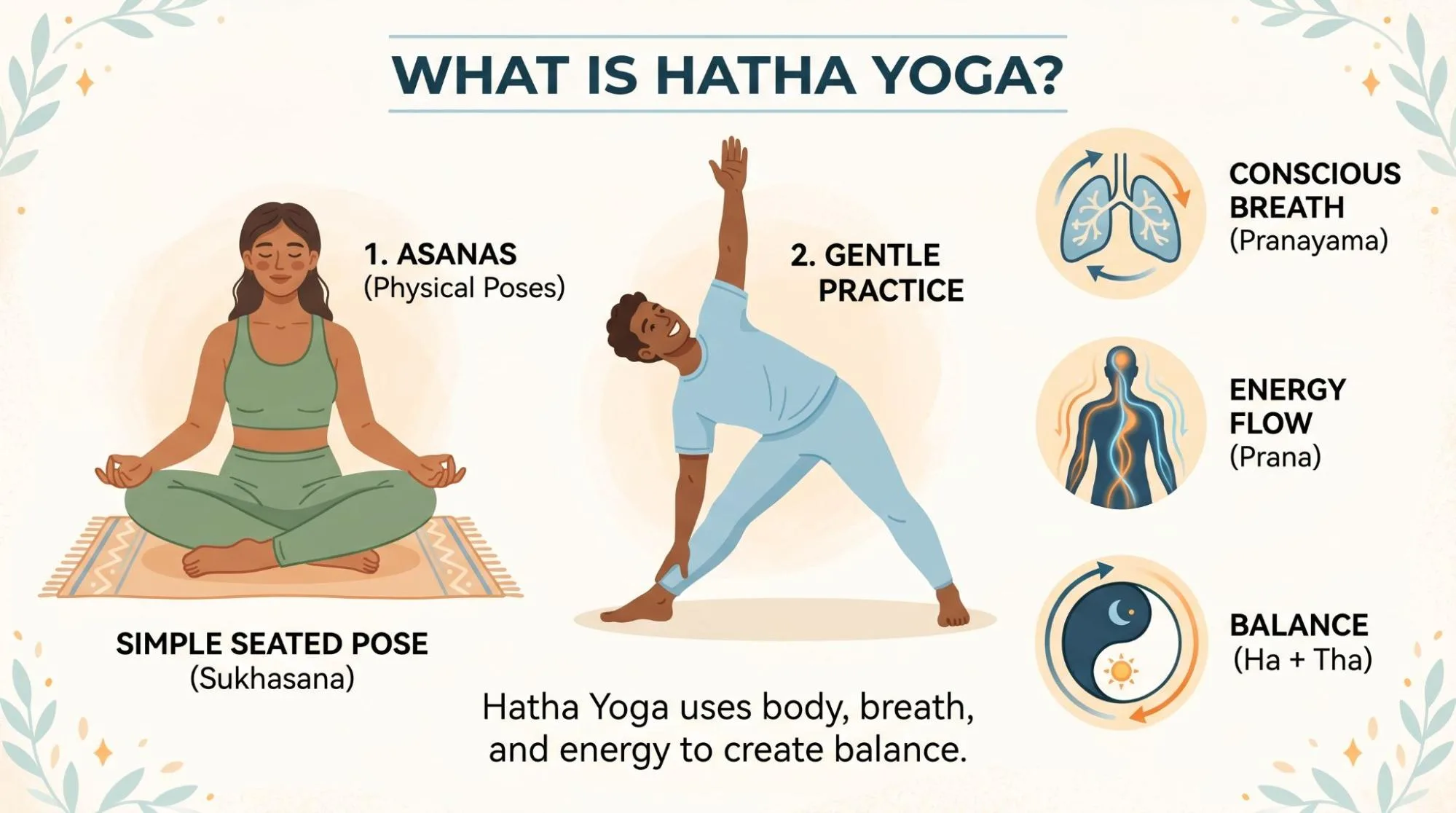
Raja Yoga is often called the “royal path” of yoga. It focuses on controlling the mind through discipline, concentration, and meditation.
While Hatha Yoga uses the body as a tool, Raja Yoga uses the mind as the main field of practice. It is closely connected with the Yoga Sutras of Patanjali, which explain the famous eight limbs of yoga.
Main Focus of Raja Yoga
The main focus of Raja Yoga is the mind.
It teaches that most human suffering comes from an uncontrolled mind. Thoughts, desires, fears, and distractions keep a person restless. Raja Yoga trains the practitioner to observe, discipline, and eventually quiet the mind.
This does not mean Raja Yoga ignores the body. It simply treats the body as one part of a larger mental and spiritual journey.
Main Practices of Raja Yoga
The main practices of Raja Yoga include:
- Ethical discipline
- Self-control
- Steady posture
- Breath regulation
- Withdrawal from distractions
- Concentration
- Meditation
- Samadhi, or deep spiritual absorption
Raja Yoga is more inward and meditative. It is less about physical movement and more about mental clarity.
Difference Between Hatha Yoga and Raja Yoga
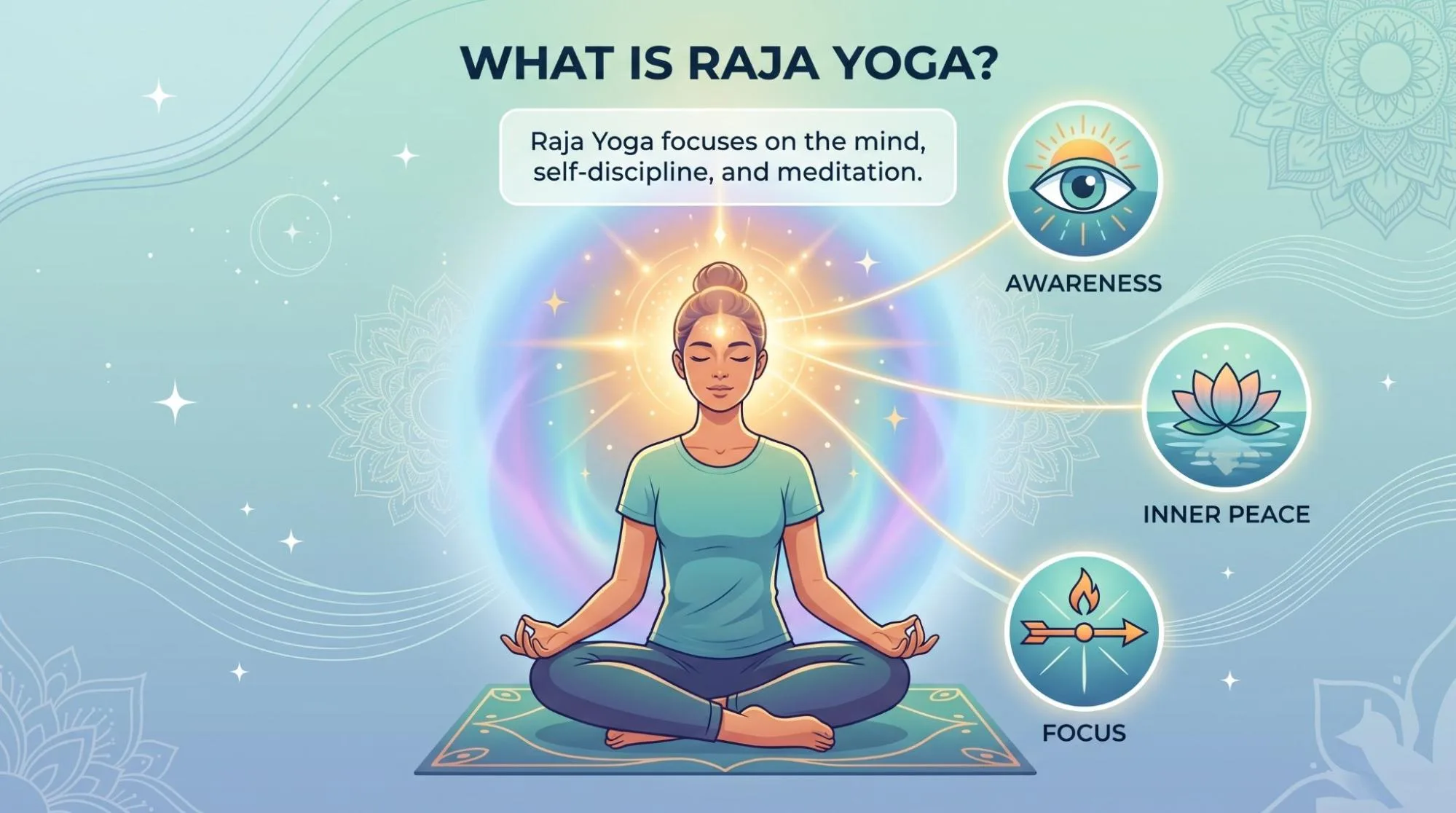
The key difference between hatha and raja yoga is their starting point.
Hatha Yoga begins with the body, breath, and energy. Raja Yoga begins with the mind, discipline, and meditation.
Both paths aim toward self-realization, but they use different methods. Hatha Yoga prepares the physical and energetic system. Raja Yoga takes the practitioner deeper into mental control and spiritual awareness.
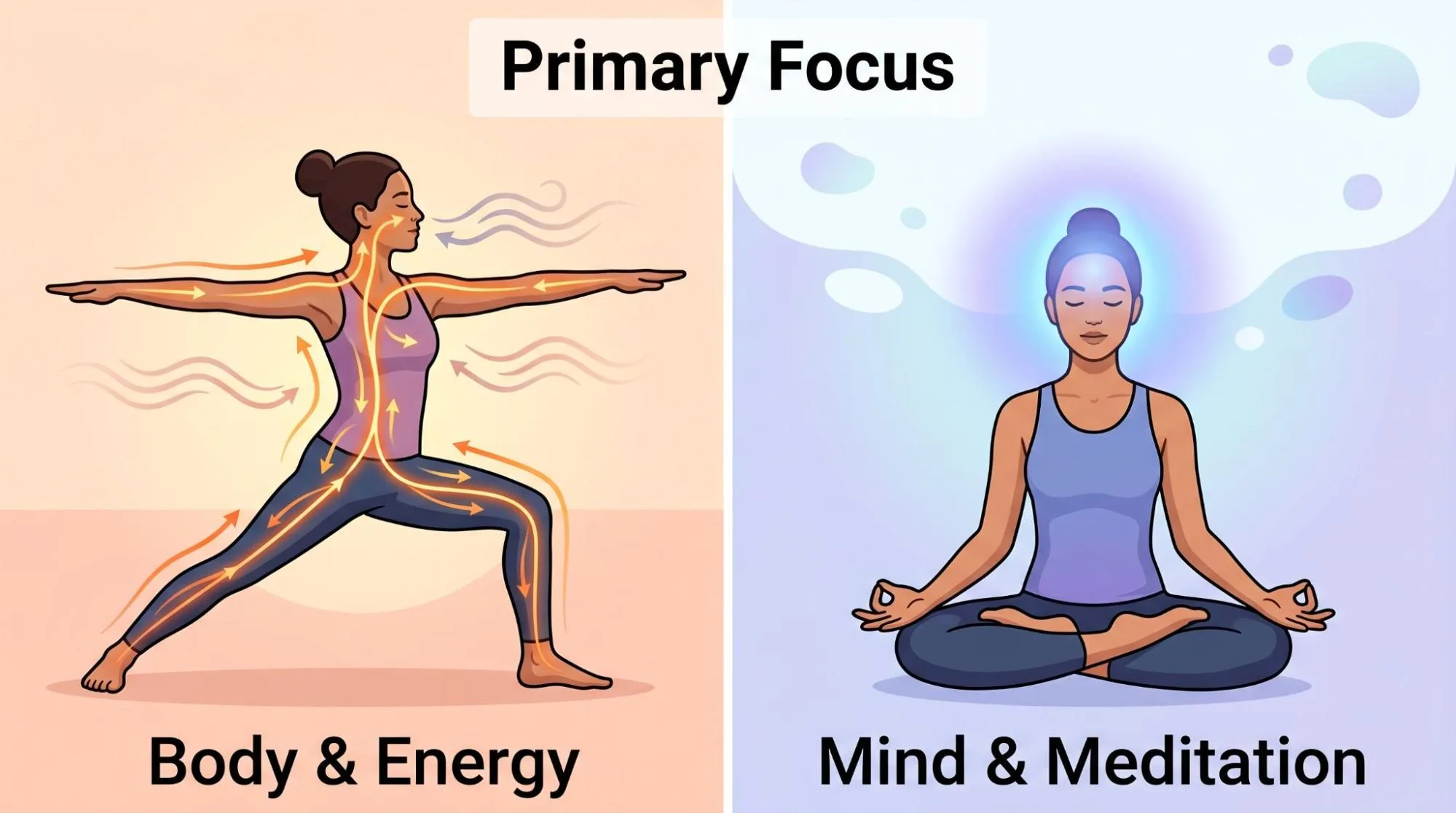
Primary Focus: Body and Energy vs Mind and Meditation
Hatha Yoga focuses on the body and energy. It uses physical postures and breathwork to remove stiffness, improve vitality, and balance prana.
Raja Yoga focuses on the mind and meditation. It works on thoughts, habits, attention, and inner stillness.
A simple way to understand it:
- Hatha Yoga: “Make the body and breath steady.”
- Raja Yoga: “Make the mind steady.”
Both are useful. A stiff, restless body can disturb meditation. A scattered mind can also make physical yoga feel shallow.
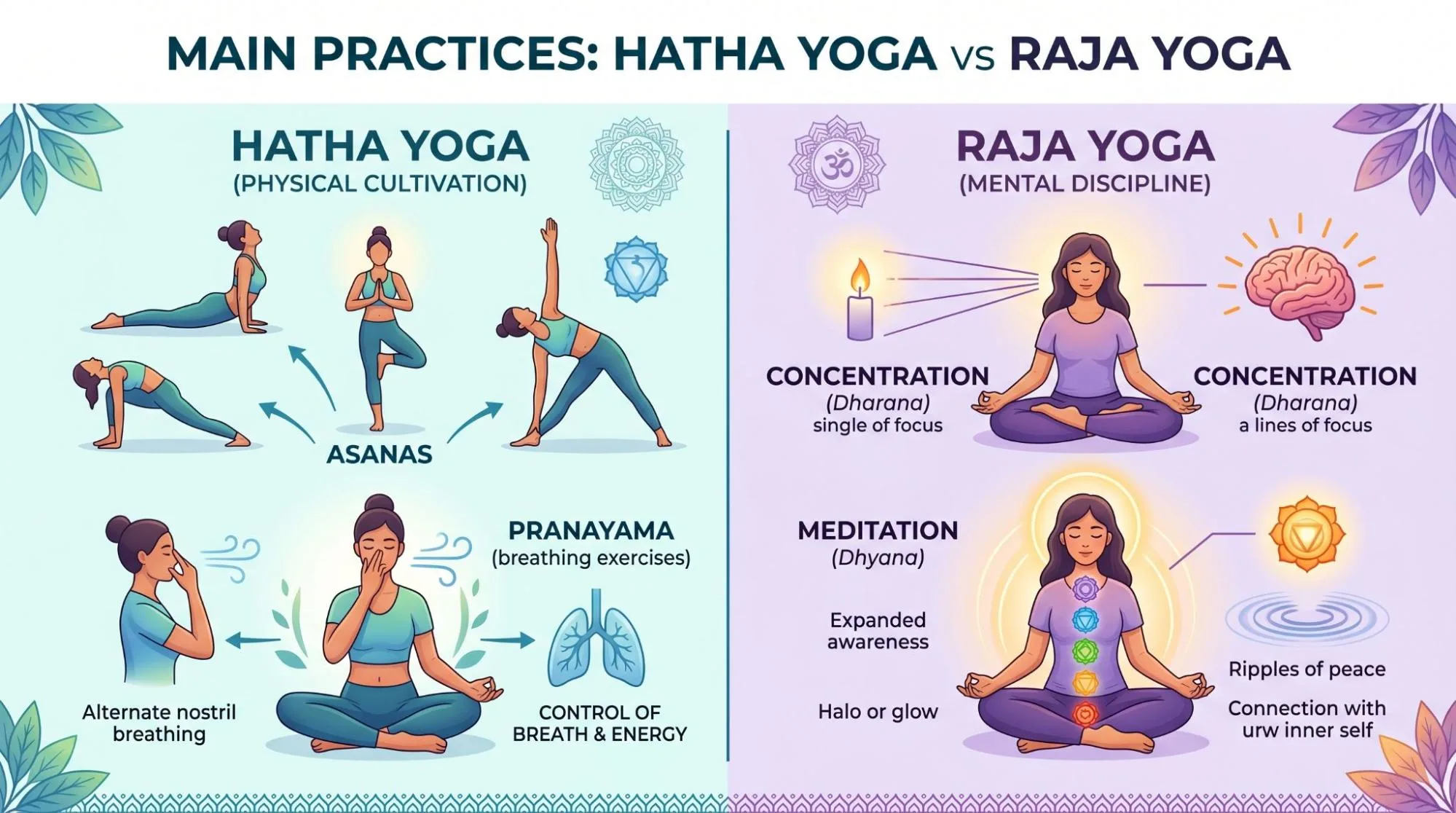
Main Practices: Asanas and Pranayama vs Concentration and Meditation
Hatha Yoga is best known for asanas pranayama practices. A typical Hatha Yoga session may include postures, breathing exercises, and relaxation.
Raja Yoga is more focused on concentration and meditation. It teaches the practitioner to gather attention and move toward deeper inner awareness.
Hatha Yoga may feel more practical for beginners because it gives the body something clear to do. Raja Yoga may feel more subtle because it asks the mind to become quiet, which is often harder than it sounds.
Learn More : Samadhi: Yoga’s Final Spiritual Union
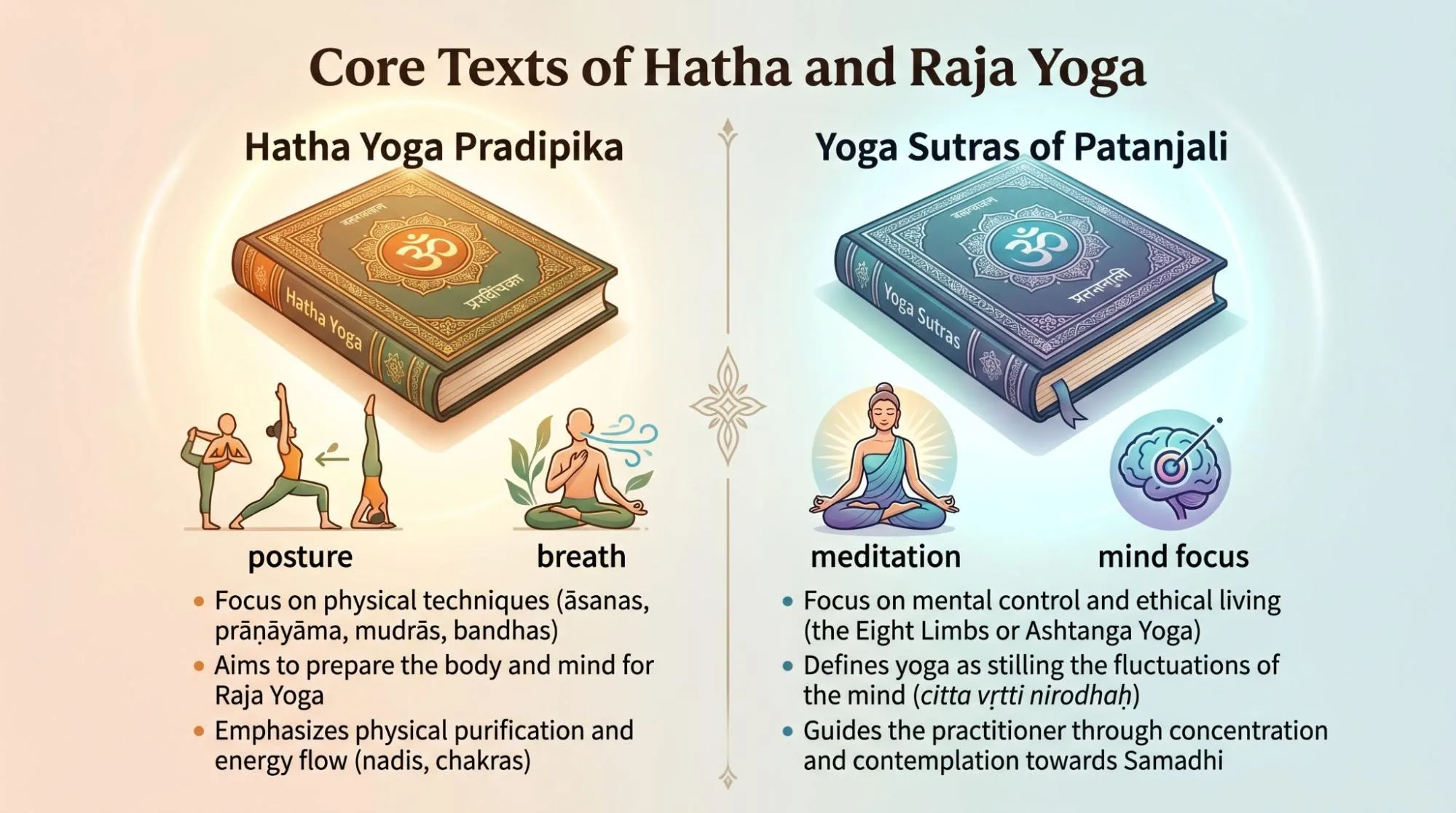
Core Texts: Hatha Yoga Pradipika vs Yoga Sutras of Patanjali
The main traditional text of Hatha Yoga is the Hatha Yoga Pradipika. It discusses postures, breath control, energy, mudras, and the preparation for higher states of yoga.
The main text linked with Raja Yoga is the Yoga Sutras of Patanjali. The yoga sutras explain how the mind works and how yoga can lead to freedom from mental disturbance.
So, if Hatha Yoga is more connected with body-energy training, Raja Yoga is more connected with mental and spiritual discipline.
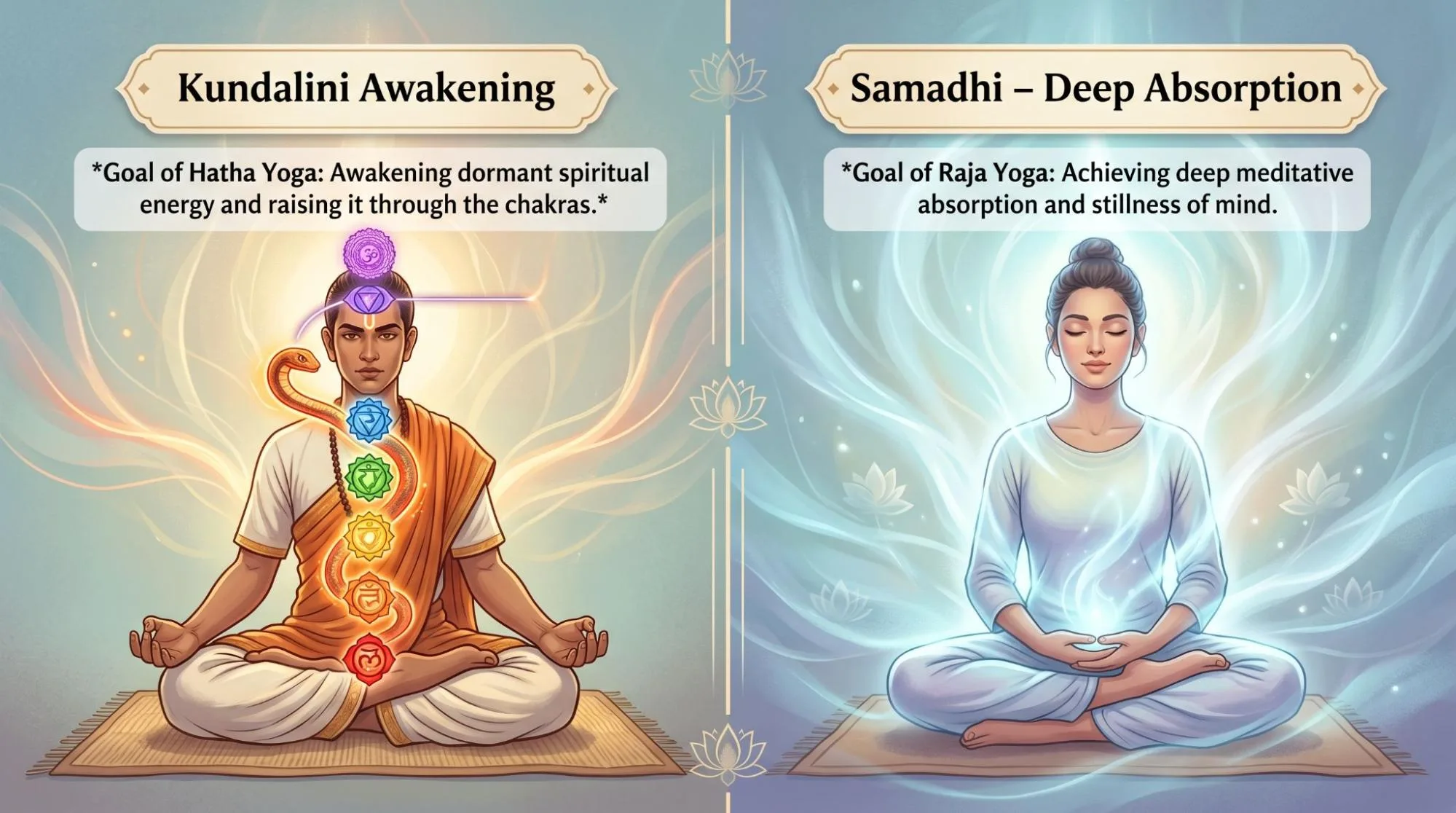
Goal: Kundalini Awakening vs Samadhi
In traditional Hatha Yoga, one major goal is to awaken and guide subtle energy, often called Kundalini. This is not something beginners should treat casually. In a practical sense, Hatha Yoga first works to purify and prepare the body and energy system.
In Raja Yoga, the ultimate goal is Samadhi. Samadhi means a deep state of absorption where the mind becomes completely still and unified.
Both paths point toward spiritual realization, but they describe the journey in different ways.
How Hatha Yoga and Raja Yoga Work Together
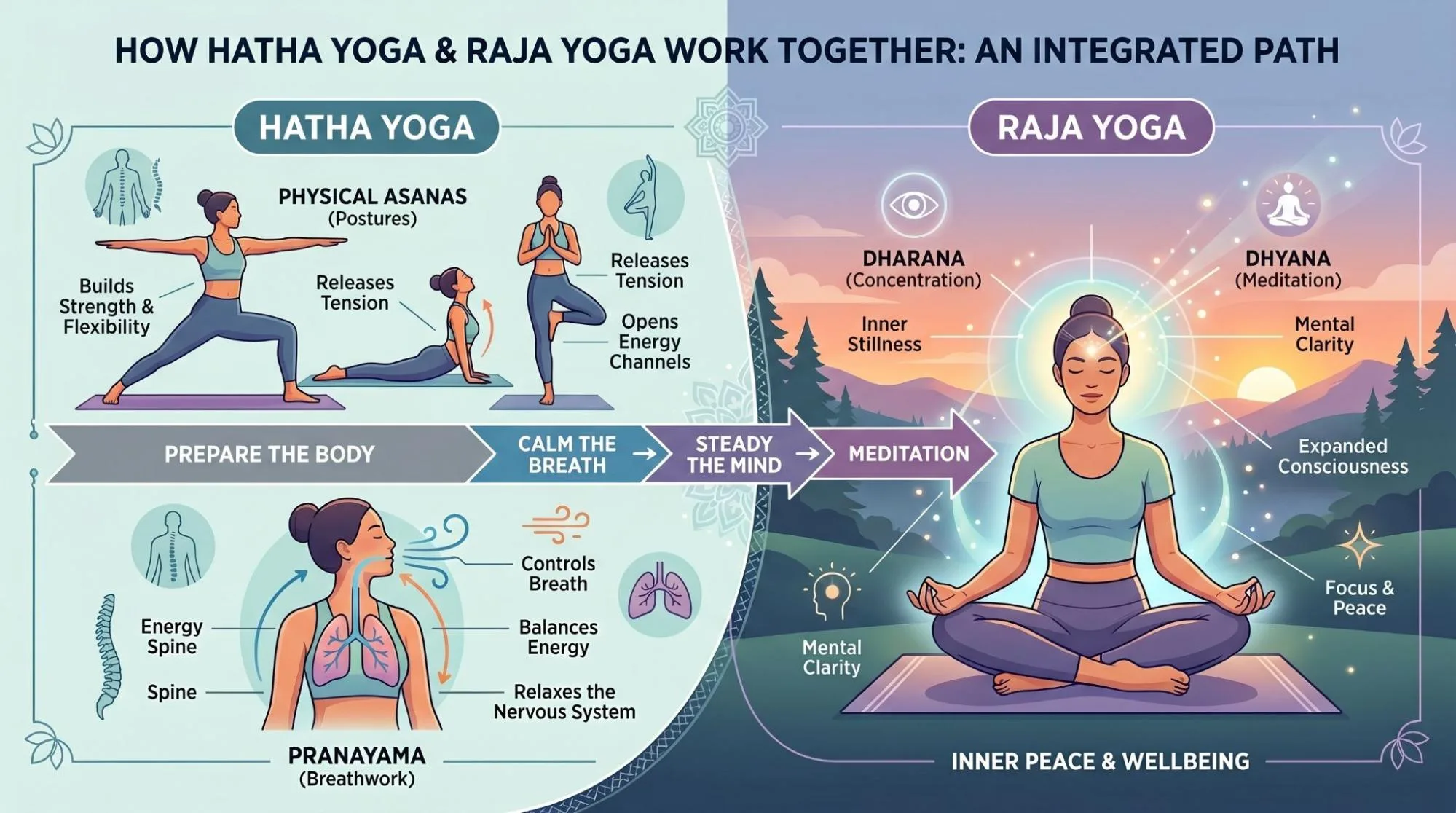
Hatha Yoga and Raja Yoga are not enemies. They support each other.
Traditionally, Hatha Yoga was often seen as preparation for Raja Yoga. If the body is uncomfortable, the breath is disturbed, and the nerves are restless, meditation becomes difficult.
Hatha Yoga helps create a strong and steady base. Raja Yoga then takes that steadiness inward.
For example, someone may first practice gentle asanas and pranayama breath exercises. After that, sitting for meditation becomes easier. This is where yoga and hatha yoga connect naturally with the deeper path of Raja Yoga.
The Eight Limbs of Raja Yoga
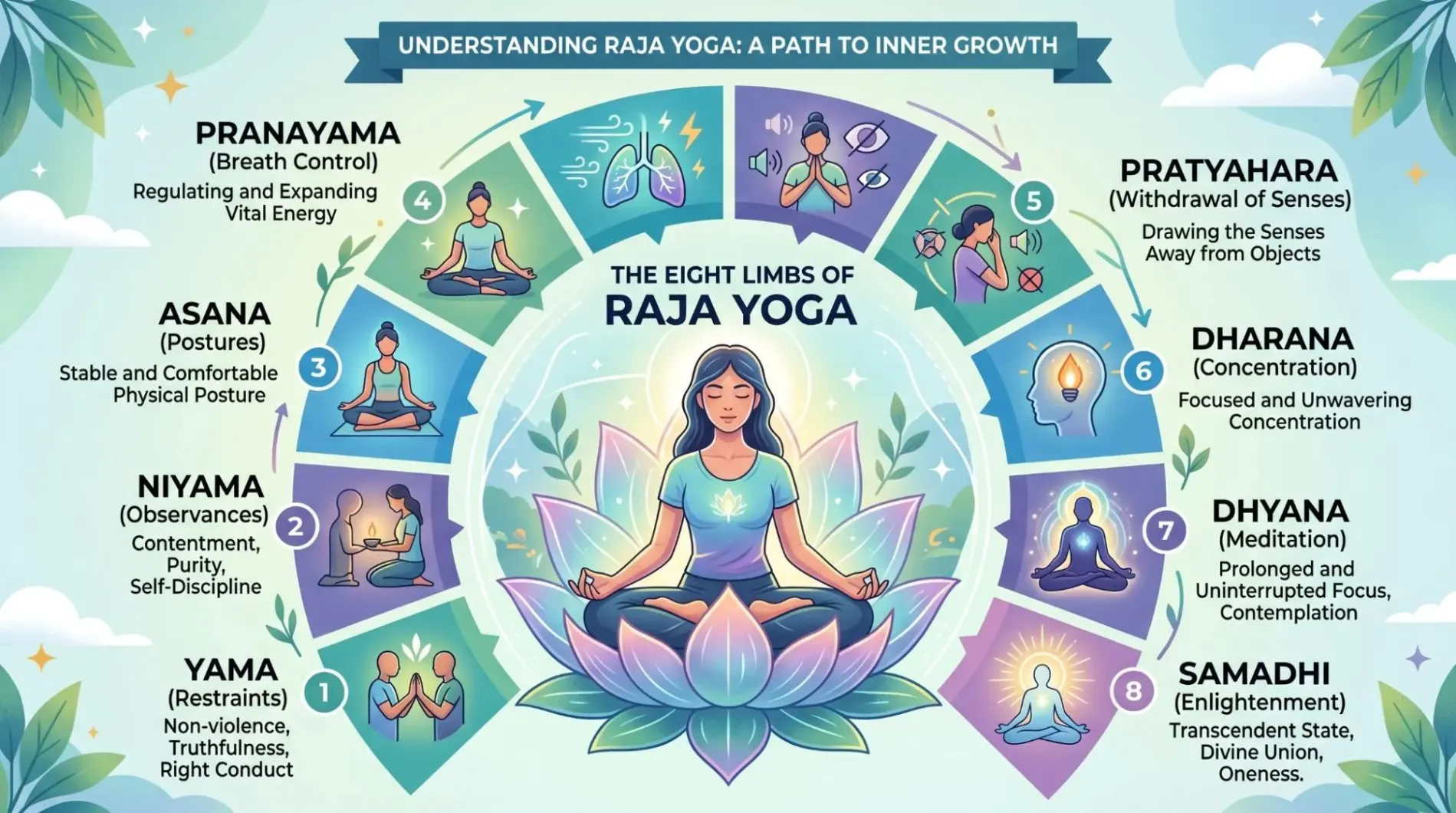
Raja Yoga is commonly explained through the eight limbs described in the Yoga Sutras. These limbs are like steps or parts of a complete yoga practice.
Yama
Yama means moral discipline. It includes values such as non-violence, truthfulness, honesty, self-control, and non-greed.
This is the foundation because meditation is difficult if daily life is full of conflict and dishonesty.
Niyama
Niyama means personal discipline. It includes cleanliness, contentment, self-study, discipline, and surrender to a higher reality.
It helps build a stable inner character.
Asana
Asana means posture. In Raja Yoga, asana is mainly about finding a steady and comfortable position for meditation.
This is different from modern yoga classes where many postures may be practiced for fitness and flexibility.
Pranayama
Pranayama means breath regulation. The breath and mind are closely linked. When breathing becomes calm, the mind also becomes calmer.
Pratyahara
Pratyahara means withdrawal of the senses. It is the practice of not being controlled by every sound, image, smell, or outside attraction.
It helps attention turn inward.
Dharana
Dharana means concentration. The mind is trained to stay on one point, such as the breath, a mantra, or a chosen object of focus.
Dhyana
Dhyana means meditation. At this stage, concentration becomes smoother and more continuous.
The mind is no longer jumping so much from one thought to another.
Samadhi
Samadhi is deep absorption. It is considered the highest state in Raja Yoga and the ultimate goal of the path.
Benefits of Hatha Yoga
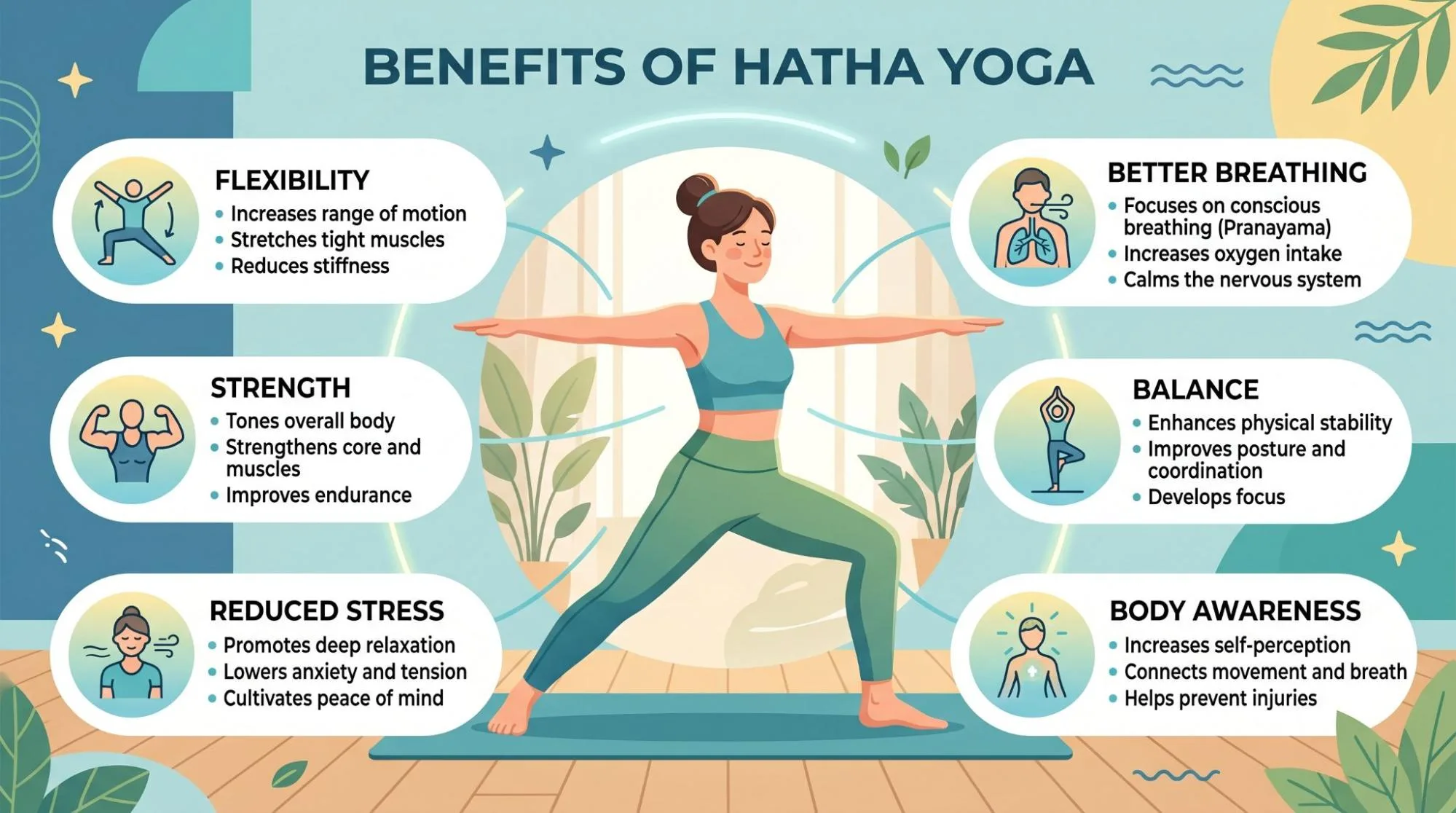
Hatha Yoga can be helpful for beginners and experienced practitioners because it works with the body in a direct way.
Common benefits include:
- Better flexibility and strength
- Improved breathing awareness
- Reduced physical tension
- Calmer nervous system
- Better posture and balance
- More body awareness
- A stronger base for meditation
Many people start Hatha Yoga for physical health, but slowly notice mental calmness too.
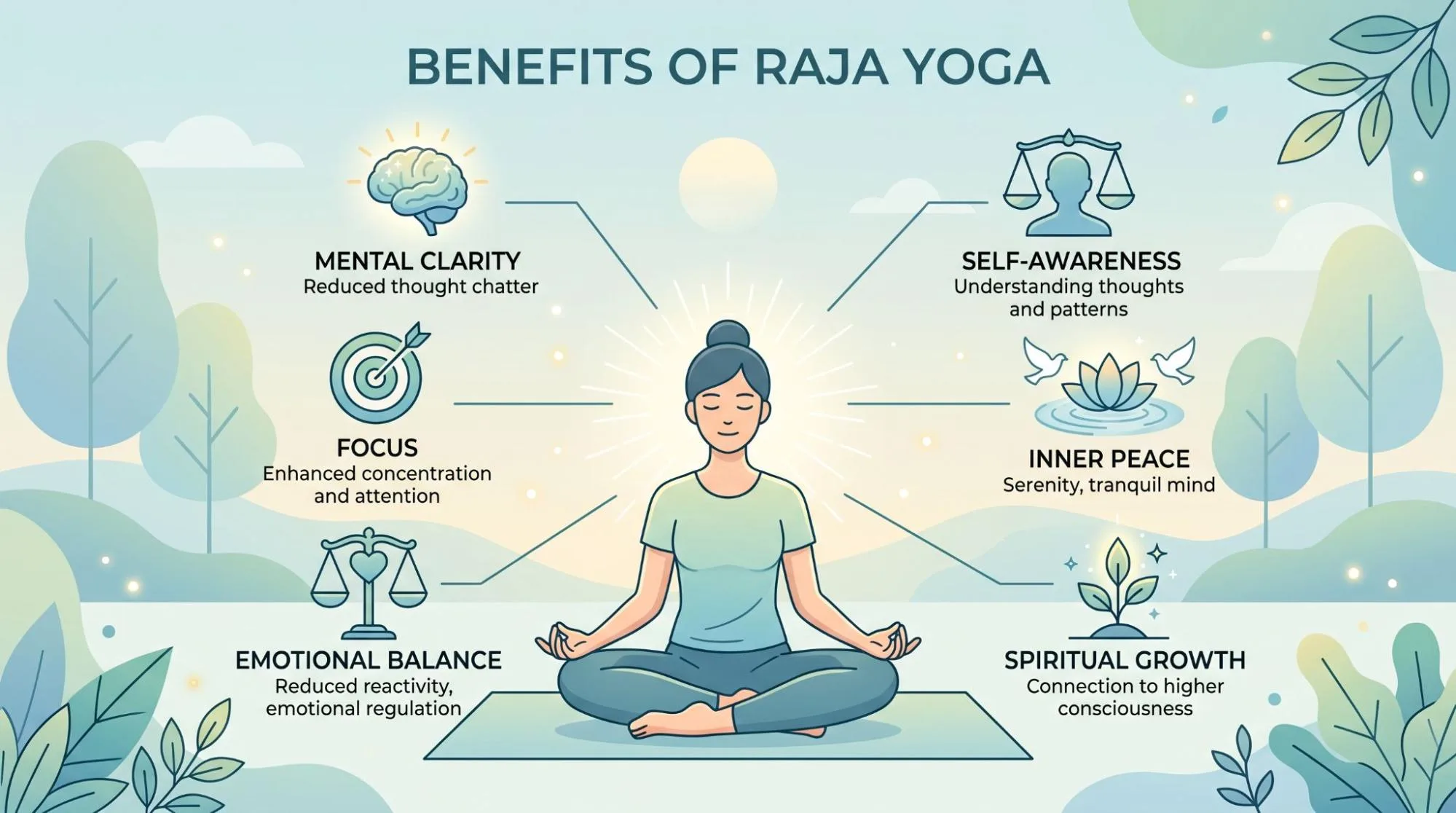
Benefits of Raja Yoga
Raja Yoga is especially useful for people who want to understand the mind and develop inner discipline.
Common benefits include:
- Better concentration
- More emotional control
- Deeper meditation
- Clearer thinking
- Less mental restlessness
- Stronger self-awareness
- Spiritual growth
Raja Yoga can be powerful, but it needs patience. The mind does not become still in one day.
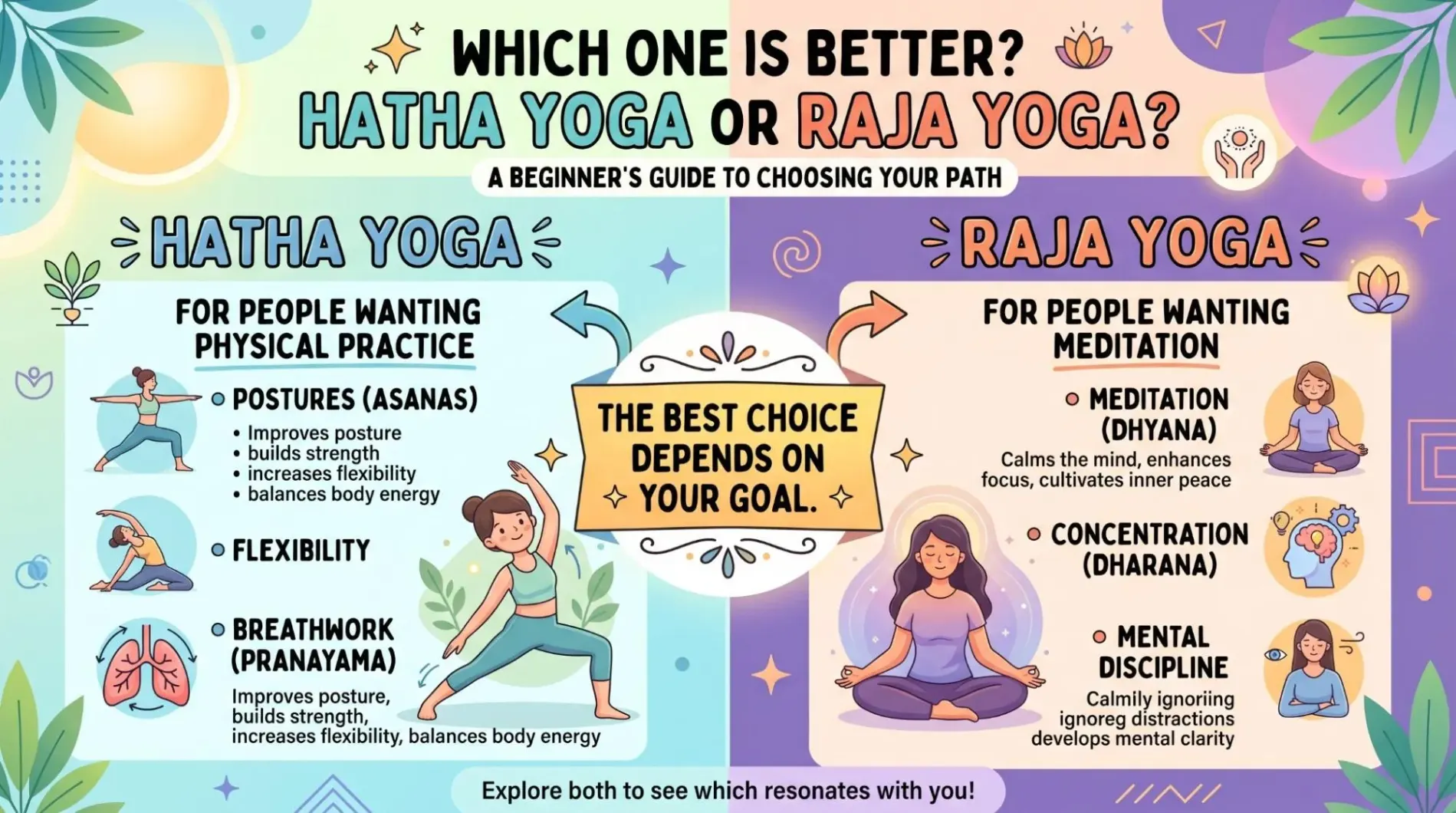
Which One Is Better: Hatha Yoga or Raja Yoga?
Neither one is “better” for everyone. It depends on your need, stage, and personality.
Choose Hatha Yoga if you want to begin with physical practice, breathing, flexibility, and body awareness.
Choose Raja Yoga if you are more interested in meditation, mental discipline, and spiritual understanding.
For most people, a balanced approach works best. Practice Hatha Yoga to prepare the body and breath. Practice Raja Yoga to train the mind.
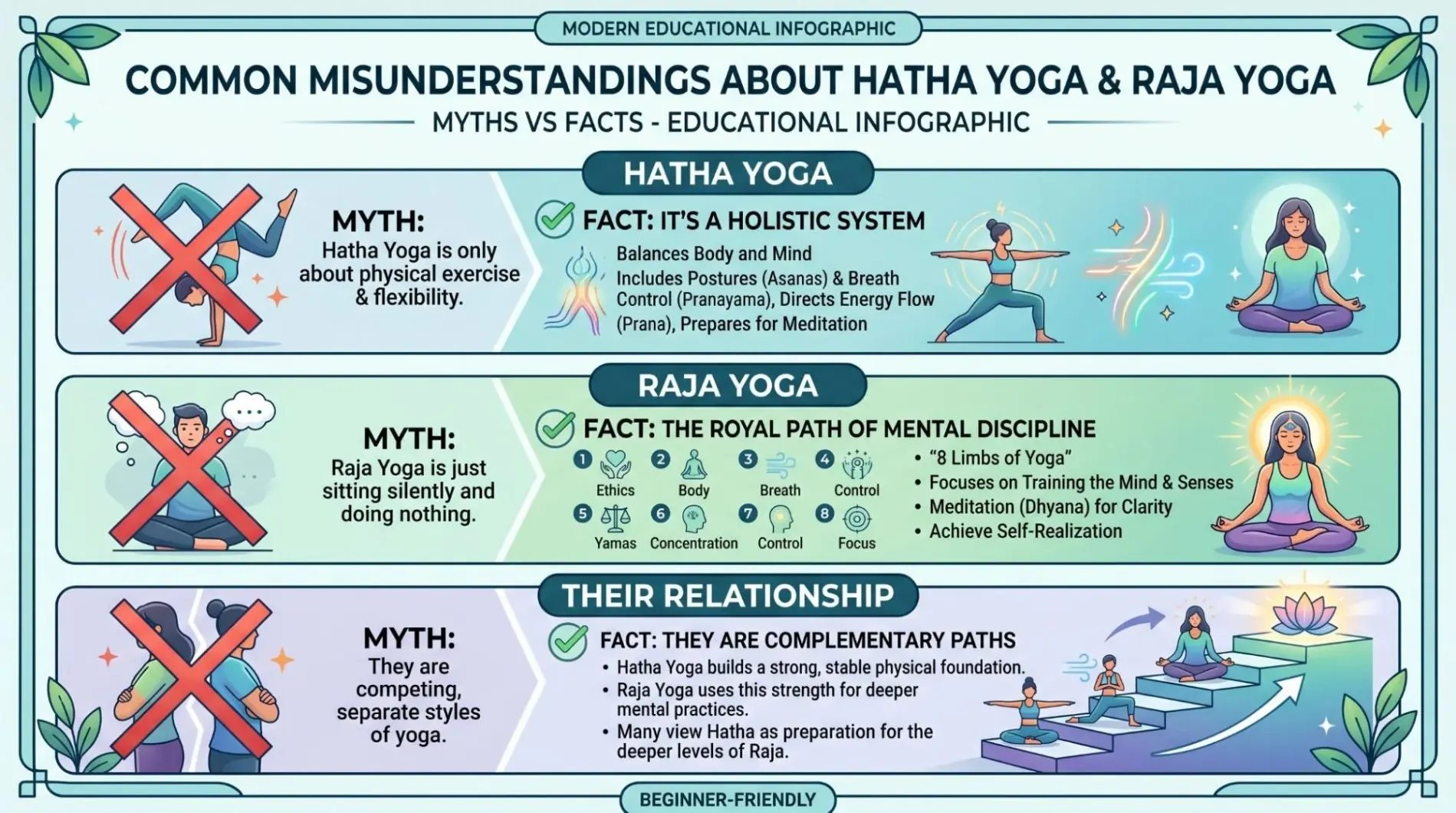
Common Misunderstandings About Hatha Yoga and Raja Yoga
One common misunderstanding is that Hatha Yoga is only exercise. It is not. Traditional Hatha Yoga includes breath, energy, discipline, and preparation for meditation.
Another misunderstanding is that Raja Yoga means only sitting with closed eyes. Real Raja Yoga includes ethics, self-discipline, posture, breath, concentration, and meditation.
People also think they must choose only one. That is not true. Many serious practitioners use both paths together.
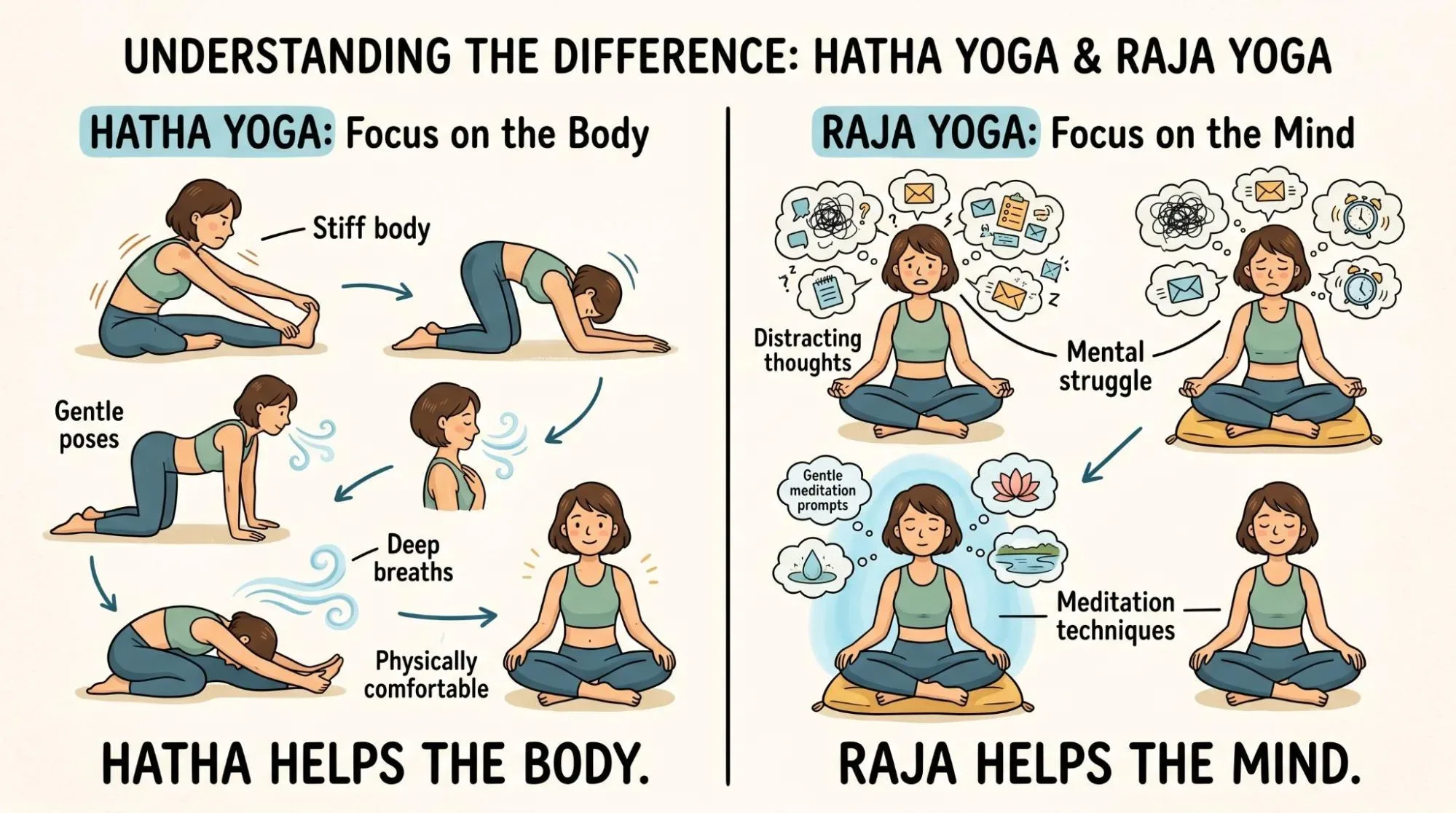
Simple Example to Understand the Difference
Imagine you want to sit peacefully for meditation.
If your back hurts, your legs feel stiff, and your breathing is heavy, meditation becomes hard. Hatha Yoga helps with this by making the body and breath more stable.
Now imagine your body feels fine, but your mind keeps thinking about work, problems, messages, and old memories. Raja Yoga helps with this by training attention and calming the mind.
So Hatha Yoga prepares the seat. Raja Yoga teaches you how to sit inside yourself.
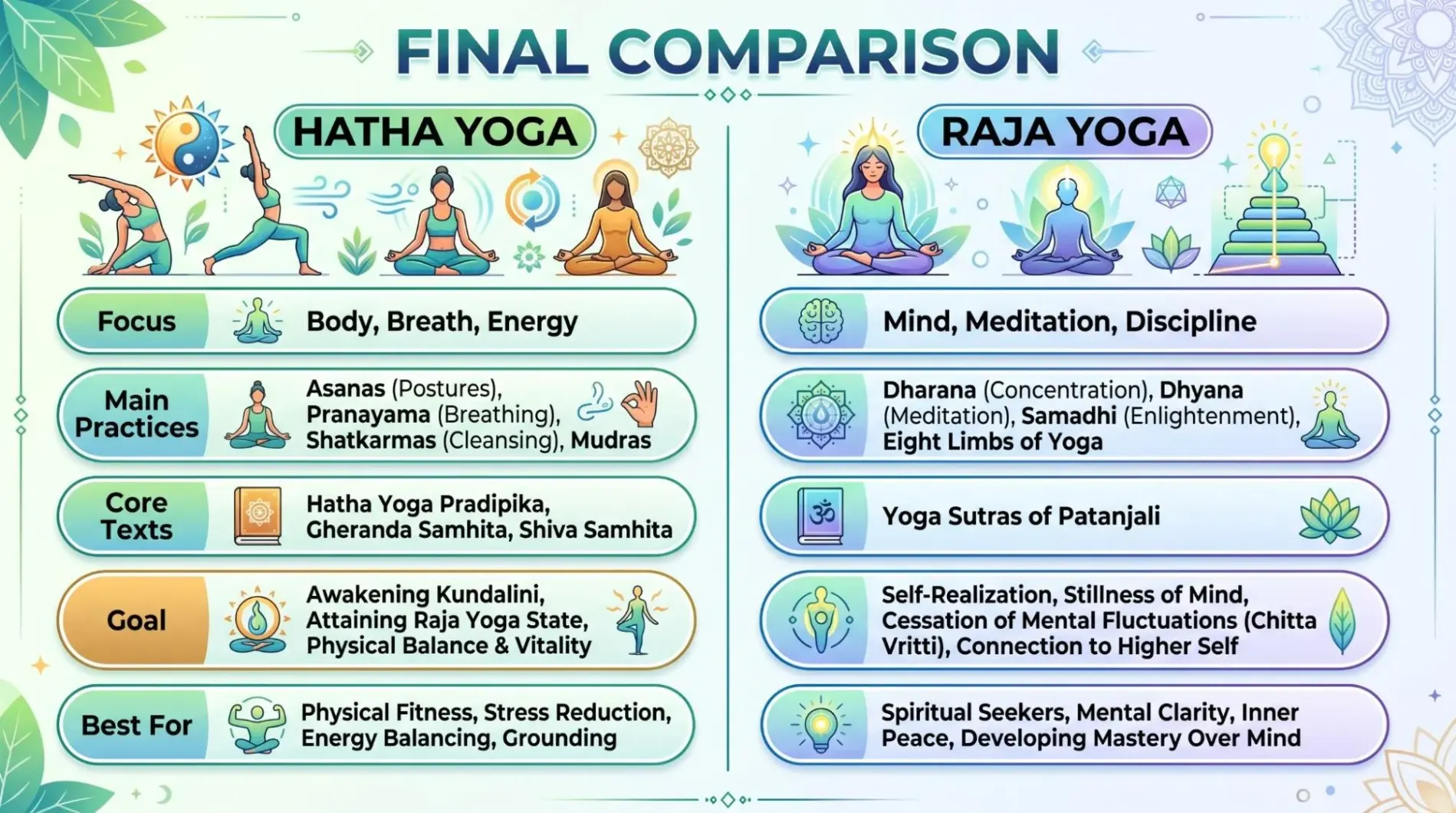
Final Comparison
| Point | Hatha Yoga | Raja Yoga |
| Main Focus | Body, breath, and energy | Mind, meditation, and discipline |
| Main Practices | Asanas, pranayama, mudras, bandhas | Concentration, meditation, eight limbs |
| Core Text | Hatha Yoga Pradipika | Yoga Sutras of Patanjali |
| Starting Point | Physical body | Mind |
| Main Aim | Energy balance and preparation | Mental control and Samadhi |
| Best For | Beginners wanting body-based practice | People interested in meditation and inner discipline |
FAQs
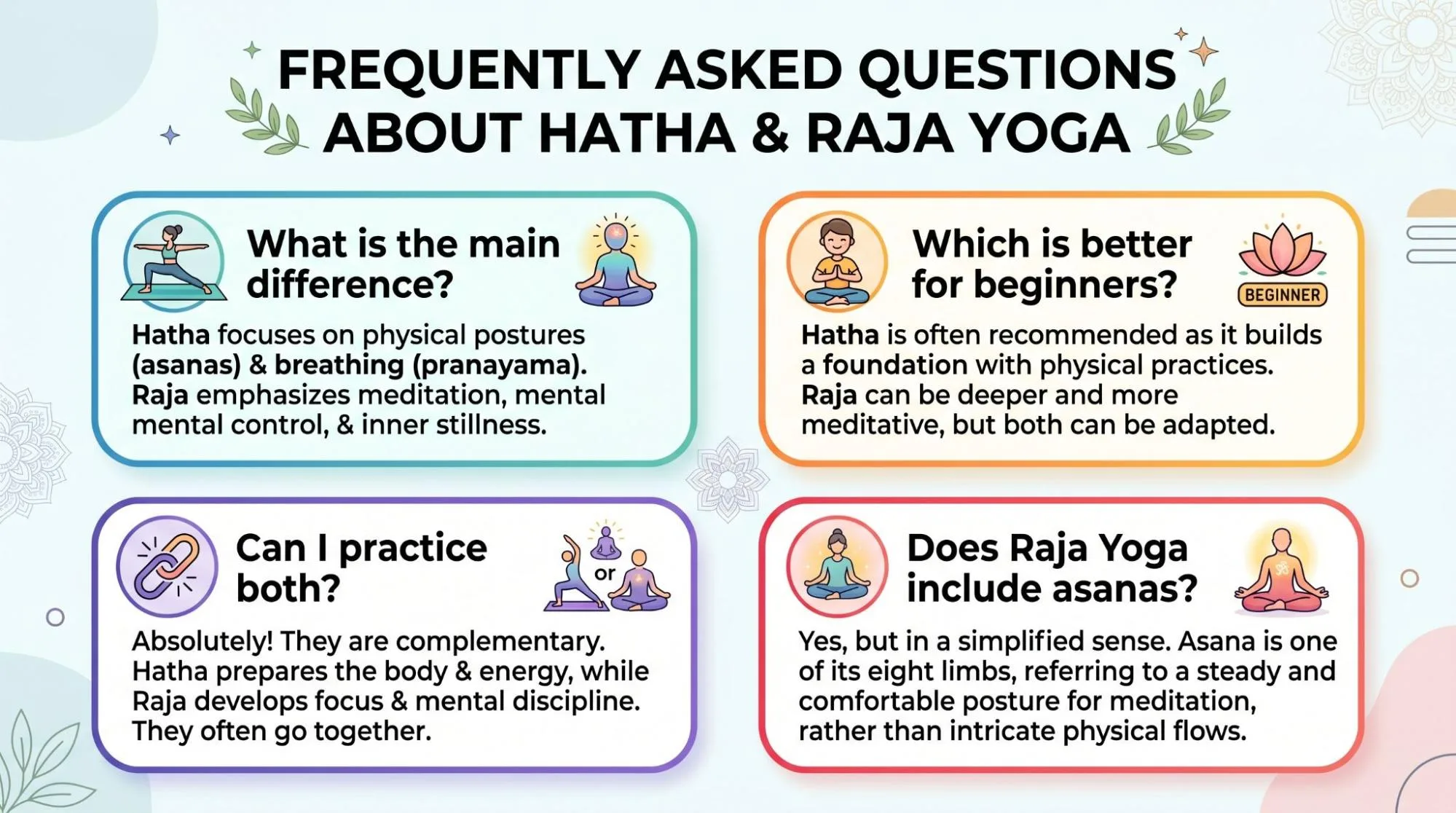
What is the main difference between Hatha Yoga and Raja Yoga?
The main difference is that Hatha Yoga focuses more on the body, breath, and energy, while Raja Yoga focuses more on the mind, meditation, and spiritual discipline.
Is Hatha Yoga part of Raja Yoga?
Hatha Yoga can support Raja Yoga, especially because asana and pranayama help prepare the body and breath for meditation. They are connected, but they are not exactly the same path.
Which is better for beginners?
Hatha Yoga is often easier for beginners because it starts with physical postures and breathing. Raja Yoga can also be practiced by beginners, but meditation and mental discipline may take more patience.
Does Raja Yoga include asanas?
Yes, Raja Yoga includes asana as one of its eight limbs. But in Raja Yoga, asana mainly means a steady and comfortable posture for meditation, not a long sequence of physical poses.
Can I practice both Hatha Yoga and Raja Yoga?
Yes. In fact, practicing both can be very helpful. Hatha Yoga can prepare the body and breath, while Raja Yoga can train the mind and deepen meditation.
What is the ultimate goal of Raja Yoga?
The ultimate goal of Raja Yoga is Samadhi, a deep state of inner absorption and spiritual realization where the mind becomes completely still.
Learn More : Kundalini Yoga Philosophy Explained Simply: 7 Powerful Tips
Conclusion
The difference between Hatha and Raja Yoga becomes simple when you look at their focus. Hatha Yoga begins with the body, breath, and energy. Raja Yoga begins with the mind, meditation, and inner discipline.
A person who wants physical balance, better breathing, and a steady body may feel more comfortable starting with Hatha Yoga. A person who wants mental control, meditation, and spiritual growth may feel drawn toward Raja Yoga.
The best path does not always have to be one or the other. For many people, Hatha Yoga prepares the body, and Raja Yoga guides the mind. Together, they create a complete and balanced yoga practice.