Virabhadrasana 1 (also referred to as warrior 1 pose) is one of the most fundamental and powerful standing yoga poses. It develops strength, stability and concentration and roots the body and relaxes the mind.
It is not merely a physical posture, but an inner strength, discipline and balance. Regardless of whether you are a beginner or an advanced practitioner, learning the proper execution of Warrior 1 Pose would change your yoga practice.
What is Warrior 1 Pose (Virabhadrasana 1)?
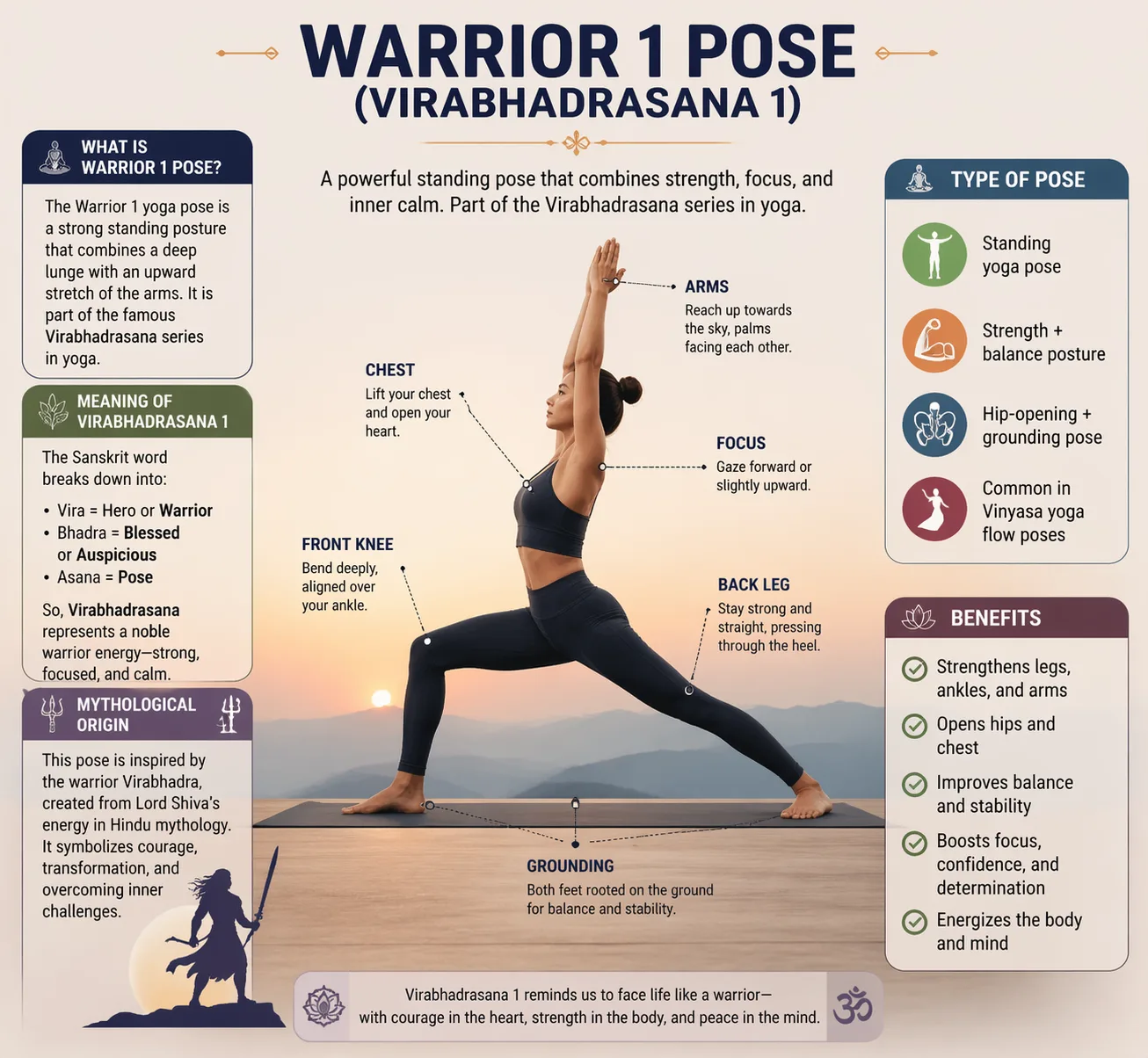
Warrior 1 yoga pose is a powerful standing pose which incorporates profound lunge with an upward arm extension. It belongs to the renowned Virabhadrasana sequence in yoga.
Meaning of Virabhadrasana 1
The Sanskrit term can be divided to:
- Vira = Hero or Warrior.
- Bhadra = Fortunate or auspicious.
- Asana = Pose
Thus, Virabhadrasana is the energy of a noble warrior, powerful, concentrated, and peaceful.
Mythological Origin
The pose is based on the warrior Virabhadra that originates in the energy of Lord Shiva in Hindu mythology. It is represented as a symbol of going through hardships, change, and triumphing over internal obstacles.
Type of Pose
- Standing yoga pose
- Strength + balance posture
- Hip-opening + grounding pose
- Typical of Vinyasa yoga flow poses.

How Many Warrior Poses Are There in Yoga?
Yoga encompasses a whole family of warrior postures and each of them trains a different aspect of the body and mind. They collectively form a harmonious system of power, steadiness, agility, and consciousness.Β
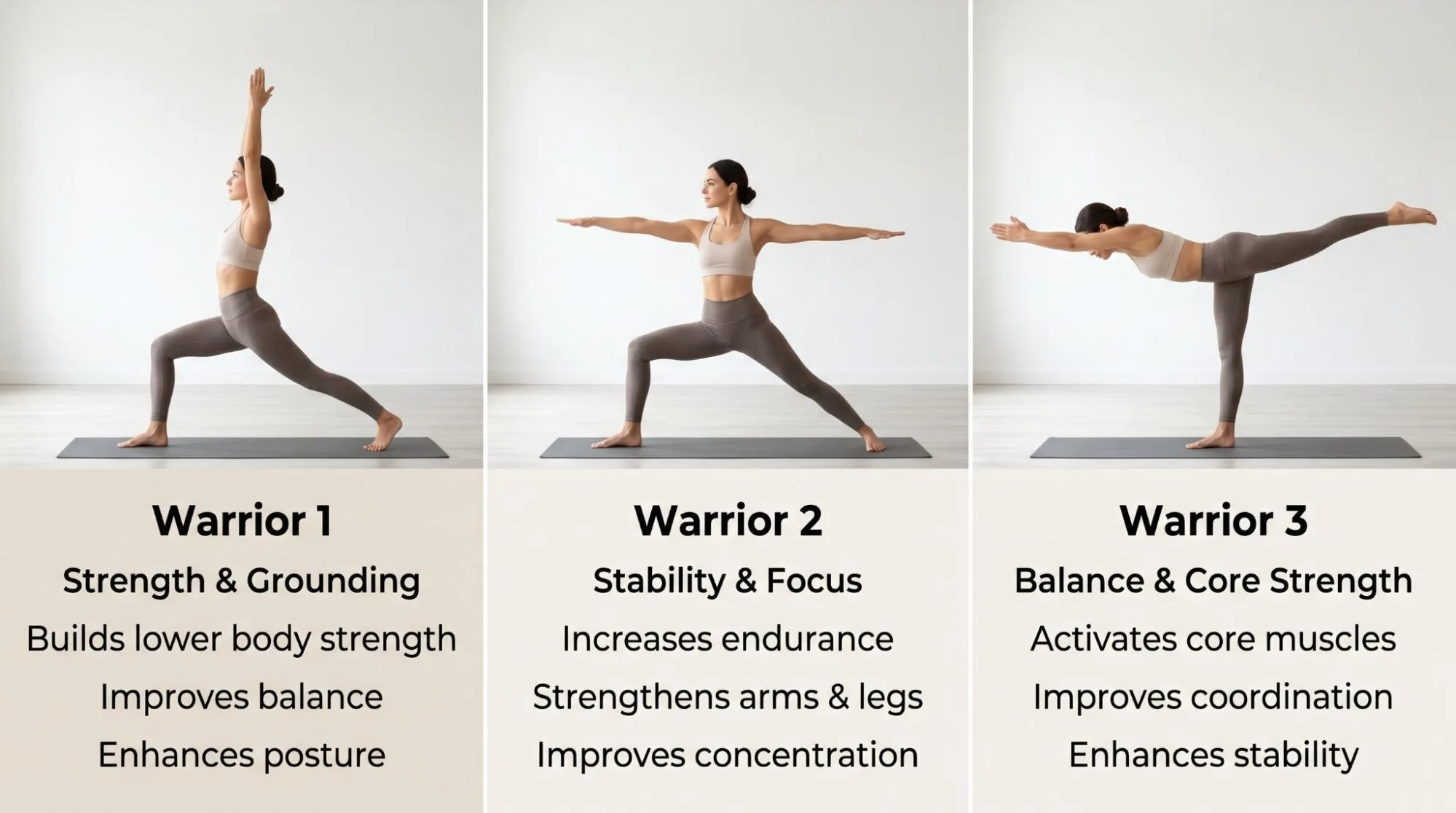
Warrior 1 (Virabhadrasana I) β Strength and Grounding
This is the original warrior pose which aims at establishing a firm base and stable position.
π What it develops:
- Body strength (legs, glutes, calves) of the lower body.
- Good grounding and balance.
- Straight back and concentration.
π Trainer insight:Β
It teaches control, alignment, and stability in a standing positionβperfect for building foundational strength.
Warrior 2 (Virabhadrasana II) β Stability and Focus
Warrior 2 shifts the body into an open stance, improving lateral strength and mental concentration.
π What it develops:
- Stability and endurance of legs.
- Shoulder and arm strength.
- Good concentration and attention.
π Trainer insight:
This pose trains you to stay steady while facing outward pressure, improving coordination and control.
Warrior 3 β Balance and Core Strength
Warrior 3 is a challenging balance pose where the body becomes parallel to the ground.
π What it develops:
- Core muscle strength and involvement.
- Whole body balance and coordination.
- Mental discipline and attention.
π Trainer insight:
It acts like a functional stability test, strengthening the entire posterior chain and improving athletic balance.
Reverse Warrior β Side Body Stretch and Openness
This side stretch provides a strong lower body base and a deep side stretch.
π What it develops:
- Flexibility of the side body (intercostal muscles)
- Spinal motion and extension.
- Expansion and openness of the breath.
π Trainer insight:
Β It improves mobility while keeping the legs stable, creating a mix of strength and flexibility.
Humble Warrior β Deep Forward Fold and Introspection
This is the most inward-focused warrior pose, combining strength with surrender.
π What it develops:
- Shoulder and chest opening
- Hip and hamstring flexibility
- Mindfulness and emotional calmness
π Trainer insight:
Β It shifts focus from external strength to internal awareness and control.
Overall Understanding
Together, all warrior poses form a complete training system in yoga.
π Combined benefits:
- Full-body strength development
- Better balance and coordination.
- Increased flexibility and agility.
- Well-developed mental concentration and awareness.
In mere words, warrior pose family can be established as a complete-body workout regimen with the poses developing distinct kinds of strength and unified to make full physical and psychological calmness.

How to Do Warrior 1 Pose (Step-by-Step Guide)
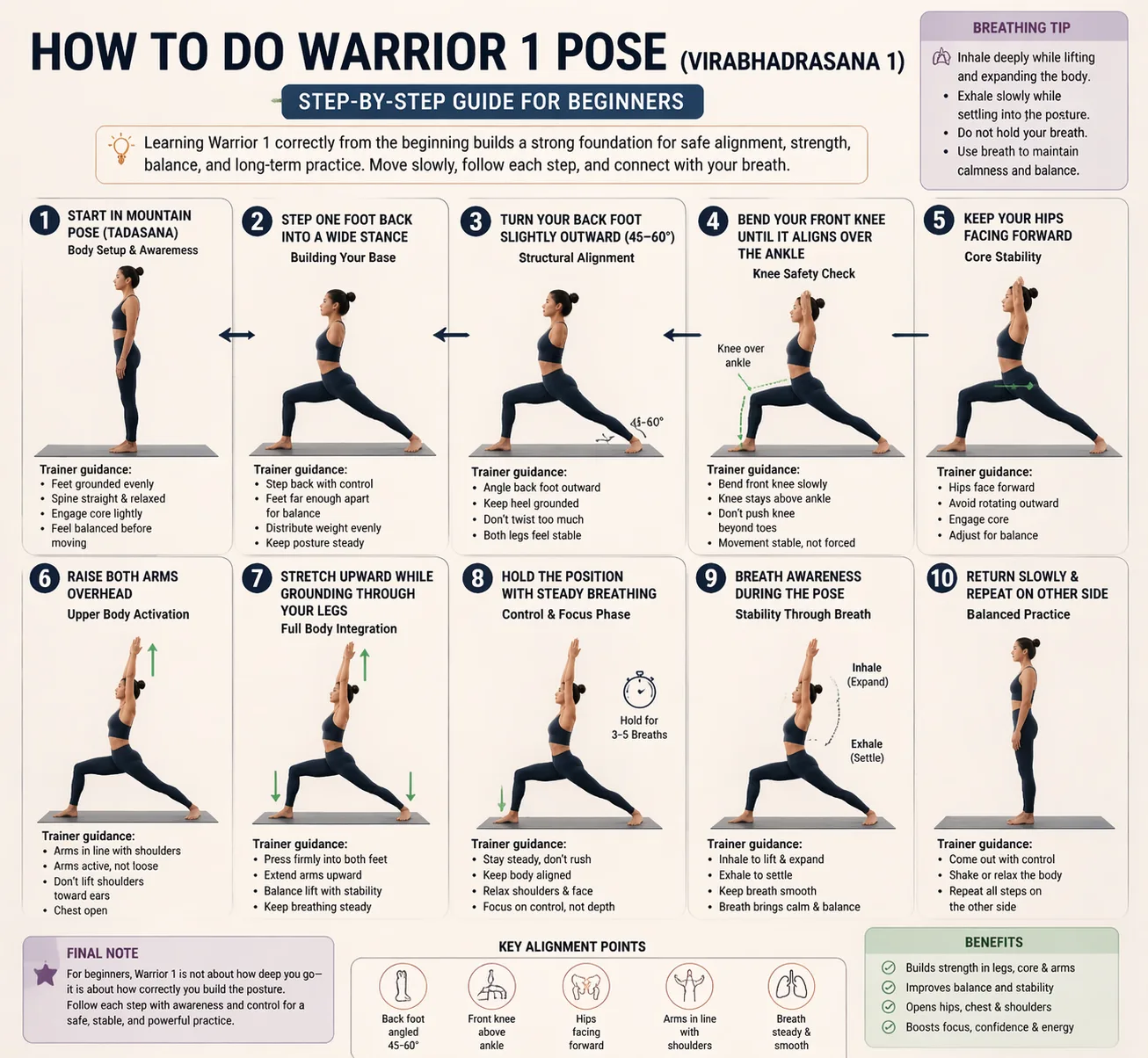
The proper practice of Warrior 1 at the beginning itself is extremely crucial as it establishes the basis of safe alignment, strength building, and practice over time. The beginners are always taught by a trainer step by step and slowly so that the body can be familiar with each movement before going into the pose further.
Step-by-Step Instructions
Start in Mountain Pose (Tadasana) β Body Setup & Awareness
This is your starting position where you prepare your body and mind for movement.
π Trainer guidance:
- Straighten back with feet even on the mat.
- Maintain straight back (no stiffness)
- Lightly engage core to stabilize.
- Pause and feel centered and then move.
Step one foot back into a wide stance β Building Your Base
This step creates the foundation of the pose, so spacing is very important.
π Trainer guidance:
- Take one foot backward under control (not in a hurry)
- Foot spacing Supportive: maintain distance between feet.
- Equal distribution of weight on both legs.
- Maintain posture and change position.
Turn your back foot slightly outward (45β60Β°) β Structural Alignment
This ensures proper joint alignment and reduces pressure on knees and hips.
π Trainer guidance:
- Angle the back foot slightly outward for stability
- Keep heel grounded firmly on the mat
- Avoid twisting the foot too much
- Adjust until both legs feel stable and supported
Bend your front knee until it aligns over the ankle β Knee Safety Check
This is one of the most important points of alignment in the whole pose.
π Trainer guidance:
- Bend control of the front knee slowly.
- Make sure that the knee is right above the ankle.
- Do not extend knee in front of toes.
- Maintain motion, not coerced.
Keep your hips facing forward (square position) β Core Stability
Hip alignment controls the entire structure of the pose.
π Trainer guidance:
- Gently turn hips forward.
- Do not allow one side to turn out.
- Turn on core to promote pelvic stability.
- Balancing is not pushing, but making little steps.
Raise both arms overhead β Upper Body Activation
This step opens the chest and builds full-body extension.
π Trainer guidance:
- Lift arms straight above the head in line with shoulders
- Keep arms active, not loose or passive
- Avoid lifting shoulders toward ears
- Stretch upward while maintaining lower body stability
Stretch upward while grounding through your legs β Full Body Integration
This is where strength and stretch work together.
π Trainer guidance:
- Press firmly into both feet for grounding
- Extend arms upward while legs stay strong
- Maintain balance between lift and stability
- Keep breathing steady throughout
Hold the position with steady breathing β Control & Focus Phase
This is where the real benefits of the pose develop.
π Trainer guidance:
- Stay steady for a few breaths without rushing
- Keep body aligned and stable
- Relax unnecessary tension in shoulders and face
- Focus on maintaining control, not depth
Breathing Tip β Stability Through Breath
Breath is what connects movement with control in this pose.
π Trainer guidance:
- Inhale deeply while lifting and expanding the body
- Exhale slowly while settling into the posture
- Do not hold your breath at any point
- Use breath to maintain calmness and balance
Final Note
To a beginner, it is not a matter of how far you can go in the Warrior 1 position; it is all about how well you can construct the posture. By exercising control and awareness in every step, the pose becomes safe, stable, and very useful in building strength, balance, and confidence.

Proper Alignment for Warrior 1 Pose
Proper alignment in Warrior 1 is the key to effective and safe practice. Any minor disorientation may lead to the entire posture- imbalance, unnecessarily straining or cost of benefits. A trainer will always look down the ground, as balance is never attained immediately, but in steps.
Foot Position (Foundation & Stability Base)
Feet are your connection to the ground, and they determine how stable your entire pose will be. If the base is weak or misaligned, the rest of the body cannot stay controlled.
π Trainer guidance:
- Front foot must face straightforward to create directional stability
- Back heel should stay firmly grounded to activate the full leg line
- Maintain a wide, balanced stance for better control
- Press evenly through both feet to avoid leaning or collapsing
Knee Alignment (Joint Safety & Control Point)
The front knee carries most of the body weight, so correct positioning is crucial for protecting the joint and maintaining strength.
π Trainer guidance:
- Make sure the front knee is aligned with ankle.
- To avoid straining the knee, do not flex the knee beyond the toes.
- Make sure knee tracks with second toe (no inward collapse)
- Keep a steady bend, neither too deep, nor too shallow.
Hip Alignment (Core Structure & Balance Control)
Hips control the direction and integrity of the pose. If they are misaligned, the spine and knees compensate incorrectly.
π Trainer guidance:
- Aim to square hips toward the front of the mat
- Prevent the pelvis from opening sideways
- Gently adjust hip position for equal balance on both sides
- Keep pelvis stable to support lower back safety
Arm Position (Upper Body Activation & Extension)
Arms are not just liftedβthey actively support posture, energy flow, and spinal extension.
π Trainer guidance:
- Keep arms straight over head.
- Hands must be active and not passive.
- Do not raise shoulders to ears (another mistake).
- Extend on the up direction and stabilize on the lower part.
Spine & Neck (Posture Quality & Alignment Flow)
The spine is the central axis of the pose, and proper alignment here ensures balance between strength and ease.
π Trainer guidance:
- Keep spine long and naturally extended
- Avoid collapsing or over-arching the lower back
- Engage core slightly for support and control
- Keep neck relaxed with a natural gaze forward or upward
Trainerβs Final Insight
Warrior 1 may seem to be a simple posture, yet it is an entire body alignment test. When a single part of the posture is not aligned, the whole posture is misshapen. The pose is strong, steady and extremely efficient in strength, balance and control when every part is in the right place.
Benefits of Warrior 1 Pose
As a professional trainer, Warrior 1 Pose is a basic strength-building position that is not only flexible, but literally enhances functional fitness, stability, and overall control of the body. It is popular in training systems as it develops practical, practical strength in everyday motion and sports performance.
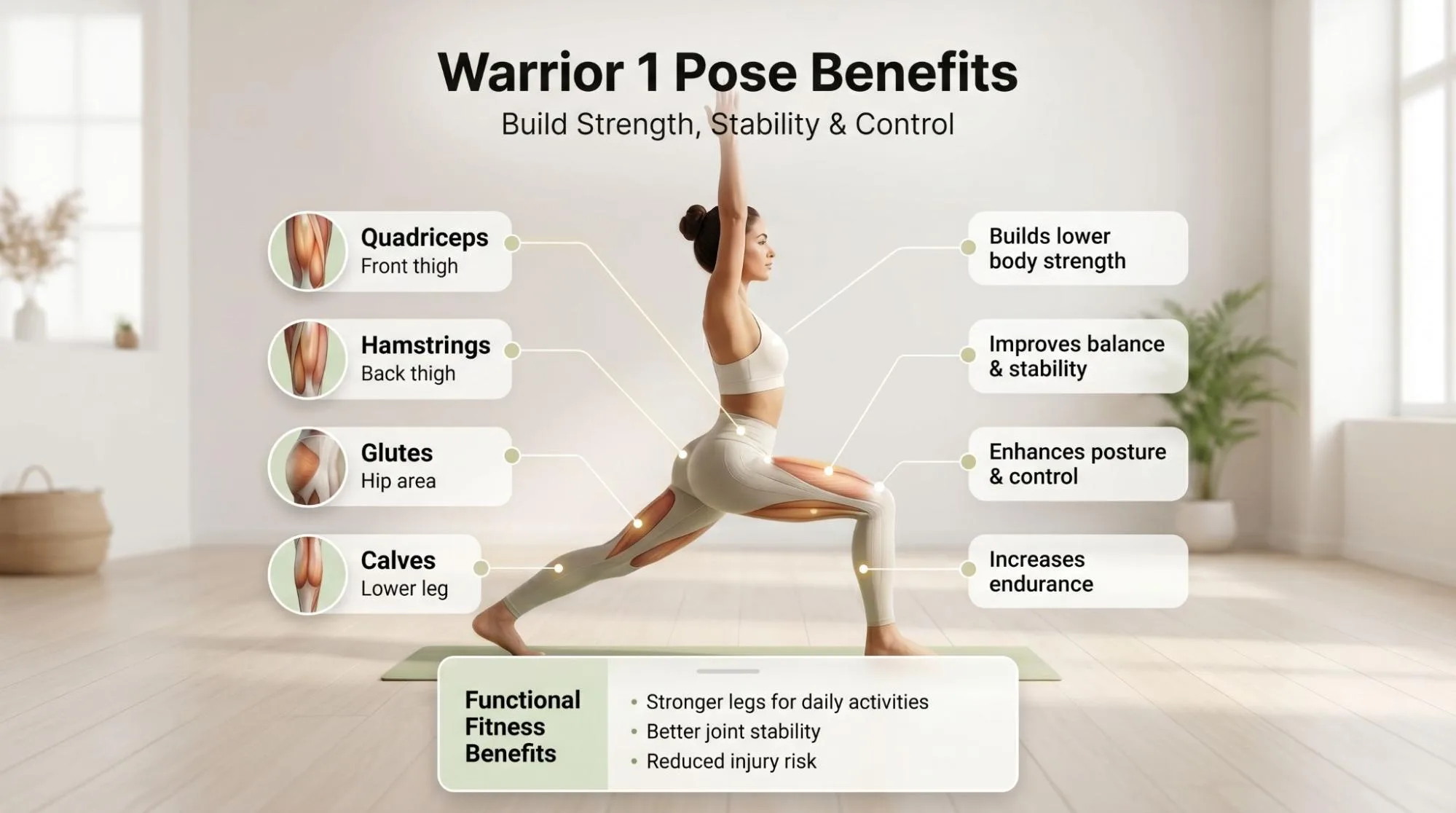
Builds Lower Body Strength
Warrior 1 is highly effective for strengthening the entire lower body because it places your legs under controlled tension, similar to a static strength training exercise.
π Muscles targeted and benefits:
- Quadriceps: Builds endurance and knee stability for walking, running, and squatting
- Hamstrings: Improves posterior leg strength and injury prevention
- Glutes: Strengthens hip support and improves posture and power
- Calves: Enhances ankle stability and balance control
π Trainerβs insight:
- The curved front leg is a form of controlled isometric squat hold.
- The leg behind stays in motion, enhancing the symmetry of legs.
- This renders it perfect to sportsmen, amateurs, and rehabilitation exercise.
π Real-world benefit:
- Powerful legs in everyday life such as walking up and down stairs, lifting and prolonged standing periods.
- Better stamina and less fatigue in lower body muscles.
- Increased knee or hip joint stability and decreased risk of strains.
On the simplest level of training, Warrior 1 is more than a yoga position, it is a complete lower body conditioning workout that develops strength, control, and functional fitness in the long-term.

Improves Balance and Stability
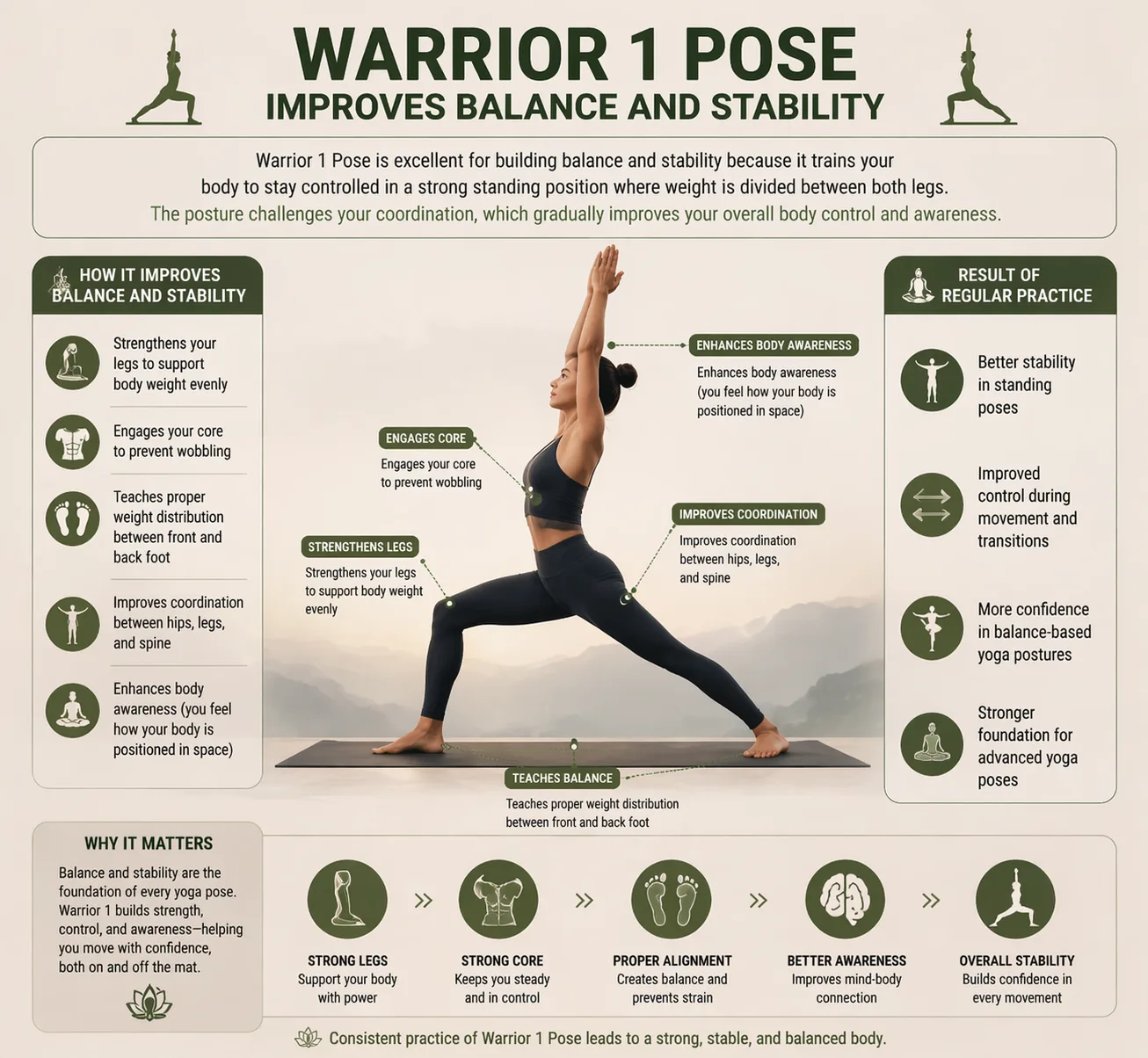
Warrior 1 Pose is excellent for building balance and stability because it trains your body to stay controlled in a strong standing position where weight is divided between both legs. The posture challenges your coordination, which gradually improves your overall body control and awareness.
π How it improves balance and stability:
- Makes your legs stronger to uphold body weight.
- Uses your middle to avoid wobbling.
- Learns correct weight bearing in front and back foot.
- Enhances the coordination of hips, legs and spine.
- Improves body awareness (you are aware of the position of the body in space)
π Result of regular practice:
- Better stability in standing poses
- Improved control during movement and transitions
- More confidence in balance-based yoga postures
- Stronger foundation for advanced yoga poses
Opens Chest and Lungs
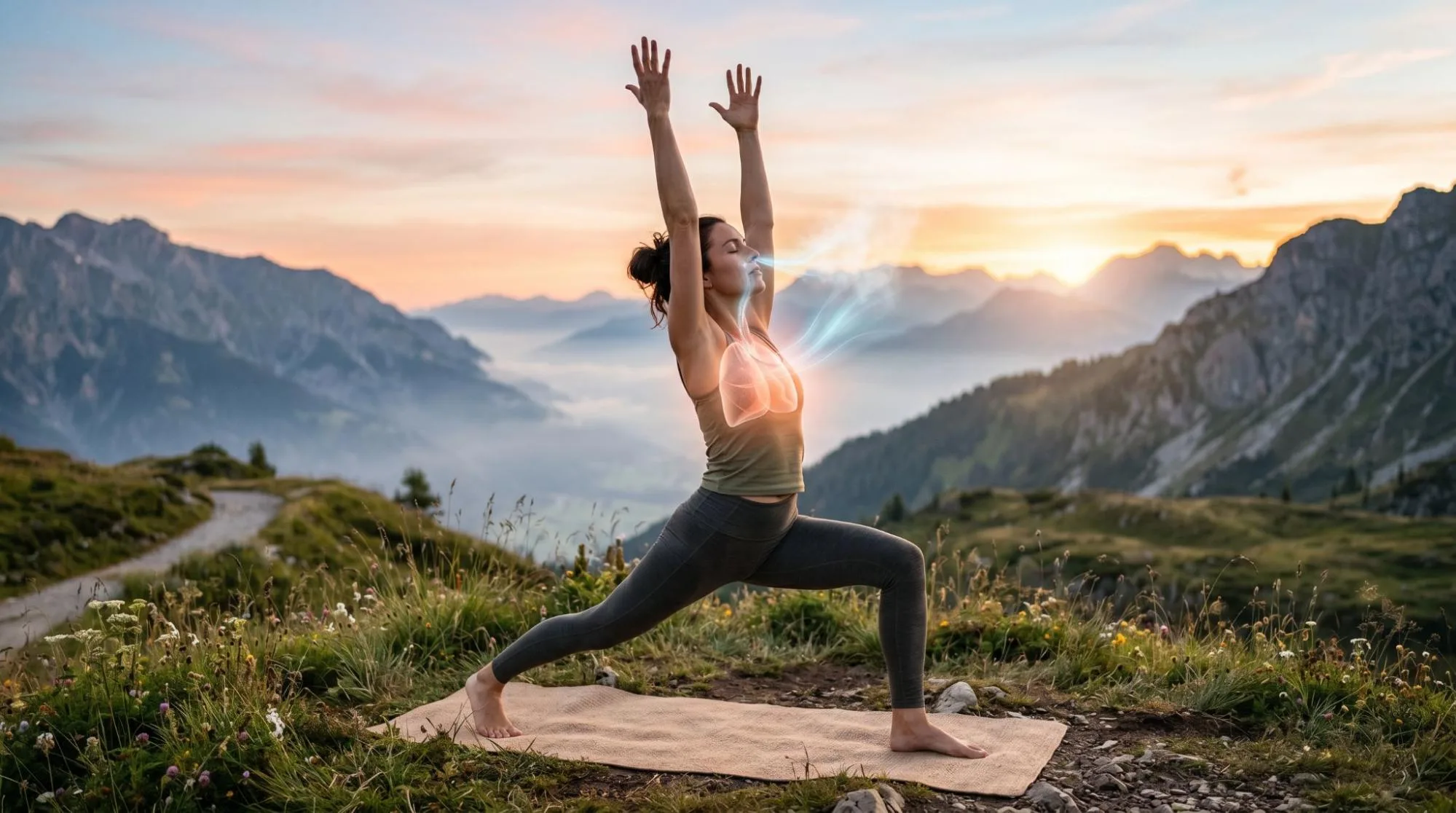
Warrior 1 Pose is useful to open the chest and stimulate the lungs due to the high extension of the arms upwards along with the raised torso. This growth leaves more room in the upper body which has a direct effect of enhancing the breathing patterns and posture as time goes by.
π How it opens the chest and lungs:
- Lifting the arms stretches the chest muscles upward
- Expands the rib cage for deeper breathing
- Improves oxygen intake by allowing fuller lung expansion
- Releases tightness in the shoulders and upper back
- Encourages upright spinal alignment for better posture
π Result of regular practice:
- Easier and deeper breathing
- Reduced chest and shoulder stiffness
- Improved posture in daily life
- Better lung capacity and breathing control
Improves Mental Focus
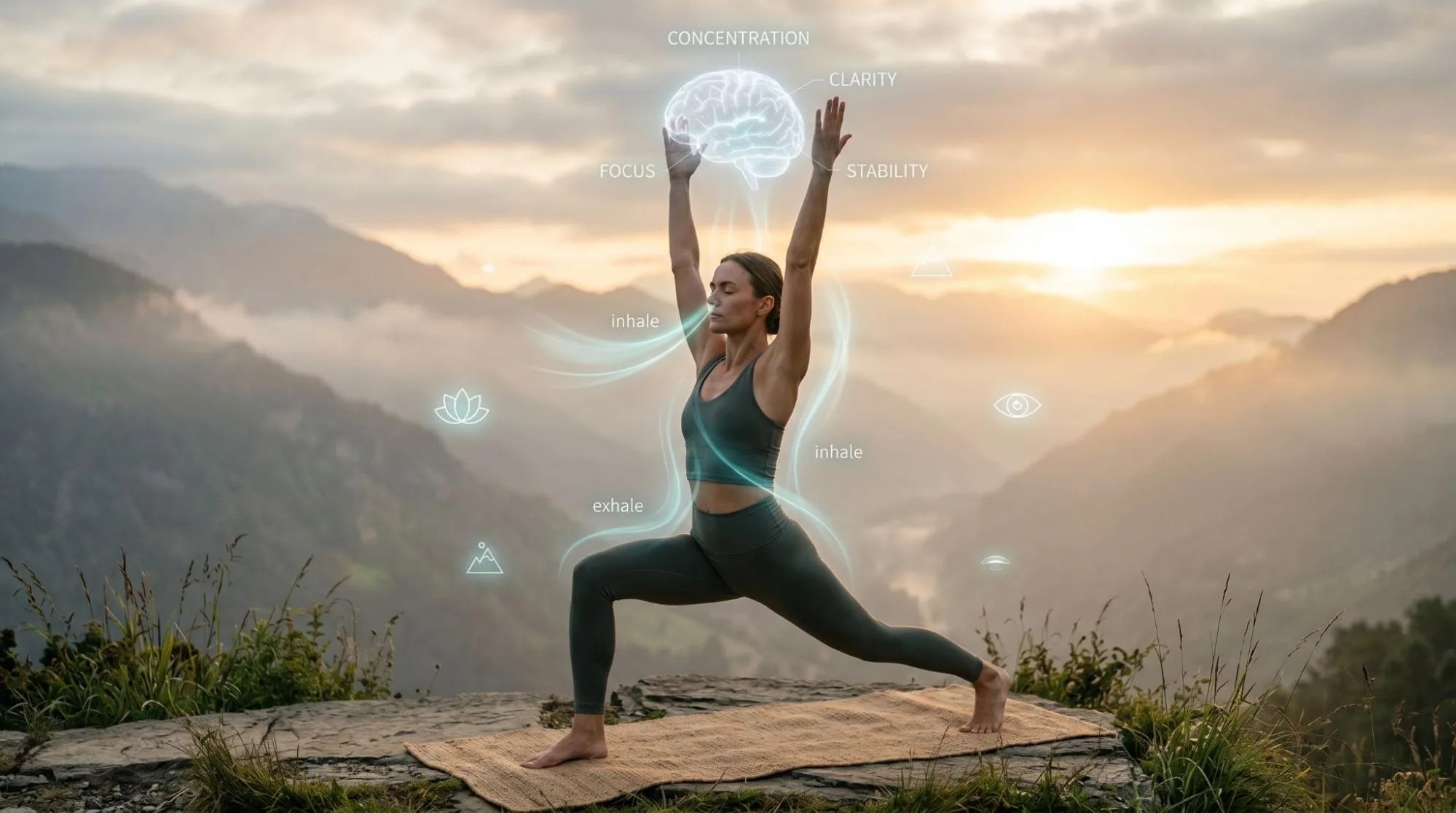
The Warrior 1 Pose is both a physical and a good mental training pose. Since you have to occupy the position in the right alignment and balance, your mind is inclined to be more attentive and in the present. This constant focus assists in minimizing the distractions and develop inner discipline with time.
π How it improves mental focus:
- Requires attention to body alignment while holding the pose
- Encourages steady breathing, which calms the mind
- Reduces mental distractions by keeping focus on posture
- Builds patience by holding the pose for a period of time
- Trains the mind to stay present and aware
π Result of regular practice:
- Increased focus on activities.
- Better mental acuity and decision-making.
- High discipline and self-control.
- A more relaxed and concentrated attitude in general.
Activates Root Chakra
Warrior 1 Pose is closely related to the Root Chakra (Muladhara), the chakra that grounds, provides stability, and a sense of safety. This pose also develops a sense of being grounded and stable since this posture demands a solid base using legs and feet.
π How it activates the Root Chakra:
- Strong grounding through both feet creates stability and connection to the earth
- Engages lower body muscles, especially legs and hips, for a solid base
- Encourages balance between strength and steadiness
- Promotes a feeling of physical and emotional security
- Helps the body feel stable and supported in the present moment
π Result of regular practice:
- Increased sense of grounding and inner stability.
- Less stress or feelings of insecurity.
- Better emotional control and self-confidence.
- Greater mind-body connection and presence.
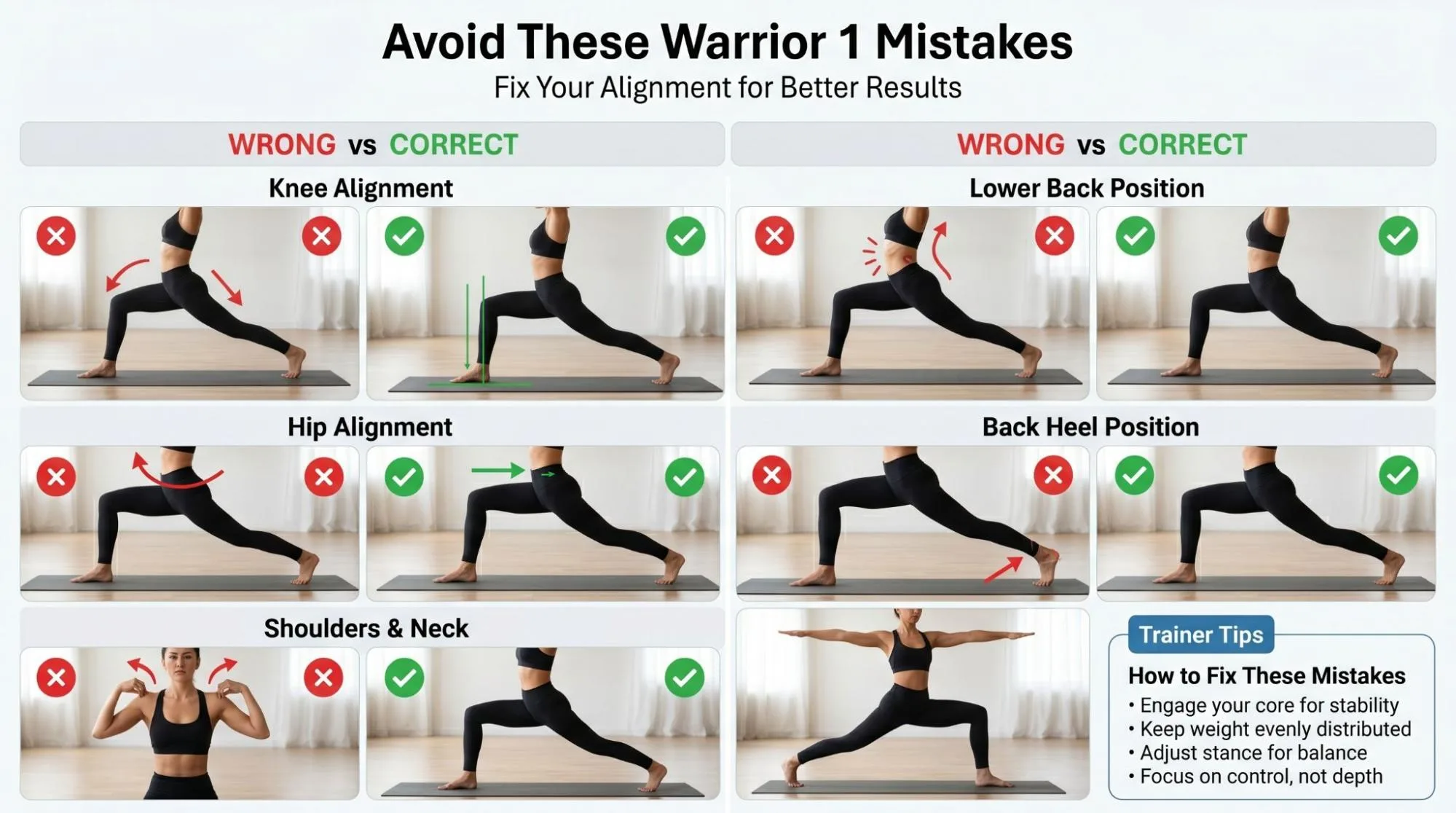
Common Mistakes in Warrior 1 Pose
These are the commonest misalignments that beginners commit when practicing Warrior 1. A trainer never leaves these untreated since even minor mistakes can impact the safety, balance and long-term progress.
Front knee collapsing inward
This is one of the most common and risky mistakes because it puts direct pressure on the knee joint.
π Why it happens:
- Weak leg engagement
- Poor awareness of knee alignment
- Stance too narrow
π Correction tips:
- Keep knee aligned with the second toe
- Engage thigh muscles to support the joint
- Press evenly through the front foot
Overarching lower back
This happens when the lower spine is compressed due to lack of core engagement.
π Why it happens:
- Core is not activated
- Over-tilting pelvis forward
- Trying to lift arms without stability
π Correction tips:
- Lightly engage your core muscles
- Lengthen the spine instead of compressing it
- Slightly tuck the pelvis to protect the lower back
Hips not squared properly
Misaligned hips reduce stability and can strain the spine and knees.
π Why it happens:
- Tight hip flexors
- Incorrect foot positioning
- Lack of awareness in alignment
π Correction tips:
- Gently guide hips to face forward
- Adjust stance width if needed
- Keep pelvis stable and controlled
Lifting the back heel
When the back heel lifts, the pose loses its grounding and stability.
π Why it happens:
- Tight calf or ankle muscles
- Stance too short
- Lack of grounding awareness
π Correction tips:
- Press the back heel firmly into the mat
- Widen stance slightly if needed
- Distribute weight evenly between both feet
Tight shoulders and neck
This creates unnecessary tension in the upper body and affects breathing.
π Why it happens:
- Over-lifting arms
- Stress or lack of relaxation
- Poor upper body engagement
π Correction tips:
- Keep shoulders relaxed and away from ears
- Stretch arms upward without tension
- Maintain smooth, steady breathing
Correction Tips
These simple adjustments help fix most alignment issues quickly:
π Key trainer advice:
- Even distribution of weight between the legs.
- Use core muscles to stabilize the whole body.
- Take a shorter pose in case balance is a problem.
- Concentrate on what is controlled, not on depth.
Once these errors are rectified, Warrior 1 is far safer, stronger, and more effective–it becomes a solid foundation instead of a tensioned posture.

Warrior 1 Pose for Beginners
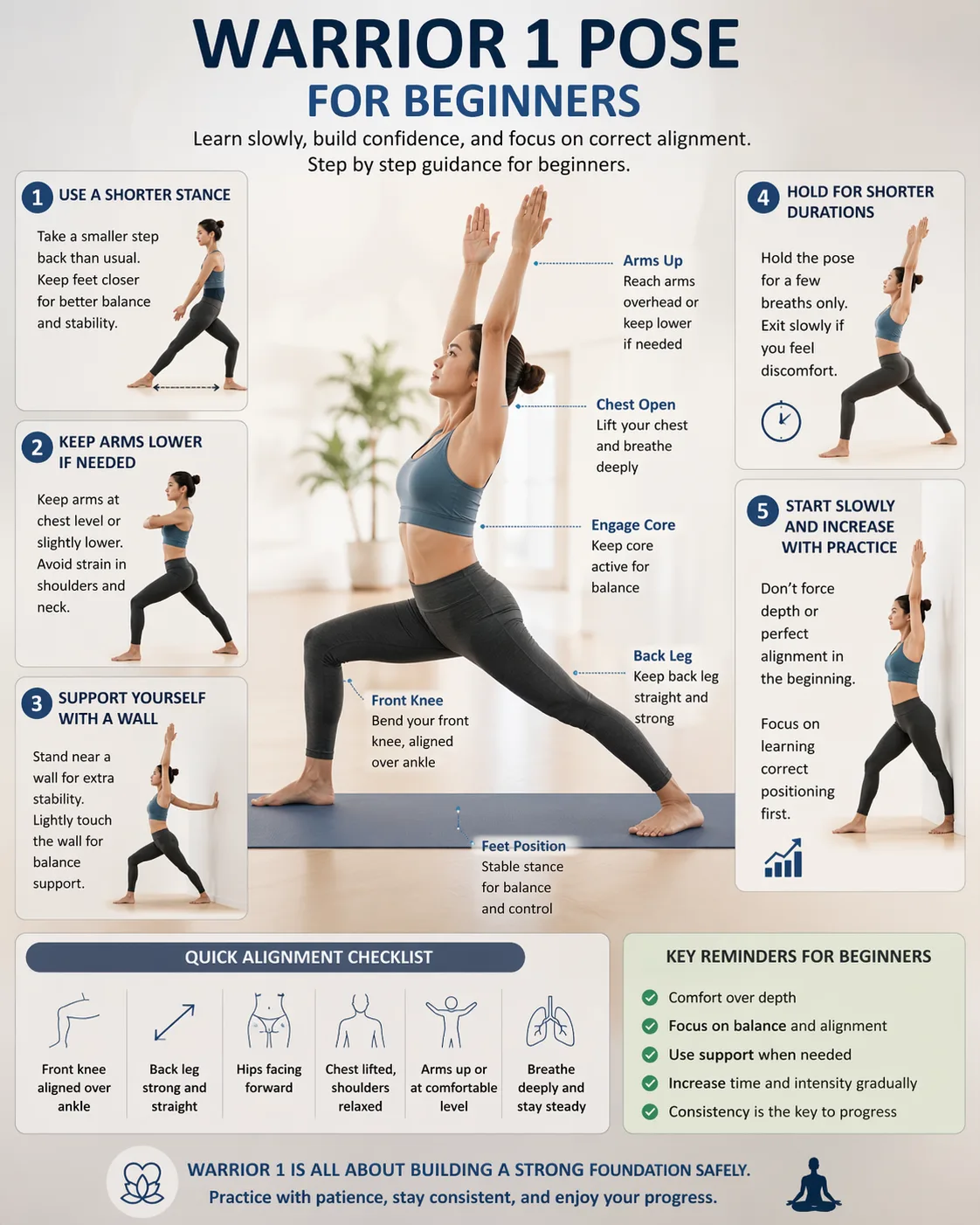
In case you are a beginner in the field of yoga, you should learn the Warrior 1 in a straightforward and moderate manner. Here, depth and intensity are not the aim, but rather the confidence, balance and proper alignment, achieved in steps.
Use a shorter stance for balance
Beginners are usually not that stable and thus the less distance between the feet, the easier the pose is to manage.
π Trainer guidance:
- Make a smaller step backwards than normal.
- To maintain balance, keep feet near.
- Get a feel of being stable first and then proceed.
Keep arms lower if needed
Holding arms fully overhead can feel difficult at the start, especially if shoulders are tight.
π Trainer guidance:
- Hands close to the chest or below where necessary.
- Do not strain shoulders or neck.
- Height should be increased gradually with increasing strength.
Support yourself with a wall
Using support is a smart beginner modification to prevent falling or losing alignment.
π Trainer guidance:
- Stand near a wall for extra stability
- Lightly touch the wall for balance support
- Use it only as a guide, not full support
Hold for shorter durations
Beginners should focus on comfort and control rather than long holds.
π Trainer guidance:
- Only hold the pose during a couple of breaths.
- Get out gradual in case you are feeling uncomfortable.
- Gradually, increase holding time by practicing.
Start slowly and increase intensity with practice
Warrior 1 improves over time, so patience is key.
π Trainer guidance:
- In the early stages, do not strain and squeeze the depth or impeccability.
- Master good positioning, first.
- Gradually get more challenging as you get stronger and more stable.
To the novices, Warrior 1 consists of establishing a good grounding in a safe manner. It helps to warm up your body to more challenging yoga positions without causing any harm or pain when done slowly and properly.
Warrior 1 Pose Variations
There are various forms of Warrior 1 that enable you to modify the intensity according to your level. A trainer tends to reproduce the pose to suit the ability of strength, flexibility and control in order to have the body grow at a safe pace.
Beginner Variation
At the beginner level, the focus is on learning balance, alignment, and comfort in the pose without overloading the body.
π Trainer guidance:
- Step further in order to put less pressure on legs.
- Maintenance of the front knee bend (not too deep).
- Concentrate on stability rather than depth.
- Rest in the pose a little, and breathe steadily.
Advanced Variation
It is the version which makes it more intense and is applied after the body has become strong and controlled.
π Trainer guidance:
- Lunge deeper to involve more leg involvement.
- Do the pose more often to develop stamina.
- Stick to alignment and intensify the practice.
- Use core and legs more actively to be stable.
Flow Integration
Warrior 1 is commonly used as part of yoga sequences, making it a transition pose in dynamic practice.
π Trainer guidance:
- Practised in Sun Salutations to generate heat and strength.
- Vinyasa flow contains smooth movement between poses.
- An aspect of standing exercises to enhance balance and coordination.
- Helps link several poses in a flowing movement.
Simply, Warrior 1 variations enable the same pose to develop with your practice- a basic learning pose, and then a strong strength-building pose, and then a flowing pose in a dynamic yoga sequence.
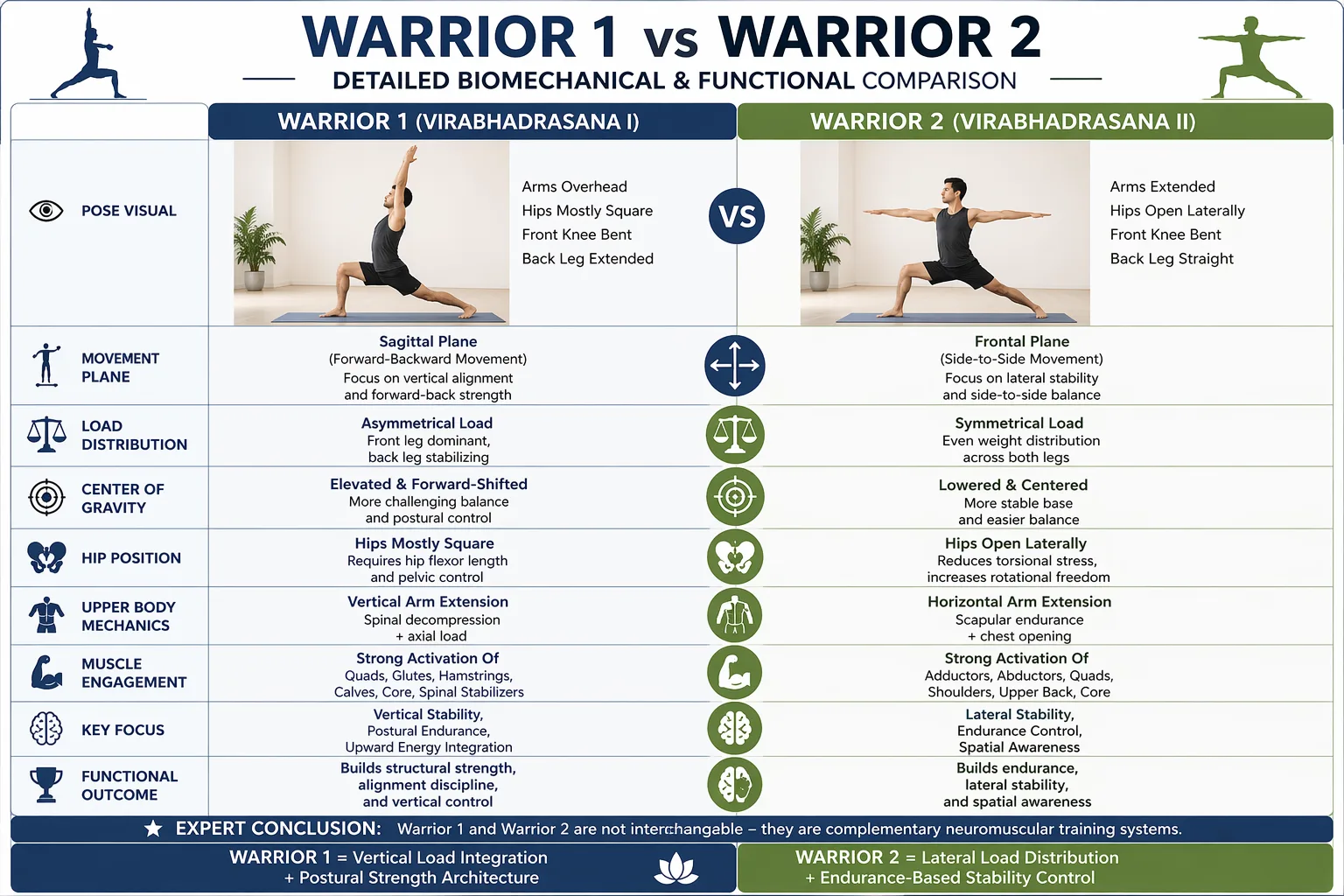
Warrior 1 vs Warrior 2
Expert yoga/biomechanics Outsiders might see Warrior 1 and Warrior 2 as variations, but these two basic kinetic patterns are quite different. They condition the body to performing various planes of movement, distribution among the body, and neuromuscular activities.
Warrior 1 (Virabhadrasana I) β Sagittal Plane Strength Model
The sagittal plane (forward-back movement) is the main direction of warrior 1, so this posture is concentrated on the production of the vertical force and control of the linearity.
π Expert breakdown:
- Hips are slightly bent forward-backed (almost squared) β needs hip flexor length and pelvic control.
- Front knee flexion results in an isometric load that is identical to a split squat hold.
- Raising the arms overhead change the center of mass to a high position β greater spinal axial loading.
- The extension of the back leg involves the activation of the stabilization of the posterior chain (glutes, hamstrings, calves).Lateral rotation of hips: Decreases torsional, increases rotational freedom.
- Shoulder shoulder position-Give a long lever arm by extending arms horizontally = demand for shoulder isometric endurance.
- The weight is balanced between the two legs evenly β increases bilateral load symmetry.
- Naturalteration is strong adductors and abductors activation to undergo subsequent stabilization on the side.
- Needs a constant scapular restriction and openness in the thorax.
- Needs a lot of core involvement to avoid lumbar hyperextension.
π Functional interpretation:
Warrior 1 develops vertical stability, postural stability and energy upwardly-integrated on controlled imbalance.
Warrior 2 (Virabhadrasana II) β Frontal Plane Stability Model
The warrior 2 is a frontal-plane (side-to-side movement) pose; hence it is a pose that has a lateral stability and load distribution, but has an open-chain control.
π Expert breakdown:
π Functional interpretation:
With an open position, warrior 2 develops the lateral stability, endurance-based control, and spatial awareness.
Deep Comparison (Biomechanical + Functional)
1. Movement Plane
- Warrior 1: Lateral plane (forward/back strength and alignment)
- Warrior 2: Side-by-side balance and stability (frontal plane).
π Expert opinion: They train entirely differing motor control systems.
2. Load Distribution
- Warrior 1: Load lopsidedness (with the front leg dominant, the back leg stabilizing)
- Warrior 2: Symmetric load (distribution equally between both legs)
πResult: Warrior 1 develops unilateral fitness; Warrior 2 develops bilateral fitness.
3. Center of Gravity Control
- Warrior 1: Increased and forward-bent posture > more difficult balance.
- Warrior 2: Bend the knee down and make it a center point of the base more stable.
πResult: Warrior 1 puts a test on postural correction; Warrior 2 improves stability tolerance.
4. Upper Body Mechanics
- Warrior 1: Extension of arms vertically to the spine with extension + loading upwards.
- Warrior 2: Arm extension of the scapula horizontally + chest opening.
5. Functional Outcome
- Warrior 1: Builds structural strength, alignment discipline, and vertical control
- Warrior 2: Builds endurance, lateral stability, and spatial awareness
Final Expert Conclusion
Warrior 1 and Warrior 2 cannot be used as one another- they are the complementary neuromuscular training systems.
- Warrior 1 = Vertical load integration + postural strength architecture
- Warrior 2 = Lateral load distribution + endurance-based stability control
In a well-designed yoga sequence, both are required to develop a complete movement systemβone builds structural integrity, the other builds adaptive stability under open conditions.

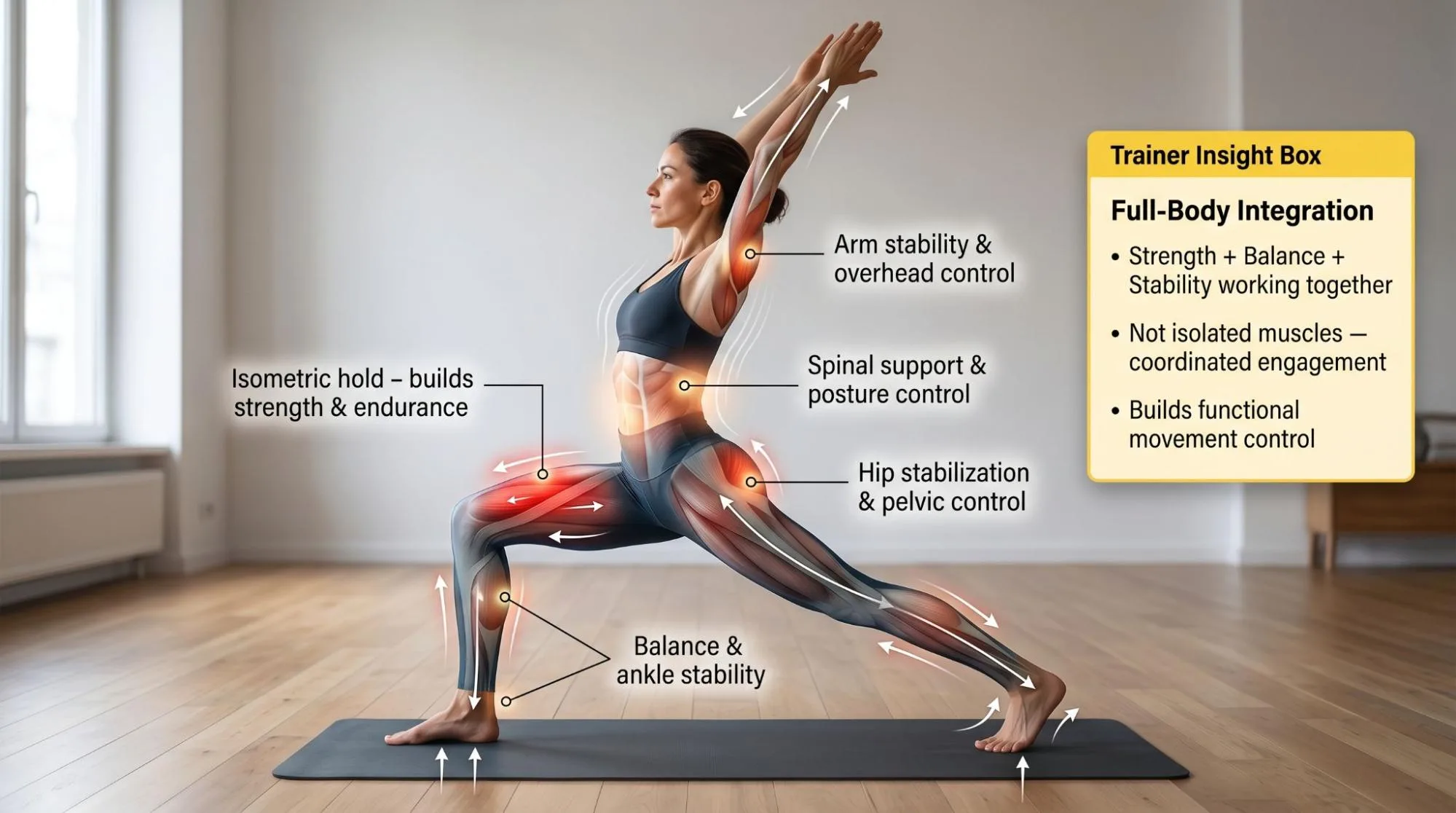
Muscles Worked in Warrior 1 Pose
As a trainer, the Warrior 1 Pose is a complex and full-body engagement position where various groups of muscles engage in a coordinated mechanism and not individual involvement, which makes it very useful in promoting functional strength and stability.
Quadriceps:
This leg position, the front leg binds in a bent position, forms a sustained isometric contraction of quadriceps. This develops lower body strength and endurance, like in a controlled squat position.
Glutes:
The glutes (particularly on the leg in front) are very engaged to stabilize the hip and support the lunge. Meanwhile, the leg glute on the back assists in keeping the pelvis aligned and collapsing pelvis.
Β Calves:
The calves are used as a balance and grounding aid to both legs. The back leg calf has the task of ensuring the calf stays put by the use of the heel, whereas the front leg calf helps in stabilizing the calf.
Core Muscles:
The core is critical in this pose as it helps to hold the spine straight and not overbend the lower back. In the case of inappropriate core work, the whole body posture becomes unsteady and misaligned.
Shoulder Stabilizers:
When projecting the arms over the head, the muscles that stabilize the shoulder (such as the deltoids and the upper back muscles) come into play to make the arms stable without causing tension in the neck.
Trainer Insight:
It is not only a leg exercise but a whole body integration, in this case strength, balance and posture are all exercised at once. When practiced properly, warrior 1 allows a person not only to gain muscle strength but coordination and control which are critical requirements in the higher way of practicing yoga.

Warrior 1 Pose in Yoga Sequences
Warrior 1 is not randomly used by a professional trainer, it is put in the sequence plans to develop strength, flow and predisposition to deeper movements.
1. Sun Salutation Variations
Warrior 1 is utilized in power activations in structured flows such as Sun Salutations.
- It follows pushing the foot backwards.
- Immediately involves legs, core, and arms.
- Increases the heart rate and is controlled.
2. Vinyasa Flow Transitions
Warrior 1 is used as a moving pose in the cyborg Vinyasa.
- Breath flows easily with the connects (inhale β become Warrior 1)
- Develops coordination in movement with breathing.
- Enhances balance in the dynamic flow.
3. Hatha Yoga Standing Sequences
Warrior 1 is used in deep work and with alignment aspects in Hatha.
- Concentrate on posture and muscle activity.
- Develops strength in the legs and shoulders.
- Enhances body awareness and control.
4. Preparation for Advanced Poses
Warrior 1 is not an end game- it is a preparer.
- Lengthens hip flexors to greater lengths.
- Practices balance in legs.
- Bends back through spine.
Final Trainer Perspective
Warrior 1 is not a mere posture: it is one of the important structural components of a yoga sequence. It develops strength, enhances the transition, and conditions the body, physically and mentally, to the higher level of exercise.
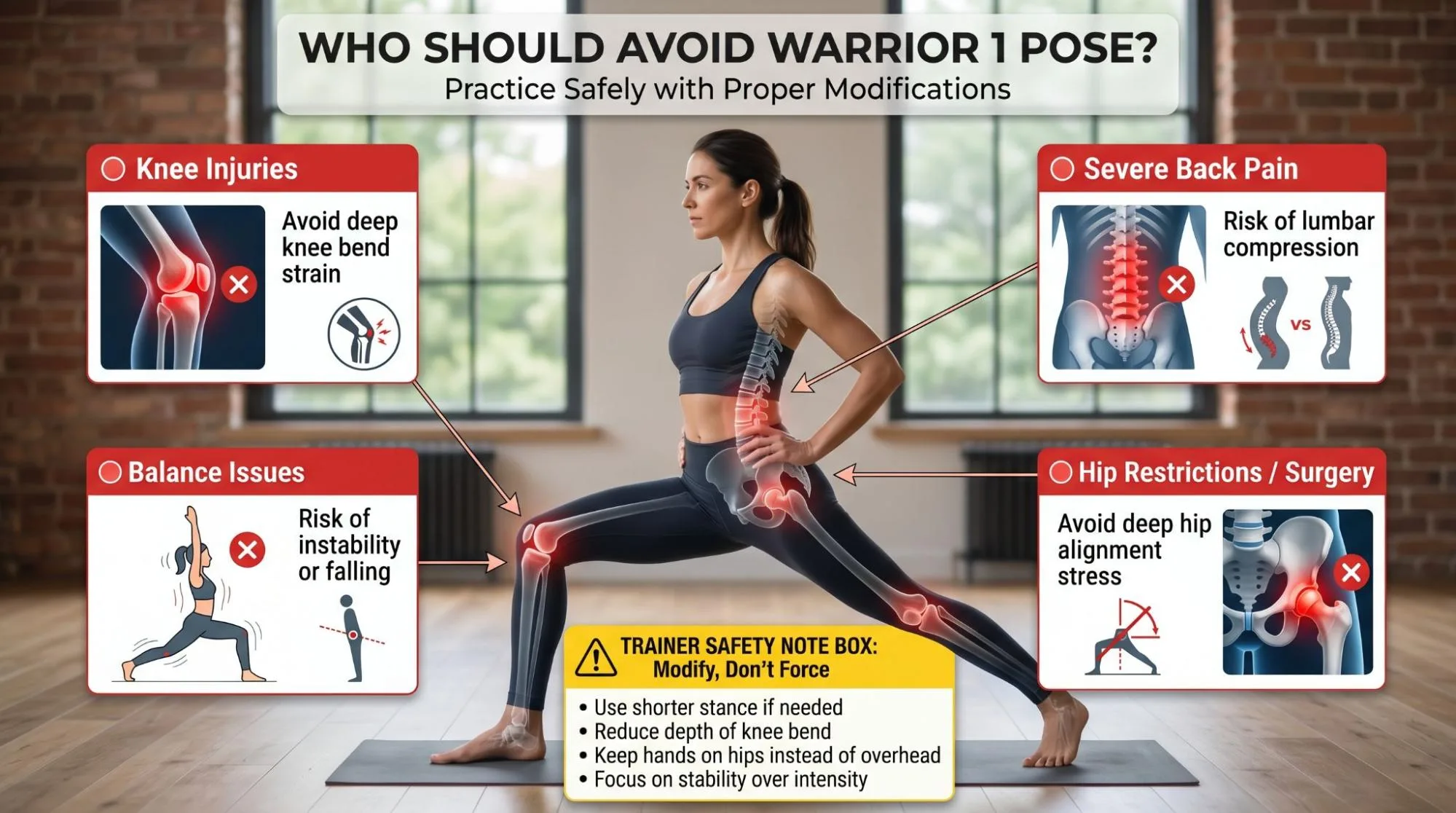
Who Should Avoid Warrior 1 Pose?
As a professional trainer, I would say that Warrior 1 is an effective yet challenging pose without modifications and not everyone should practice it in its complete version.
1. Knee Injuries
In case of knee pains or a prior insult:
- This extreme knee spike can cause too much stress of the knee.
- Ineffective alignment can aggravate the situation.
2. Severe Back Pain
In the case of lower back problems:
- The overhead arm posture may cause lumbar compression.
- Sense of non-core involvement can contribute to tension.
3. Balance Issues
In case of balance instability:
- The bent posture and raised hands change your center of gravity.
- This enhances the risk of falling or wobbling.
4. Recent Hip Surgery or Tight Hips
Where there is hip recovery or restricted mobility:
- Forces Due to squaring of the hips in front may produce undesired tension.
- May disrupts curing or is painful.
Final Trainer Note
Warrior 1 is not to be painful or coerced. An intelligent practitioner would understand when to change, turn it down or not practice the pose altogether. It is far better to always be in control, on track and safe than to be deep and risky in yoga since the real benefits of progress in this practice arises not only out of consistency but also moderation.

FAQs About Warrior 1 Pose
What is Warrior 1 Pose good for?
It enhances balance, strength, flexibility and concentration of the mind.
Is Warrior 1 beginner friendly?
Yes, correct alignment and adjustments.
What muscles does Warrior 1 work?
It works on legs, core, glutes and shoulders.
How long should you hold Warrior 1 Pose?
Normally 20-60 seconds per side.
What is Virabhadrasana 1?
It refers to Sanskrit to warrior 1 Pose.
Final Thoughts on Warrior 1 Pose
Warrior 1 Pose (Virabhadrasana 1) is not a mere physical yoga pose; it is a totality of power, stability and concentration of mind. As a trainer, it is something like a ground movement which develops physical strength and inner discipline simultaneously.
Doing it right and regularly, it will make your legs stronger, your posture better and your body more controllable and it will put your mind into training to be relaxed and in the game when you are straining. The true worth of this pose is not its appearance, but its ability to teach you about being aligned, patient, and conscious in each breath and movement.
Through time, the Warrior 1 position is not merely a pose, but a balancing act between effort and control, which is one of the most powerful standing positions in yoga.