
Mentally unstable or physically rigid following a hectic day? Humble warrior is an effective yet a stabilizing yoga pose that makes you re-link with your body, balance and core strength all in one.
Also referred to as the humble warrior yoga pose or Bound Warrior Pose, the posture is a mixture of strength, flexibility and mindfulness. Humble warrior pose is an important yoga pose that, whether as a beginner or an experienced yogi, can greatly enhance your yoga practice when you know how to do it right.
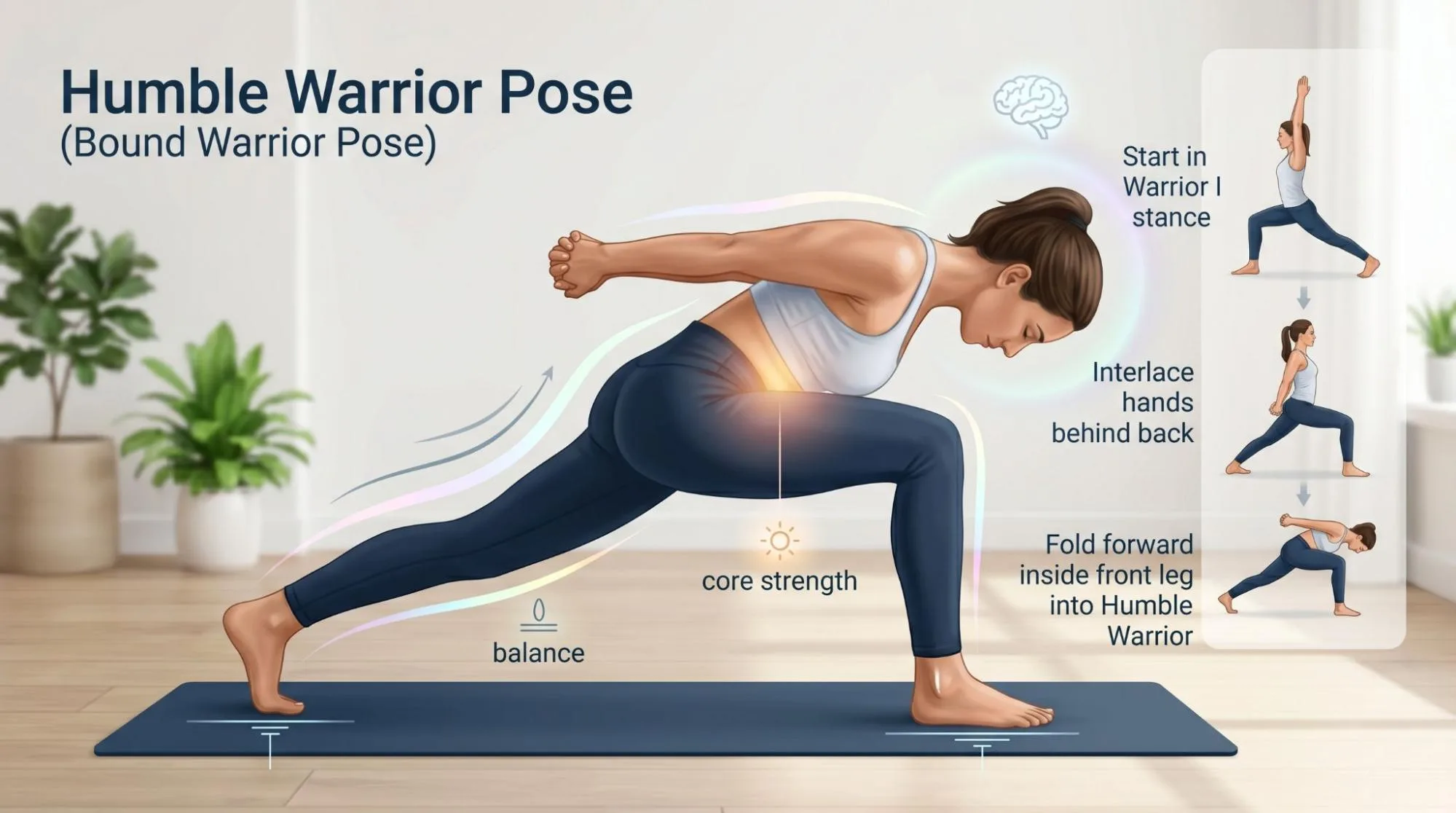
What Is Humble Warrior Pose?
Humble warrior pose is a standing yoga pose which combines a forward bend and chest-opening posture. It is based on Warrior I, but with a more insightful and reflective twist.
Key Characteristics
- Also known as: Bound Warrior Pose
This is more often known as Bound Warrior Pose due to the interlocking of hands behind the back producing a binding effect, which improves the opening of the shoulders and chest. - Type: Standing + Forward Fold + Chest Opening
It is a complex pose in yoga, which involves standing in balance, a forward bends, and an active chest expansion. This combination renders it grounding and penetrating to the upper body. - Focus areas: Balance, flexibility, shoulder mobility, and mindfulness
The pose enhances physical balance by using powerful leg work, improves hamstring and hip flexibility, improves shoulder range by using the bind, and teaches mindfulness by reminding one to be aware of their breathing and their bodies during the pose. - This is a common yoga balance pose since it puts a test of balance and promotes inner concentration. It is also a hip opening yoga pose and a chest opening yoga pose, thus it is a good all-round pose to include in any routine.
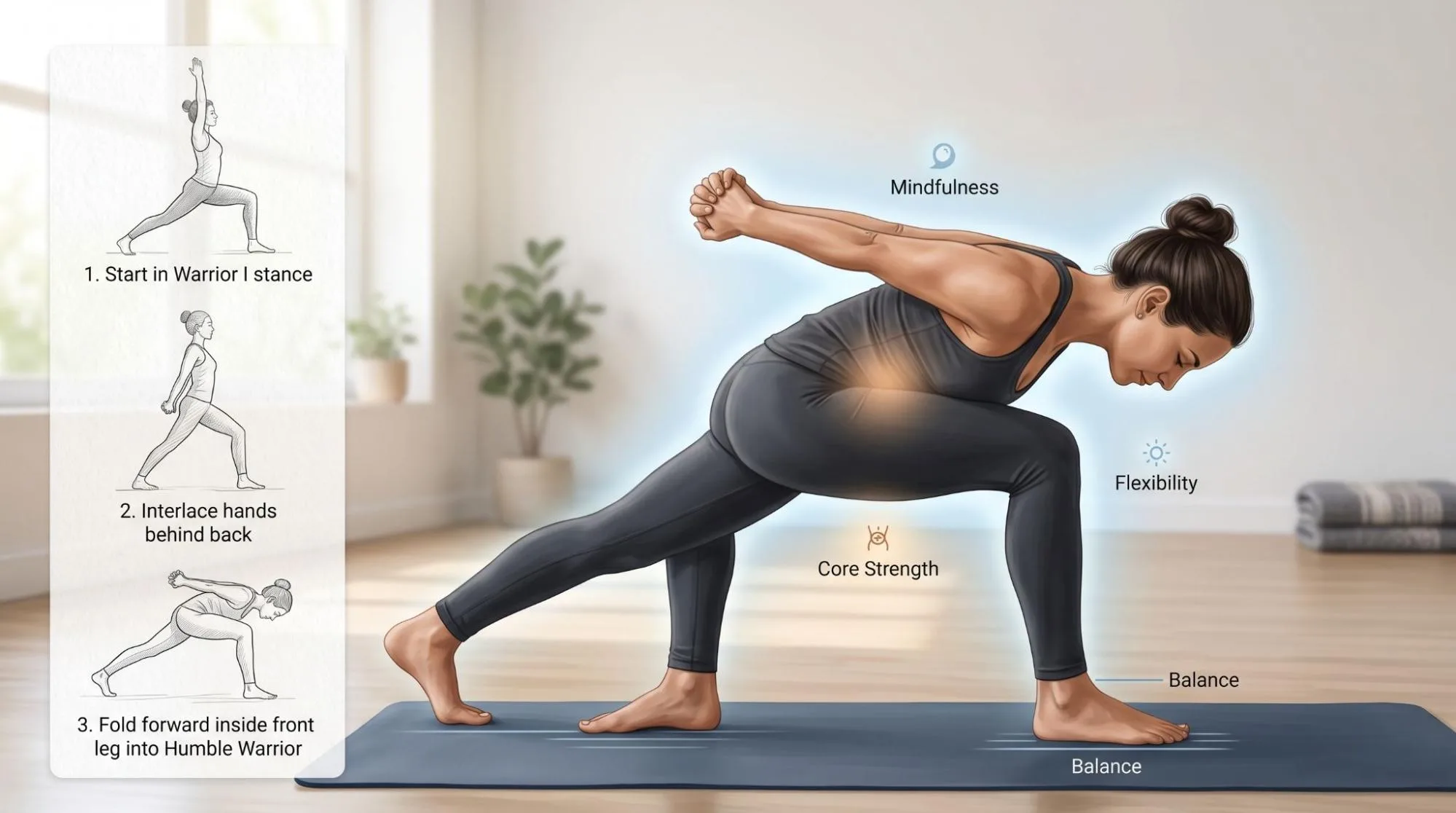
Learn More : Warrior 1 Pose: Benefits, Steps, Alignment, and Beginner Tips
Top Benefits of Humble Warrior Pose
Improves Core Strength
The forward fold pose makes your abdomen muscles work against each other. Your core is used to stabilize your torso, particularly when bending forward. With time, this develops strong core strength and enhances posture.
Enhances Balance and Stability
This is a position where your feet are needed to be firmly grounded. The front foot is heavily pushing into the mat and the back leg holds your body steady. This enhances coordination and makes it one of the most effective benefits of humble warrior pose in the core strength and balance.
Opens Chest and Shoulders
You can stretch the chest and shoulders deeply by clenching your hands behind your back and lifting them upwards. This is useful to overturn the bad posture induced by sitting or watching a screen.
Boosts Proprioception
Proprioception in yoga is the sense of position in space of your body. Since your head lowers below your heart in this pose, your balance system is challenged, enhancing body awareness and control.
Supports Mental Calmness
The curves of the pose are inward folding, which facilitates introspection. It is usually part of mindfulness yoga postures as it promotes slow breathing and mindfulness.
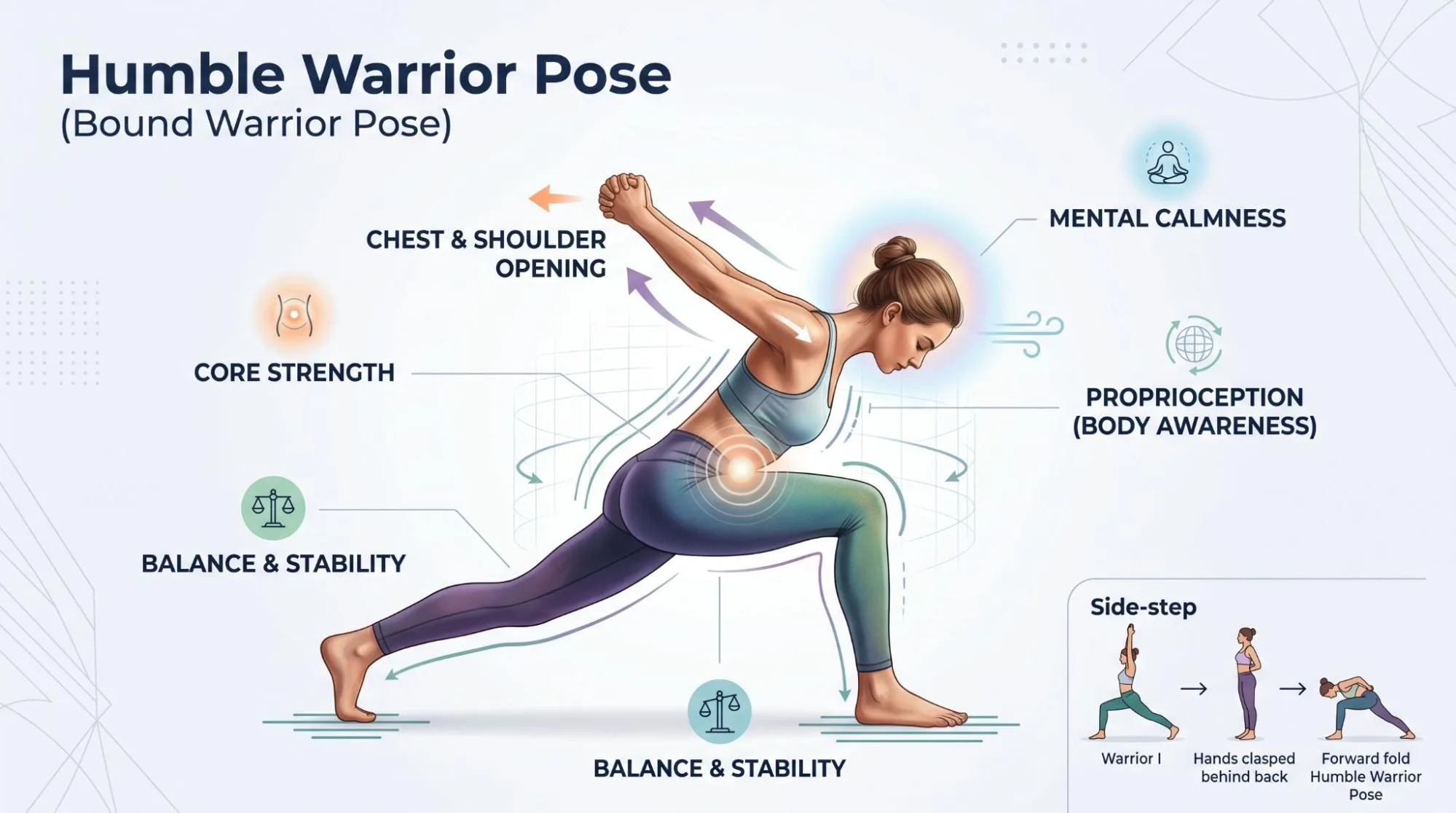
How to Do Humble Warrior Pose (Step-by-Step)
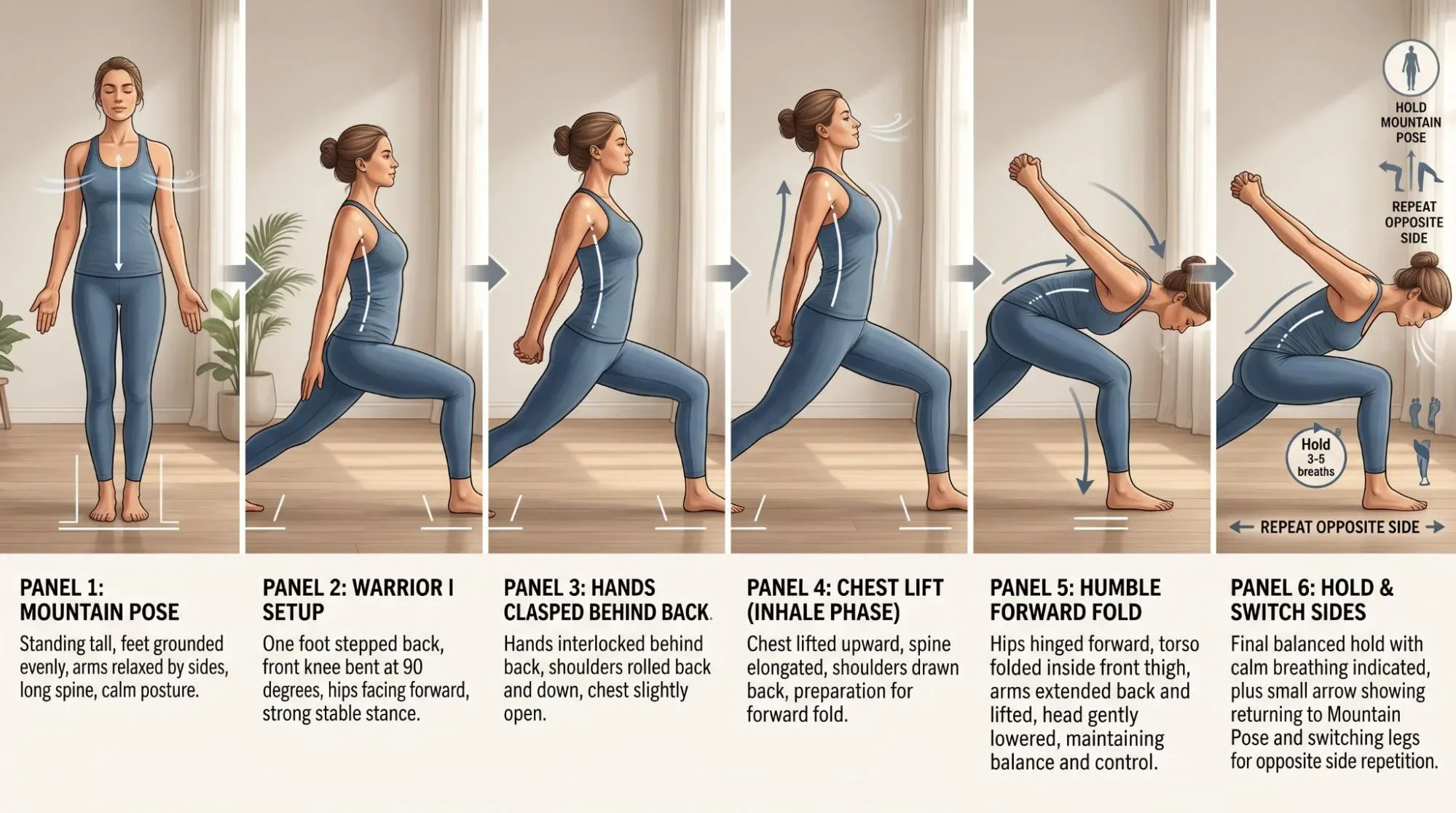
The step-by-step breakdown of the entire process of alignment in this section gives you a safe way to construct the pose step-by-step, making sure not to disturb the final expression. Speed does not matter; the point is smooth transitions.
Start in Mountain Pose
Start by creating an even-handed position. This preconditions all standing balance yoga.
👉 Focus points:
- Straighten posture with feet close or hips apart.
- Place weight equally on feet.
- Keep your arms loose next to your body.
- Bring your body to life (long spine, naturally open chest).
Step Back into Warrior I
This is a step that forms the structural foundation of the pose, engaging legs, hips and core alignment.
👉 Focus points:
- Take one foot back into a long position.
- Flex front knee to maintain a consistent 90 degrees.
- Hold back your legs high and straight.
- Turn your hips in front (this is necessary to keep them in line and safe).
- Stamp both feet on the mat.
Clasp Hands Behind Your Back
The upper body and shoulder are made ready by this movement to open the chest and activate the shoulder.
👉 Focus points:
- Place hands behind your.
- Bend your arms straight (without straining).
- Shoulder roll back and a downward direction.
- Make chest raised and open then fold.
Inhale and Lift Your Chest
This is the pre-preparation stage before the forward fold to make room in the upper body.
👉 Focus points:
- Breathe deeply, through the nose.
- Lift up your chest and in front.
- Shoulders: Move away.
- Maintain length in the spine (avoid compressing lower back)
Exhale and Fold Forward
This is the central motion of Humble Warrior where in control and awareness is vital.
👉 Focus points:
- Hinge at hips rather than waist.
- Bend your trunk into the front leg.
- Pretend to be holding arms high and active behind your back.
- Set the head crown to go down softly.
- Do not fall or hurry the movement.
Hold and Breathe
This is where the maximum gains of the pose are achieved- stability, flexibility and mindfulness.
👉 Focus points:
- Remain in the pose 5-10 deep breaths.
- Breath steadily, in control.
- Keep legs moving and core involved.
- Keep head straight but allow the neck to relax.
- Focus on balance between strength and surrender
Switch Sides
The practice of yoga should be on both sides of the body to prevent asymmetry.
👉 Focus points:
- Gradually come back to standing Mountain Pose.
- Breathe and sit up again.
- Take the other foot backwards.
- Duplicate the same sequence and pay equal attention and control.
The methodology of breaking down the process into steps makes sure that Humble Warrior Pose is done safely, with an appropriate alignment and full consciousness at each step as opposed to diving deeper.
Common Mistakes to Avoid
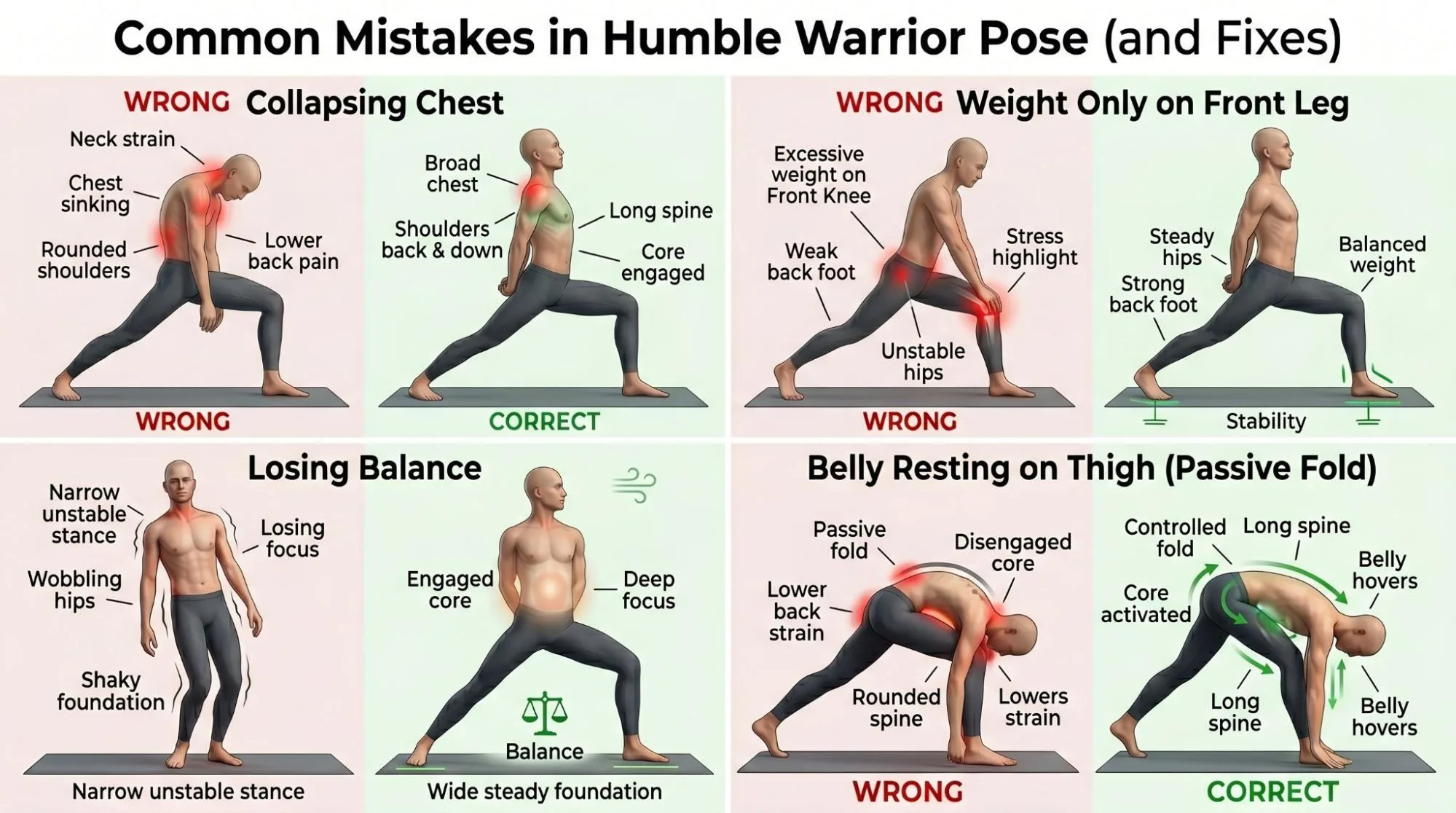
It is important to avoid such mistakes in order to do Humble Warrior Pose safely and effectively, particularly when a person is a beginner. Every error has a direct influence on alignment and balance as well as the general benefit of the pose.
Collapsing the Chest
In cases when the chest is pulled in, the pose loses its main advantage upper body opening. This typically occurs when the arms are passive, or shoulders are rounded forward. The body is no longer able to create space in the chest; it is compressed, and it also may put a strain on the neck and upper back.
👉 How to fix it:
- Raise your arms up, and a little backwards.
- Pull shoulders back towards ears.
- The chest should be kept slightly stretched out in the anterior position.
Putting Weight Only on the Front Leg
The most frequent error is to put all the weight of the body on the front leg and this produces pressure on the knee and makes this pose unstable. Such imbalance decreases control and may cause joint strain in the long run.
👉 How to fix it:
- Kick over both feet.
- Firmly step the back foot onto the mat.
- Use both legs to distribute the load.
Losing Balance
Since Humble Warrior is a forward bends with a narrow stance, balance is easily lost. This may cause beginners to wobble or fall forward because of improper foot placement or insufficient grounding.
👉 How to fix it:
- Stand slightly wider to be more supported.
- Do not lock knees, keep them bent.
- Use your core to be stable.
- Gaze down to be able to control.
Resting Belly on Thigh
Allowing the belly to fall all the way on the front thigh eliminates active involvement of the core, and transfers the pressure to the lower back. This decreases the strength-building and safety advantages.
👉 How to fix it:
- Remember to keep your core slightly engaged during the pose.
- Keep back a straight back rather than bending forward.
- Think of controlling the folding instead of falling down.
Learn More : Triangle Pose Yoga Common Mistakes and How to Fix Them
Beginner Modifications and Variations
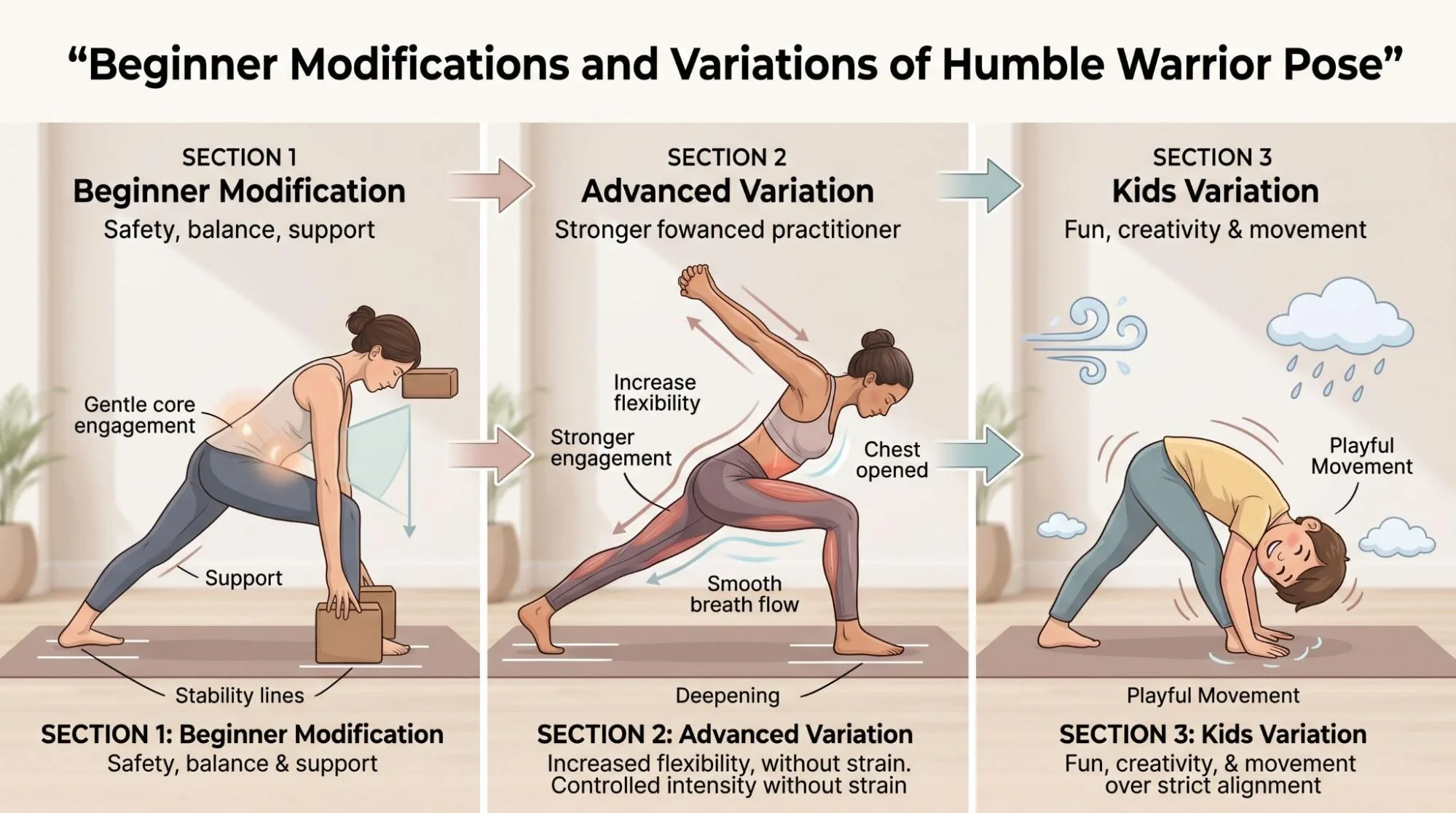
Such variations will make you fit Humble Warrior Pose to the level of your flexibility, strength, and experience. Control and safety–not depth–is always the aim.
For Beginners
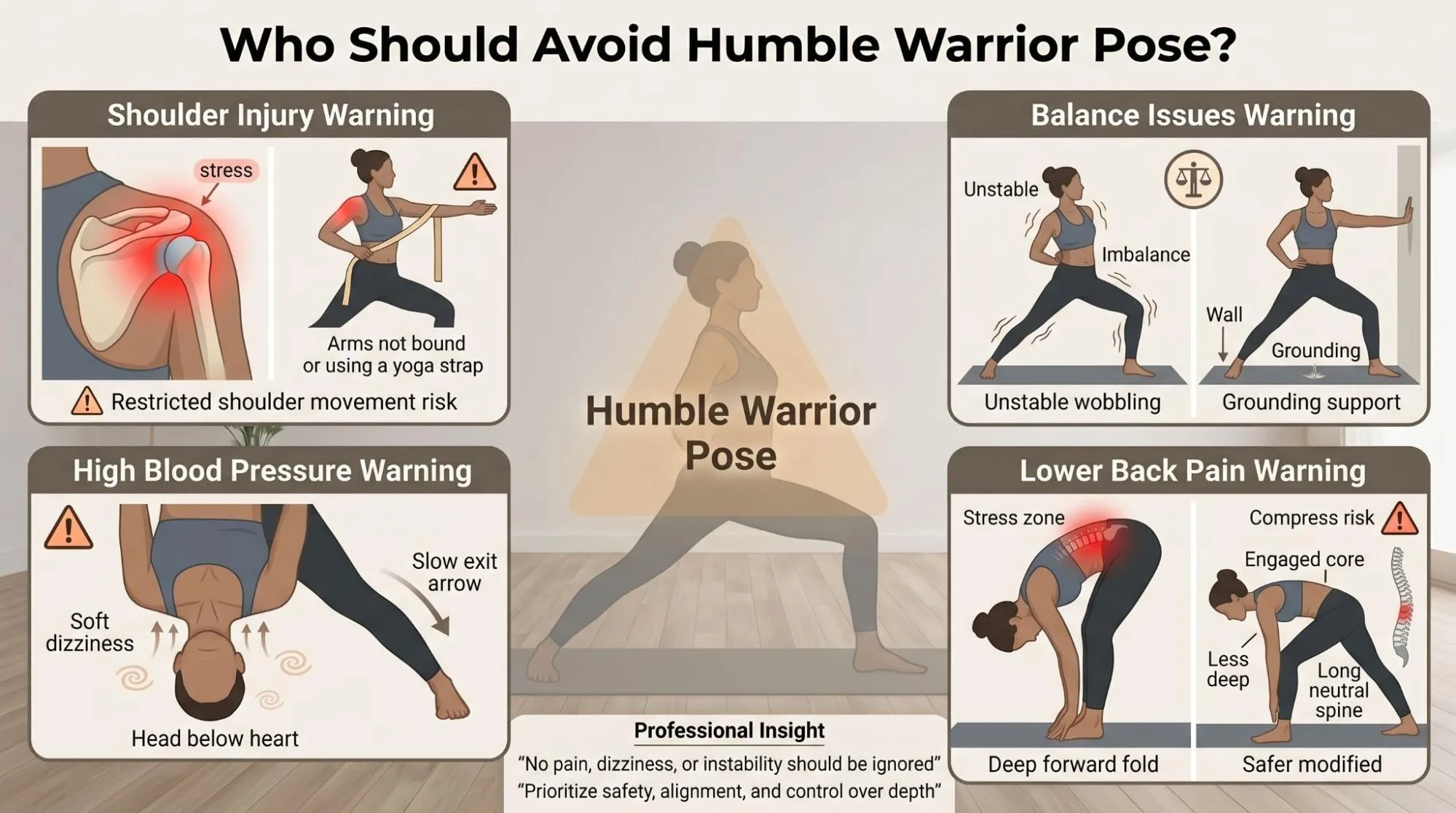
On the beginner level, one should aim at stability and correct positioning and not deepening into the pose. Most of the individuals lose balance or overstrain the muscles by pushing too hard too fast.
👉 How to practice safely:
- Take a wider stance for better balance and grounding
- Place yoga blocks under hands or forehead to gain additional support.
- Bend forward, rather than taking a deep fold.
- Use your core on a light level, which will prevent falling.
Advanced Variation
After your body gets used to the basic alignment, you can progressively increase the pose. The advanced variation deals with greater flexibility and enhanced muscle engagement.
👉 How to deepen the pose:
- Bend forward further, keeping control.
- Bring your interlaced arms upwards to enhance shoulder and chest opening.
- Use your core and legs more intensively to stabilize.
- Practice breathing evenly to prevent tension.
Kids Variation
In the case of children, yoga must be fun and not organized or intense. Humble Warrior can be converted into a movement of fun, which creates awareness without coercion.
👉 How to make it fun:
- Make it an ostrich pose, and have the children hide their head as a bird.
- Promote folding rather than alignment.
- To make it interesting add some imagination (such as avoiding the wind or rain).
- Be movement-oriented and fun-oriented, not perfection-oriented.
These variations will make Humble Warrior Pose friendly, safe and enjoyable to all levels: complete beginners, advanced practitioners and even children.
Humble Warrior vs Warrior 1
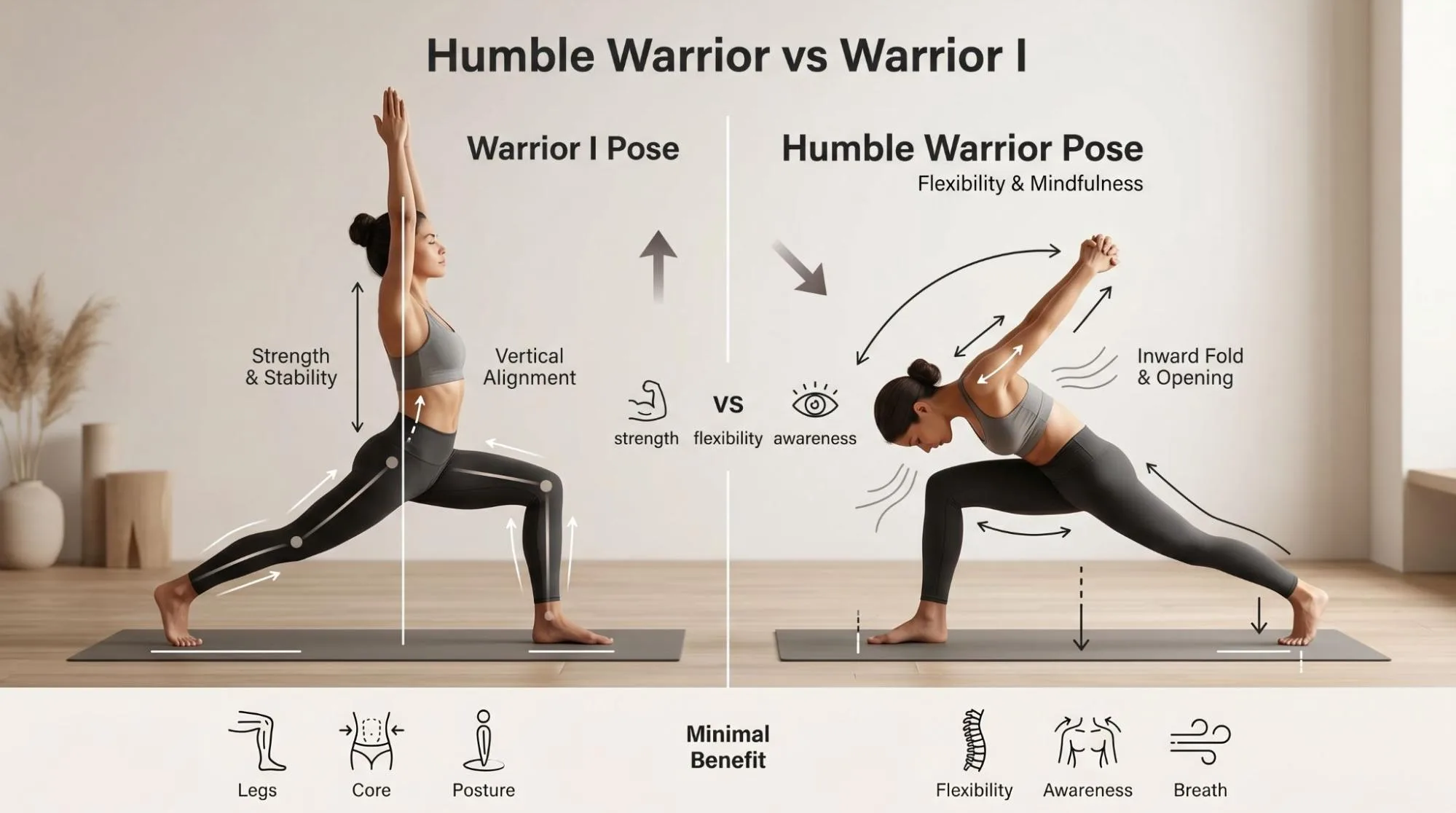
Knowing the distinction between the two is beneficial to you as you practice them in a proper manner. They appear to be rather similar, but their purpose, body movements, and advantages differ significantly.
Key Differences
Body position and direction of movement are the primary difference. Warrior 1 is all about stability and standing power, whereas Humble Warrior includes a forward toxin and extended upper body aperture.
👉 Breakdown:
- Warrior 1: Sitting straight and upright with chest raised and arms stretched upwards.
- Humble Warrior: Forward bending cross, crossed at the back.
- Warrior 1: Focuses on vertical alignment and Humble Warrior focuses on inward fold and shoulder opening.
- Humble Warrior: has an additional emphasis on breath control and bowing forward the torso.
When to Use Each
Every pose has a different purpose in your yoga sequence and thus the right choice of pose will depend on your purpose.
👉 Use Warrior 1 when you want to:
- Develop lower body strength.
- Enhance posture and alignment.
- Enhance concentration and balance in standing.
👉 Use Humble Warrior when you want to:
- Flexibility in hips, hamstrings, and shoulders.
- Promote more inward reflection and rest.
- Lengthen the upper body, but without lifting.
Benefits Comparison
Both postures are effective, yet they aim at achieving various physical and mental results.
👉 Warrior 1 benefits:
- Trains leg, butt, and core strength.
- Enhances body position and posture.
- Improves stability and attention in standing poses.
👉 Humble Warrior benefits:
- Enhances spine, shoulder and hip flexibility.
- Improves balance and body awareness.
- Encourages mindfulness by breathing in and out and focusing inward.
Concisely, Warrior 1 builds upon strength and form whereas Humble Warrior builds upon flexibility and awareness, meaning that they complement each other and do not compete in a harmonious yoga practice.
Tips to Master Humble Warrior Pose
Breathing Control
The stability in Humble Warrior Pose is based on breathing, rather than a supplementary aspect. Slow and deep breathing switches your body to the parasympathetic nervous system, enabling it to remain calm and alert rather than nervous. Your chest is squashed a bit in this pose by the forward bend and shallow breathing is very frequent–but that is just what you must not allow. Pay attention to deep breathing, pushing your rib cage and a little bit into your back with your nose. When exhaling, the deeper your torso sinks, without pushing the stretch. This beat is a moving meditation- with every breath leading you deeper and maintaining your balance in a steady and controlled way.
Foot Grounding
Whatever you can make of yourself in Humble Warrior is all the way your feet are stuck into the mat. Imagine your feet have anchors. The heel and the ball of the foot of the front foot should push hard and the outer edge of the back foot should push hard. Do not fall over into the arch–lift it actively upwards to form muscular activity. Not only does this grounding stabilize your lower body, but it also enables energy to flow up your legs into your core. Once your feet are engaged correctly, you will find that there is less wobbling and more control even folding forward deeply.
Hip Alignment
One of the most difficult but important parts of this pose is to keep your hips square. The hips tend to be forced outwards since your torso is folded in front of the leg of the front. But to ensure you are in the right position and that your lower back and knees are not unduly strained, you must pull in your front hip and your back one slightly forward. This creates a “neutral” pelvis position. Proper hip positioning helps spread the stretch evenly through your hips, hamstrings and inner thighs, and not focusing on one area. It keeps the structure intact, too, so the pose is safer and more efficient.
Shoulder Engagement
Your shoulders contribute significantly to this pose turning it into an effective chest-opening posture. Don’t passively hang your arms over your back when you are interlacing your fingers. Rather, energetically pull your shoulders back and up towards your ears and raise your arms as high as you can do so. This interaction opens the chest, stretches the shoulders and enhances posture with time. Remember not to push the lift, concentrate on slow activation. The idea is to make space between your collarbones and feel comfortable and in control as opposed to being pushed into pain.
Tips to Master Humble Warrior Pose
Breathing Control
The stability in Humble Warrior Pose is based on breathing, rather than a supplementary aspect. Slow and deep breathing switches your body to the parasympathetic nervous system, enabling it to remain calm and alert rather than nervous. Your chest is squashed a bit in this pose by the forward bend and shallow breathing is very frequent–but that is just what you must not allow. Pay attention to deep breathing, pushing your rib cage and a little bit into your back with your nose. When exhaling, the deeper your torso sinks, without pushing the stretch. This beat is a moving meditation- with every breath leading you deeper and maintaining your balance in a steady and controlled way.
Foot Grounding
Whatever you can make of yourself in Humble Warrior is all the way your feet are stuck into the mat. Imagine your feet have anchors. The heel and the ball of the foot of the front foot should push hard and the outer edge of the back foot should push hard. Do not fall over into the arch–lift it actively upwards to form muscular activity. Not only does this grounding stabilize your lower body, but it also enables energy to flow up your legs into your core. Once your feet are engaged correctly, you will find that there is less wobbling and more control even folding forward deeply.
Hip Alignment
One of the most difficult but important parts of this pose is to keep your hips square. The hips tend to be forced outwards since your torso is folded in front of the leg of the front. But to ensure you are in the right position and that your lower back and knees are not unduly strained, you must pull in your front hip and your back one slightly forward. This creates a “neutral” pelvis position. Proper hip positioning helps spread the stretch evenly through your hips, hamstrings and inner thighs, and not focusing on one area. It keeps the structure intact, too, so the pose is safer and more efficient.
Shoulder Engagement
Your shoulders contribute significantly to this pose turning it into an effective chest-opening posture. Don’t passively hang your arms over your back when you are interlacing your fingers. Rather, energetically pull your shoulders back and up towards your ears and raise your arms as high as you can do so. This interaction opens the chest, stretches the shoulders and enhances posture with time. Remember not to push the lift, concentrate on slow activation. The idea is to make space between your collarbones and feel comfortable and in control as opposed to being pushed into pain.
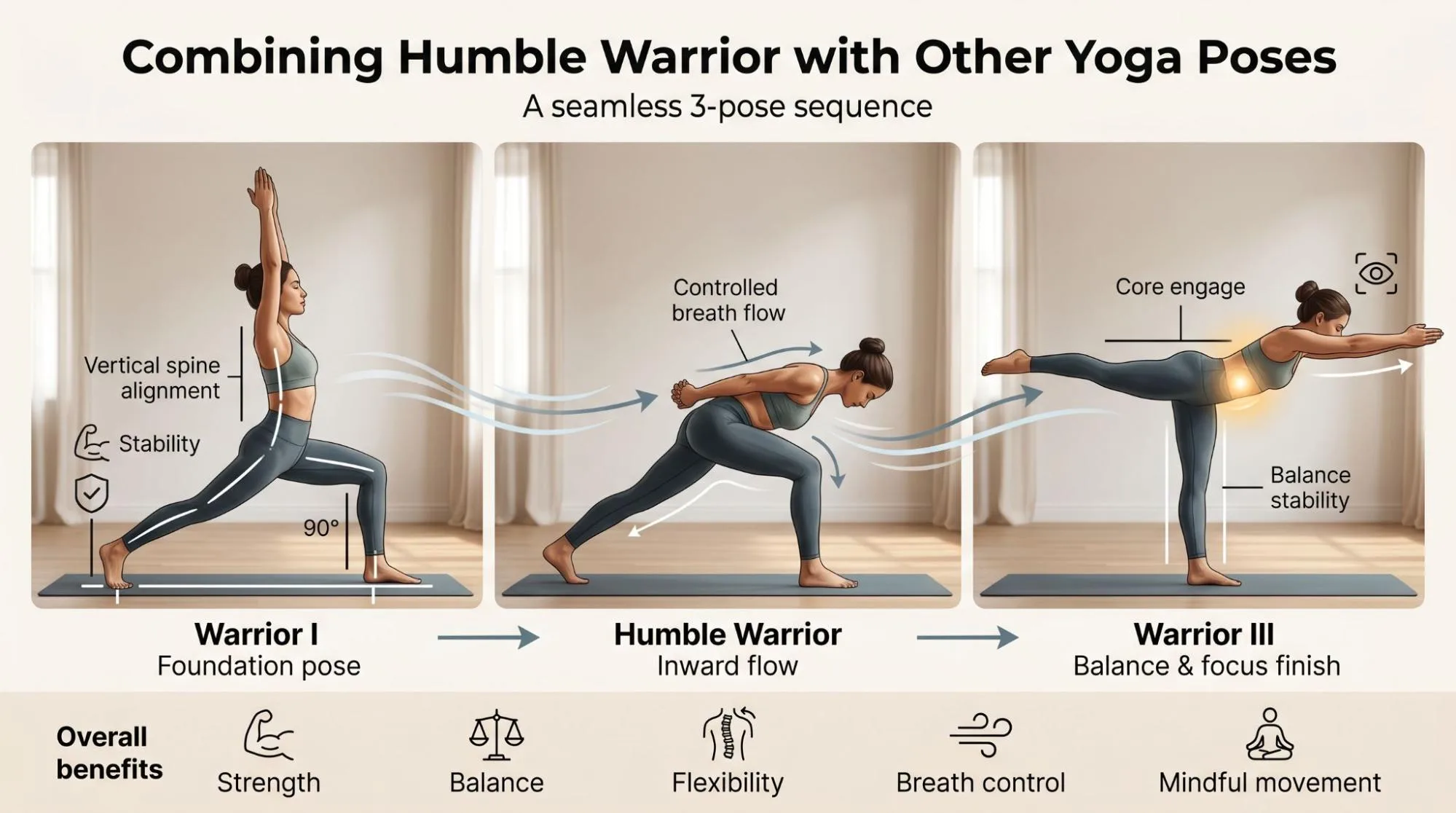
Combining Humble Warrior with Other Yoga Poses
Humble Warrior is further enhanced when it is performed in a series of flows instead of a single pose. Connecting it to other standing aids facilitates enhanced strength, coordination, and body awareness in a more dynamic manner.
Start with Warrior 1
This is your foundation pose and it sets the body ready to move by establishing stability and alignment.
👉 Focus points:
- Create a base of good standing, one foot forward and one back.
- Keep your hips square, keep the torso straight.
- Raise your shoulders to engage shoulders and core.
- Use your legs to develop a dependable base to transition.
This will warm up the lower body and establish correct positioning prior to deeper movement.
Transition into Humble Warrior
And here the current turns more inward, towards strength to flexibility and control.
👉 Focus points:
- Clasp your hands behind your back
- Unbutton your shirt and fold.
- Bend gradually forward in a straight thrust in the front thigh.
- Breath in a constant manner and hold legs stable.
This transition builds flexibility, shoulder range, and mindfulness and maintains the base strong.
Move into Warrior 3
This is the last movement in the series, which brings balance, concentration and coordination of the whole body.
👉 Focus points:
- Get on the front leg.
- Raise the tail leg at right angles to the ground.
- Stretch out your arms or maintain a prayer posture.
- Use your core to keep yourself balanced and stable.
Warrior 3 tests your concentration and makes your whole back chain strong.
Overall Flow Benefits
Practicing these poses together creates a well-rounded standing sequence that blends strength, flexibility, and balance.
👉 Key outcomes:
- Strengthens the body and the core.
- Improves balance and coordination
- Improves shoulder and hip joints.
- Learns to control breathing using transitional progression.
- Develops a mindful, flowing yoga.
This combination of the Humble Warrior turns into one pose into a strong, built sequence that exercises the body and mind equally.
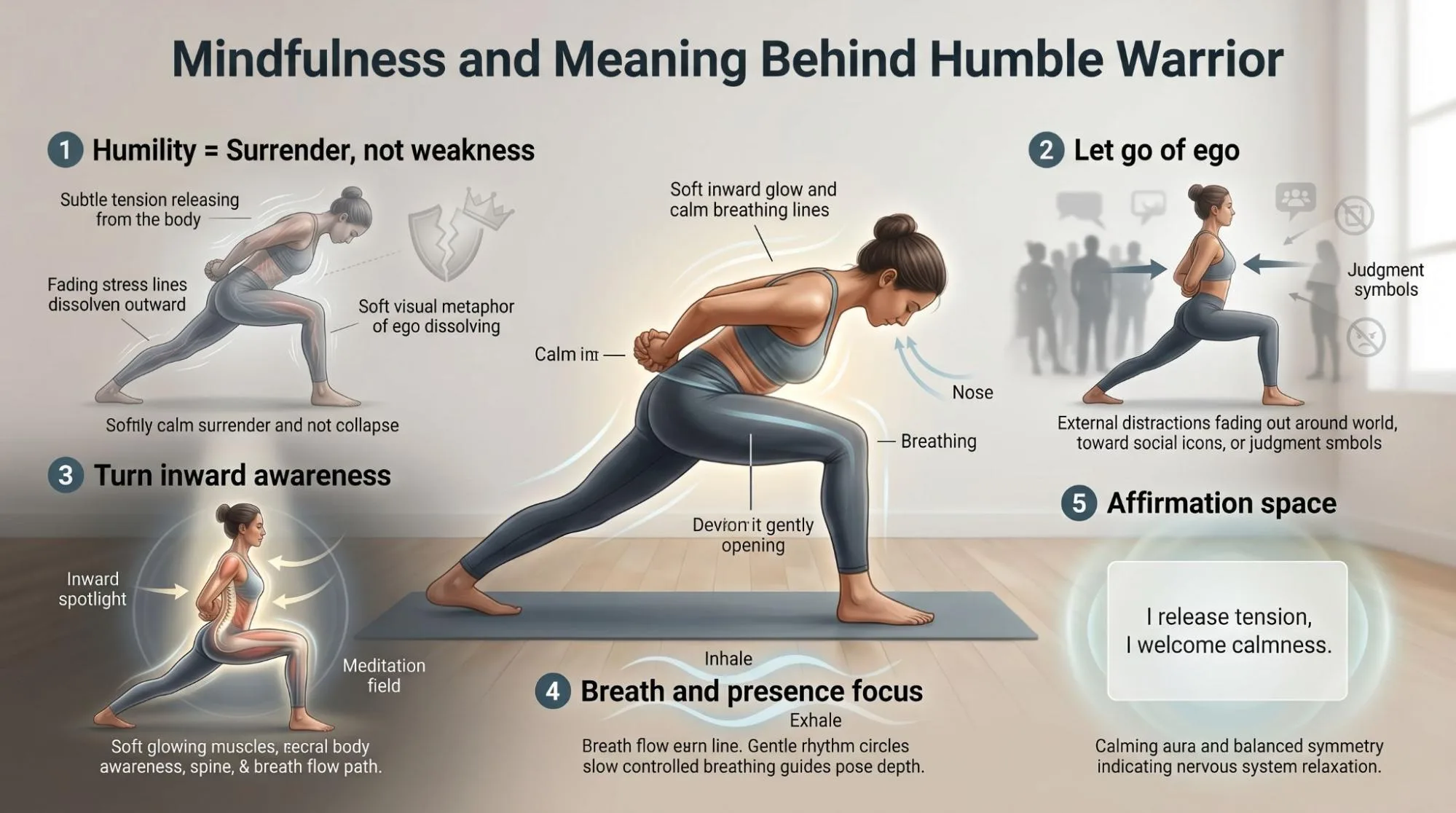
Mindfulness and Meaning Behind Humble Warrior
Humble Warrior is not merely a physical position but it has a powerful emotional and psychological overture. The name of the pose in itself is humble, which shows the internal attitude that is promoted in the pose.
The word “humble” represents surrender and self-awareness
Humble in this case does not equate to weakness. Rather it is conscious surrender, letting go of tension, ego and external pressure. When you fold forward, the body is inverted symbolically and this gets you to reflect on yourself and how you are at this point. It is a time when physical work collides with mindlessness.
👉 Key idea:
- Giving up means not giving up strength.
- It is the release of unneeded resistance of body and mind.
- Awareness replaces force
This pose encourages you to: Let go of ego
The forward-fold automatically limits visibility and projection to the outside which assists in shifting attention off-the-look or off-the-performance. This is a manner of making the ego soft in yoga philosophy.
👉 What this means in practice:
- Quit worrying about the appearance of the pose.
- Get rid of the desire to act the pose.
- Allow the body to be guided by breath instead of judgment
Turn inward
Humble Warrior makes a physical form that attracts your eye on being inside and not outside. The natural constriction of the folded posture restricts the extraneous stimuli, promoting reflection.
👉 How this manifests:
- The focus is on the environment and turned to internal feelings.
- You are more conscious of muscle activity and rhythm of breathing.
- The mind is brought to a state of quietness and concentration.
Focus on breath and presence
The pose is anchored by breathing. Due to the compression of the chest, which is partly compressed, consciousness of breath becomes even more significant.
👉 Practice focus:
- Breath slowly and steadily, inhalations and exhalations.
- Breath should be used to control depth, not to force.
- Be there in every step of the hold and not in a hurry.
Affirmation
I get rid of tension, I welcome calmness.
This statement enhances the psychological will of the pose. It assists in synchronizing the nervous system with the relaxation state and promotes a change of the stress reaction to a state of peaceful awareness.
👉 How to use it:
- Hold: Repeat silently.
- Be able to synchronize it with your breath.
- As a mental reference point when the pose is intense.
In short, Humble Warrior is a ritual of physical submission with mental acuity- whereby power is not manifested in a physical manner, but in a composed and un-harassed state of consciousness.
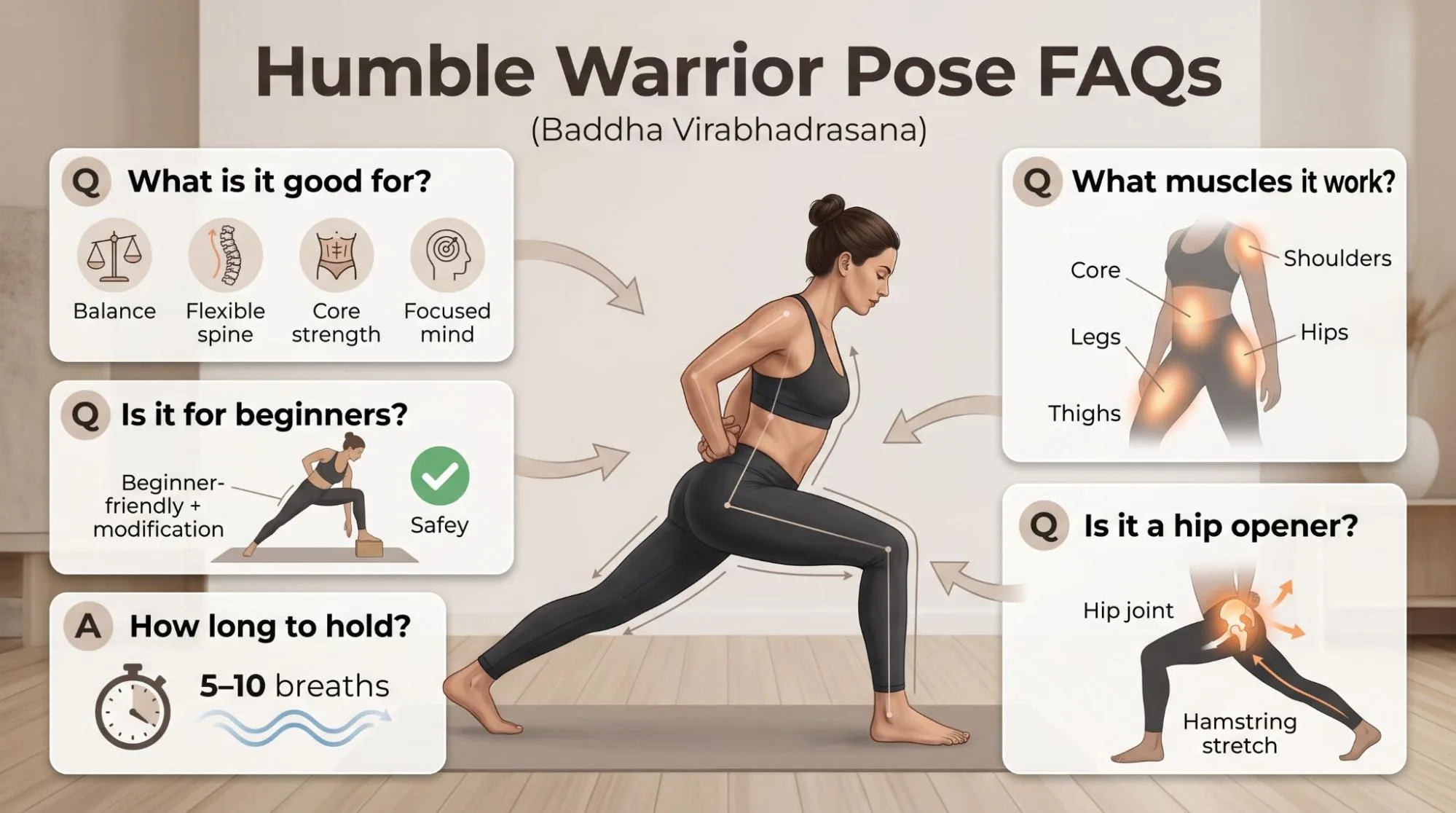
FAQs
What is humble warrior pose good for?
It enhances balance, flexibility, core strength, and mental focus.
Is humble warrior pose for beginners?
Yes, it can be safely practiced by beginners with some easy changes.
How long should you hold humble warrior pose?
Breath 5-10 breaths on either side.
What muscles does humble warrior work?
It works on the core, legs, shoulders and hips.
Is humble warrior a hip opener?
Yes, it is a hip opening yoga pose but also stretches the hamstring.
Learn More : Extended Side Angle Pose Benefits
Final Thoughts
The Humble Warrior Pose is not merely a mere physical pose; it is an entire body-mind practice that involves strength, flexibility, balancing, and mindfulness in a single-position movement. Physically it assists in opening the shoulders and chest, enhancing the flexibility of hips and hamstrings and developing stability due to high involvement of legs. Psychologically, it will have you take your time, concentrate on your breathing, and redirect your consciousness inwards, outside of distractions. This pose serves as a strength and calming influence on the mind as well as the body with practice and alignment, you will learn to stay on track, get out of tension and be able to move in control and awareness.