The single-leg Romanian deadlift exercise is one of the best exercises to develop strength, balance, and body control, as it involves the lower body (most of the body). It works one leg at a time, thereby helping you to work on weak areas, strengthen the hamstrings, buttocks, and to increase stability using the hips and the belly.
This one is also referred to as the single-leg RDL. It seems simple, but it should be taken care of and organized accordingly. You are on one leg, you are hinged at the hips, you bring your upper body forward and the other leg backwards behind you. Not to touch the floor only. The concept is to move with control with your spine in a straight position and your hips fixed.
The single leg Romanian deadlift is useful to most, both novices and athletes. It may help to improve posture, make the legs stronger, enhance balance, and improve movement during everyday activities. It can also be applied by those who want to have a stronger posterior chain that includes the glutes, hamstrings, lower back and core.
What Is the Single-Leg Romanian Deadlift?
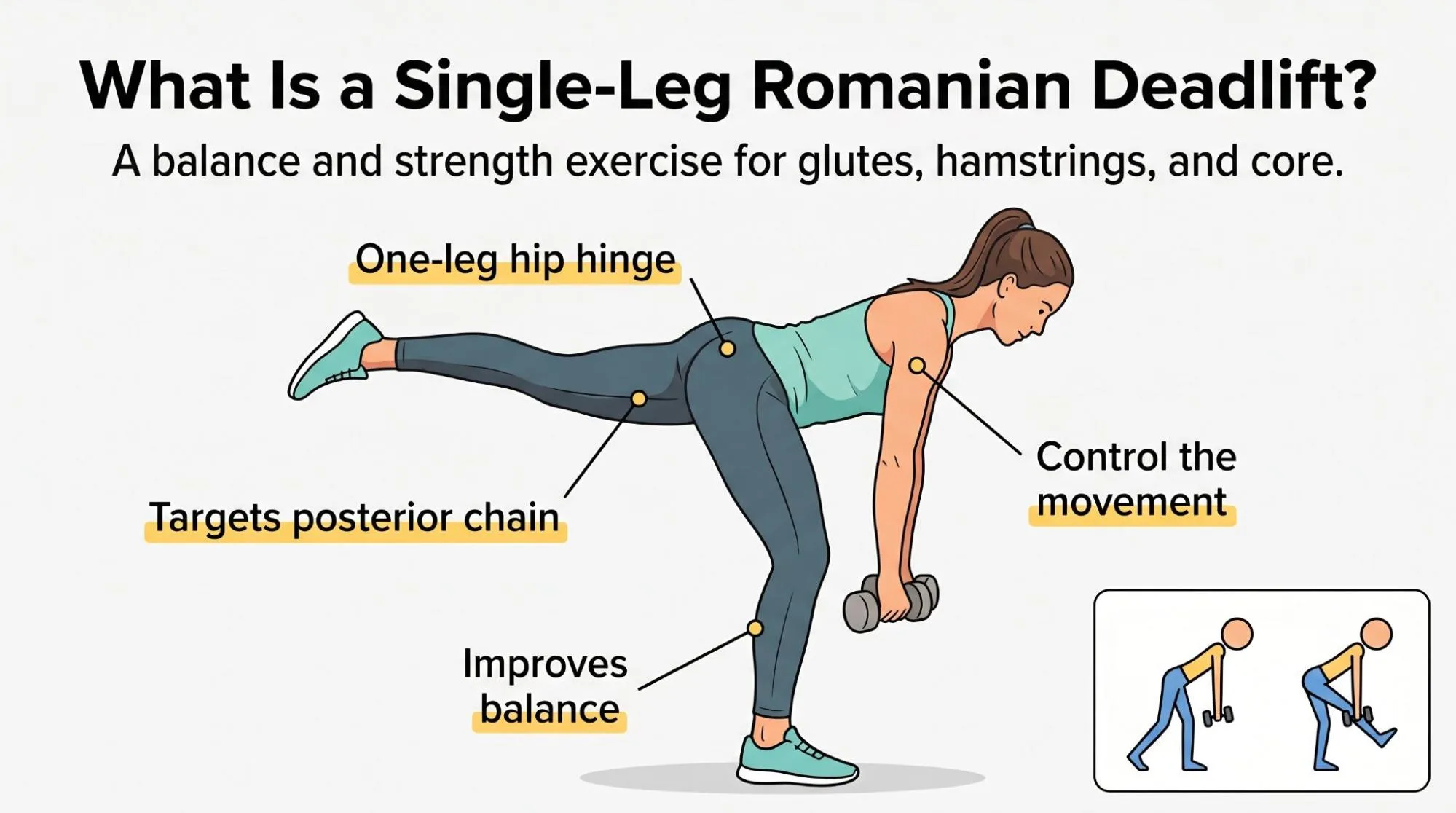
Romanian deadlift (单足 Romanian deadlift) is a one-legged, hip-hinge exercise. A hip hinge describes bending, primarily around the hips, and not around the lower back. The leg that is standing is doing most of the work with the other leg. It is also extending behind you to hold yourself after the standing leg has been doing most of the work.
Compared to a squat, in which your knees bend around more, the one-legged RDL is more focused on the hips. You swing the hips back, make the chest continue to go forward and experience a stretch in the hamstring of the working leg. This makes it an excellent exercise to the back of the legs and glutes.
This motion is mostly employed in power training, sports training, physical training and local workouts. You may dress it out with body weight or dumbbells or kettlebells or even a barbell when you are in good form.
Why the Single-Leg Romanian Deadlift Is So Useful
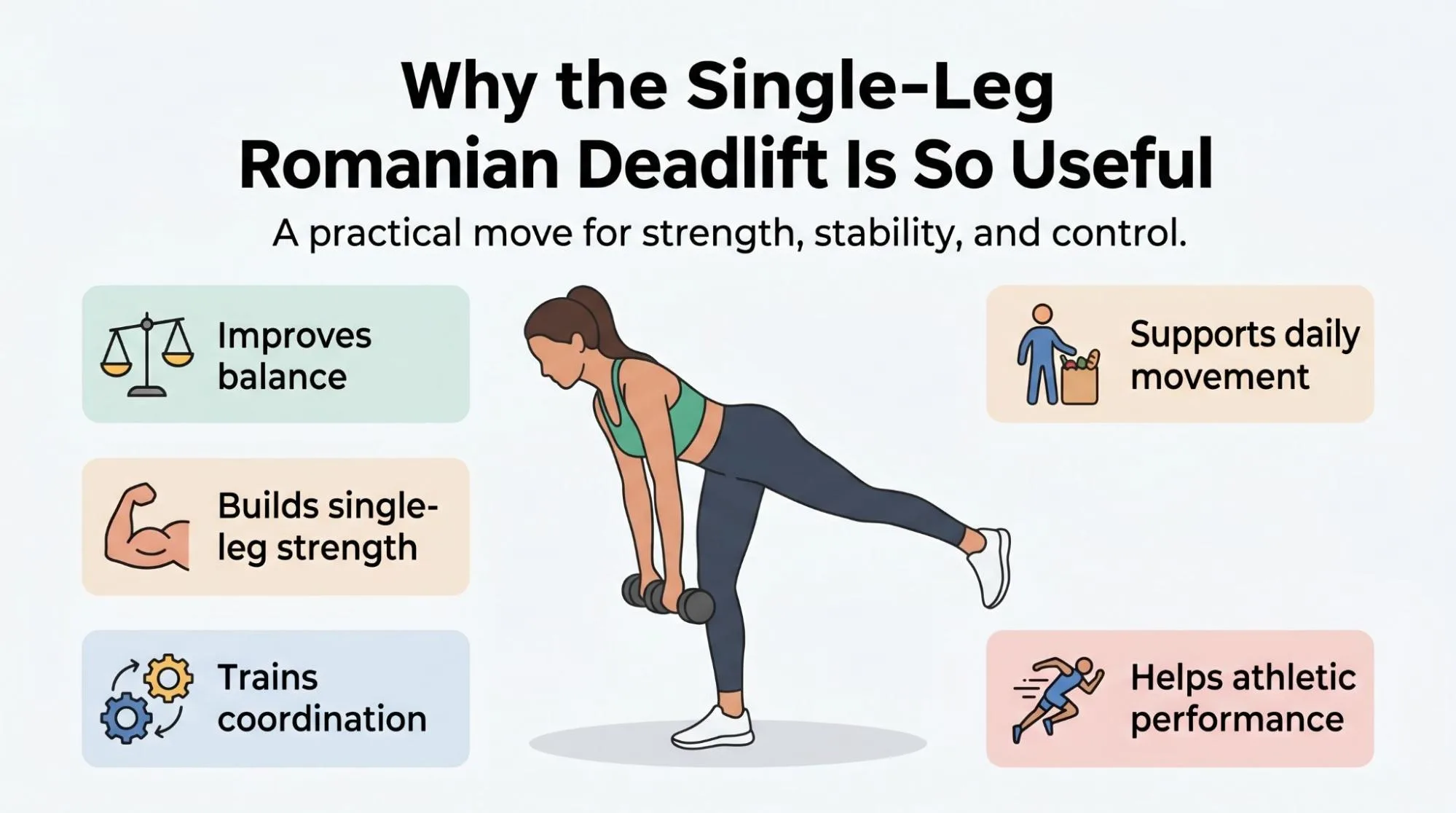
Single-leg RDL is practical as it helps to develop the strength and balance simultaneously. A lot of exercises involve the lower body, and about half the effort is performed on both legs collectively, whereas this motion, done in the right side or the left side separately, challenges the right side and left side respectively. That will allow you to remember whether one of your legs is weaker or less stable than the other.
You also learn how to keep your body in control when you move on one leg, because this exercise also teaches your body how to do this. It is significant in walking, running, jumping, climbing steps, and alternative direction in sporting activities.
The single-leg Romanian deadlift can also be used to enhance coordination since it is performed in single legs. Foot, ankle, knee, hip, core and back are to be together. This renders it more than a leg exercise. It is a complete body hold movement.
Single-Leg Romanian Deadlift Muscles Worked
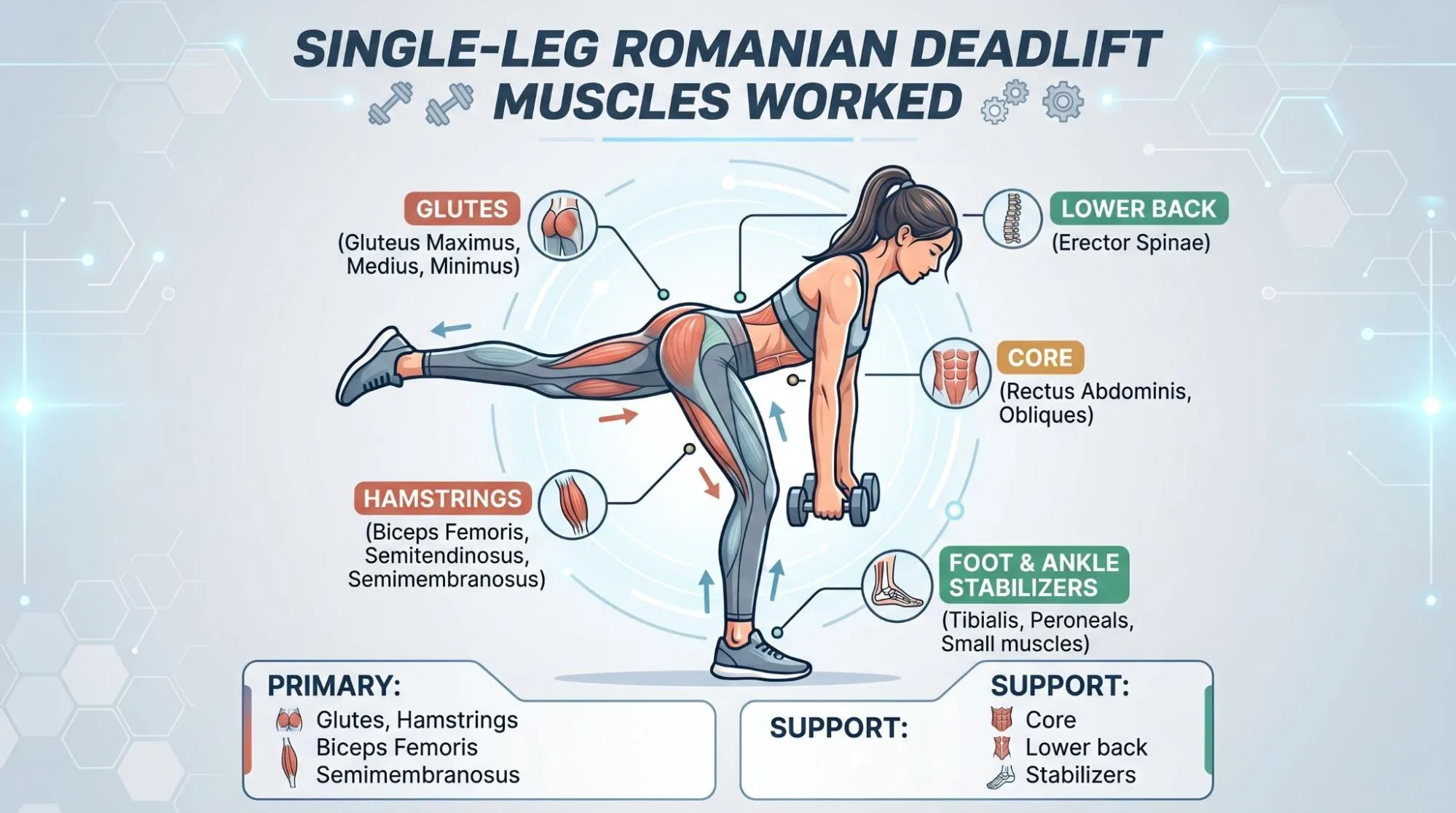
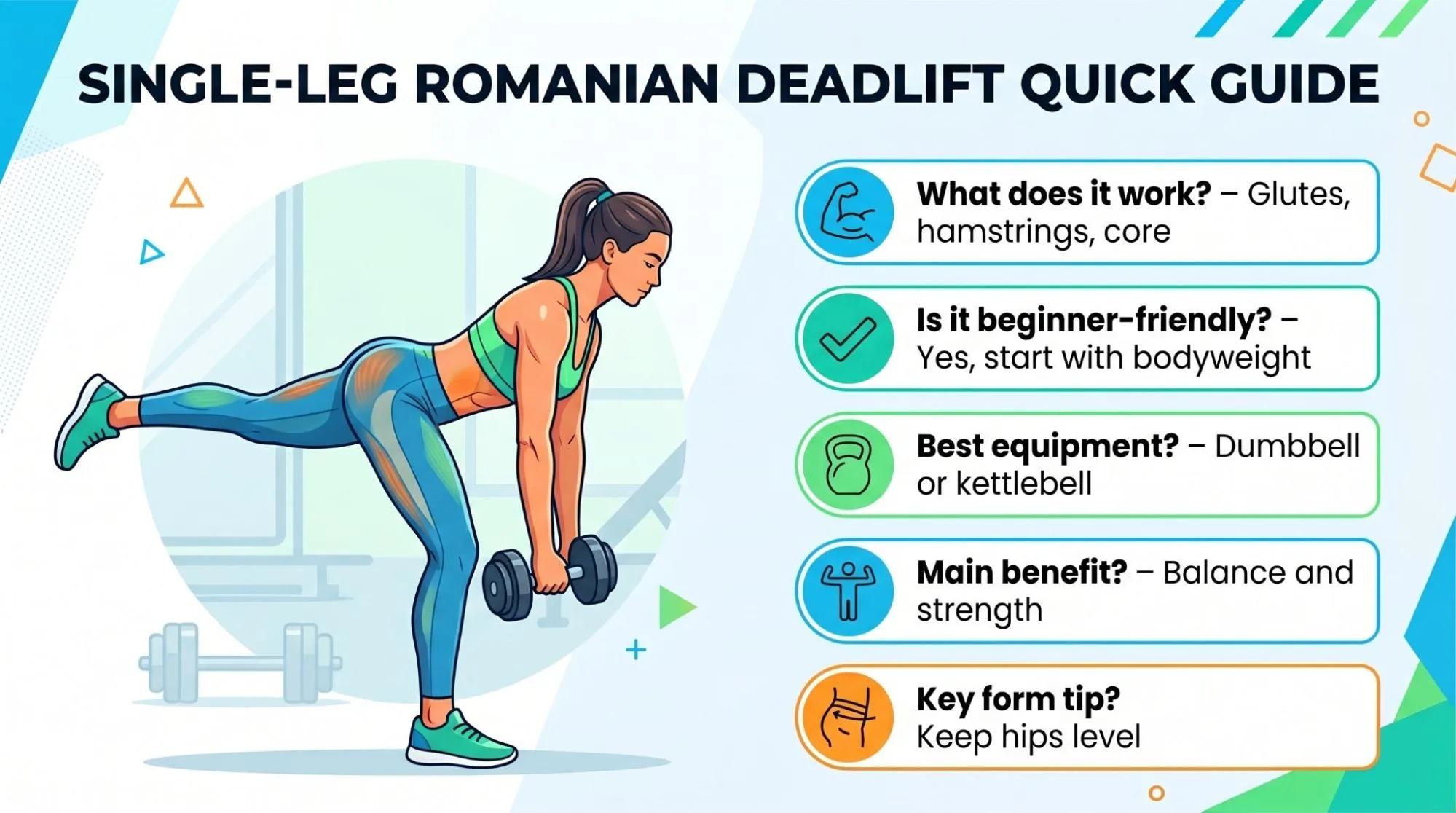
The muscles involved in the single-leg Romanian deadlift include the hamstring, glutes, core, lower back, hips and stabilising muscles around ankle and foot. It is a combination of these muscles which helps to maintain your balance and move your body in a safe manner.
Hamstrings
Hamstrings refer to muscles in the back of your thigh. They pull very hard when the lowering stage of the single-leg Romanian deadlift is involved. When you hinge forward your hamstrings are stretched in a controlled manner. When you get back on your feet they assist in getting your body back up. This is among the reasons as to why the exercise is so effective in building a strong and flexible hamstring. Powerful hamstrings aid in running, jumping, lifting, and stability of the knee. They further assist in safeguarding the lower body when making rapid movements.
Glutes
The muscles of your hips and backside are called the glutes. The single-leg deadlift of the glutes and hamstrings is a favourite exercise since it involves a great deal of targeting of the two areas. Your glutes assist in the lengthening of the hip, as you move back to the starting position. On the top of the movement, you are supposed to squeeze your glutes without excessive bending of your back. This aids in developing increased hip power and enhances control about the pelvis. Good glutes will also help in a better posture and power of the lower body.
Core Muscles
The central part of your body ensures that it is held steady by your immune system. As you stand on one leg, your core must prevent twisting, leaning, or falling of your body on one side. These are your abs, oblique and deep stabilising muscles. Through a strong core, you get to maintain a straight back and straight hips. The movement may be hectic without central control. You can turn your hips or go round the back or lose balance.
Lower Back and Spinal Stabilizers
The lower back is not the primary mover, only serves the purpose of stabilizing the spine. When performing a single leg Romanian deadlift, the back of the body should remain neutral and long. It must not turn or curve in deep. The posture is supported by your spinal stabilizers as your torso moves forwards. This is the reason why form is important. The workout must be painless in the lower back rather than being controlled in the hips and hamstrings.
Ankles, Feet, and Small Stabilising Muscles
During this exercise, your standing foot is exercising. The muscles encircling your ankle and foot are responsible for keeping you balanced. This renders the one-legged RDL helpful in enhancing upside-down stability. You can experience that your foot is holding the floor a bit. That is normal. In the long-run, this may enhance balance, body awareness, and control during unilateral movements.
Single-Leg Romanian Deadlift Benefits
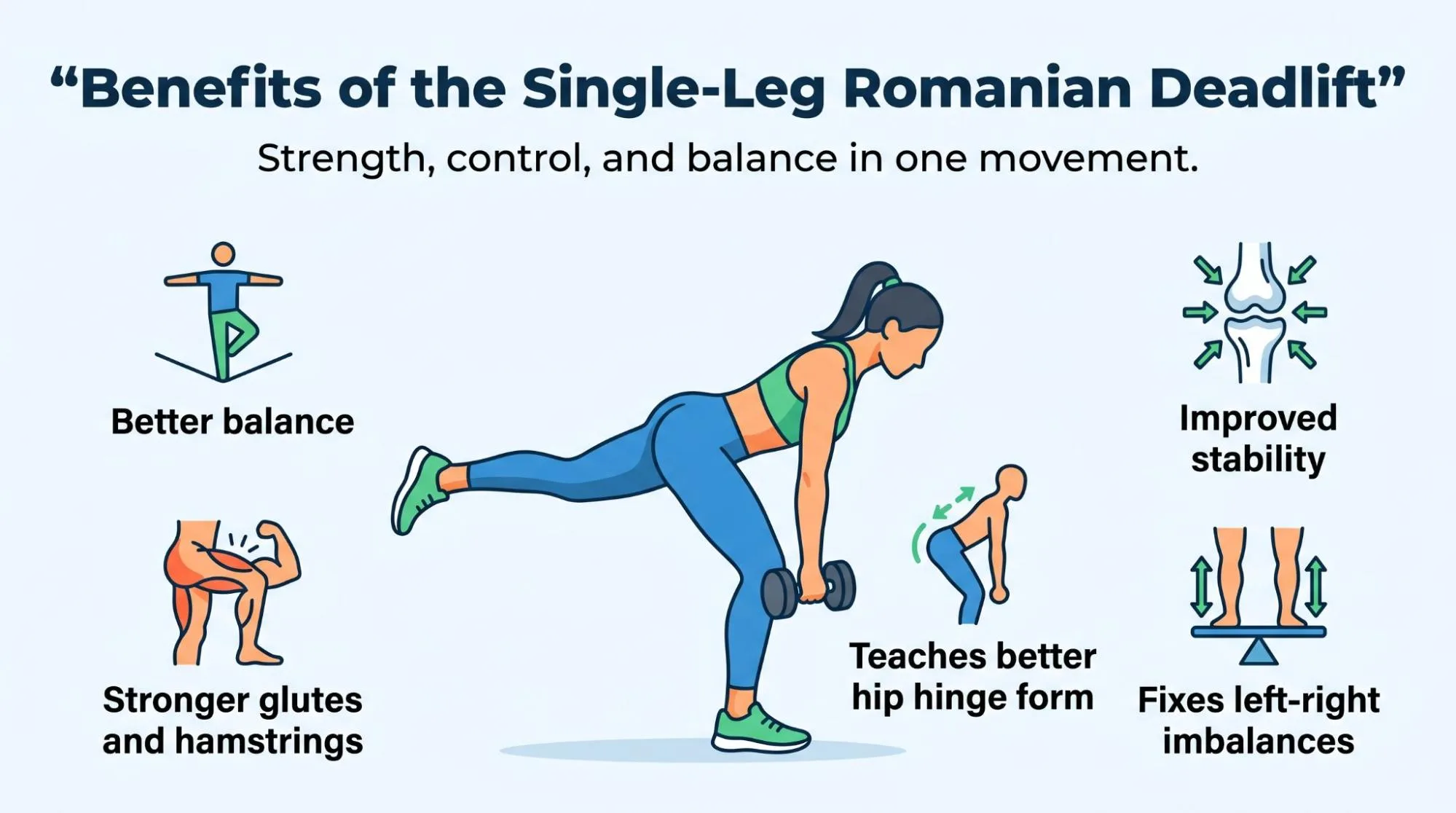
The single-leg Romanian deadlift benefits go beyond building muscle. It enhances a sense of balance, the back side of the body, improves better movement, and helps correct the difference in strength between the left and the right side.
Builds Strong Glutes and Hamstrings
The exercise is an outstanding one to use in training the glutes and hamstrings. Hip strengths, running speed, jumping power and daily movement are some of the important functions of these muscles. Properly trained, they will also aid in supporting the knees and lower back. Since this movement occurs on one leg, the working side must be in charge of additional control. This may make the workout feel fairly tough with the light weight.
Improves Balance and Stability
One of the greater components of the single-leg Romanian deadlift is balance. You are in charge of your body and your centre of gravity shifts. This conditions your nervous system and muscles to co-operate. Improved balance may be used in everyday life and in sports. It can also render other exercises more stable, e.g., lunges, step-up, and squats.
Helps Fix Muscle Imbalances
There are also a lot of individuals, one of which feels stronger or more stable as compared to the other leg. The standard Romanian deadlift involves both legs; thus, the stronger leg can perform more work. The one-leg version is where each side trains separately. This is to assist you in discovering and working on areas of weakness. In the long run, it can be used to achieve improved balance between your left and right legs.
Teaches Better Hip-Hinge Form
The hip hinge is an important learning concept in that there are many exercises that need to be mentioned, including deadlifts, kettlebell swings, good mornings, and hip thrusts. The one leg RDL will teach you how to move with your hips but have the spine remain in position. This should enhance your entire lifting exercise. It also encourages you to learn how to load the hamstrings as well as the glutes rather than bending at the lower back.
Supports Athletic Movement
A lot of sports need the power of single legs. Running, kicking, jumping and changing direction all use the same leg performing a good deal of work at once. The single-leg Romanian deadlift develops strength in such a way that I find it helpful to these movements. It also conditions balance and control which are valuable towards safe and powerful athletic performance.
How to Do Single-Leg Romanian Deadlift Correctly
To introduce heavy weight it is important to learn to do single-leg Romanian deadlift properly before doing it with heavy weight. Start with the weight of your body or a light dumbbell. Concentrate on control, balance, and experiencing movement in the ham strings and glutes.
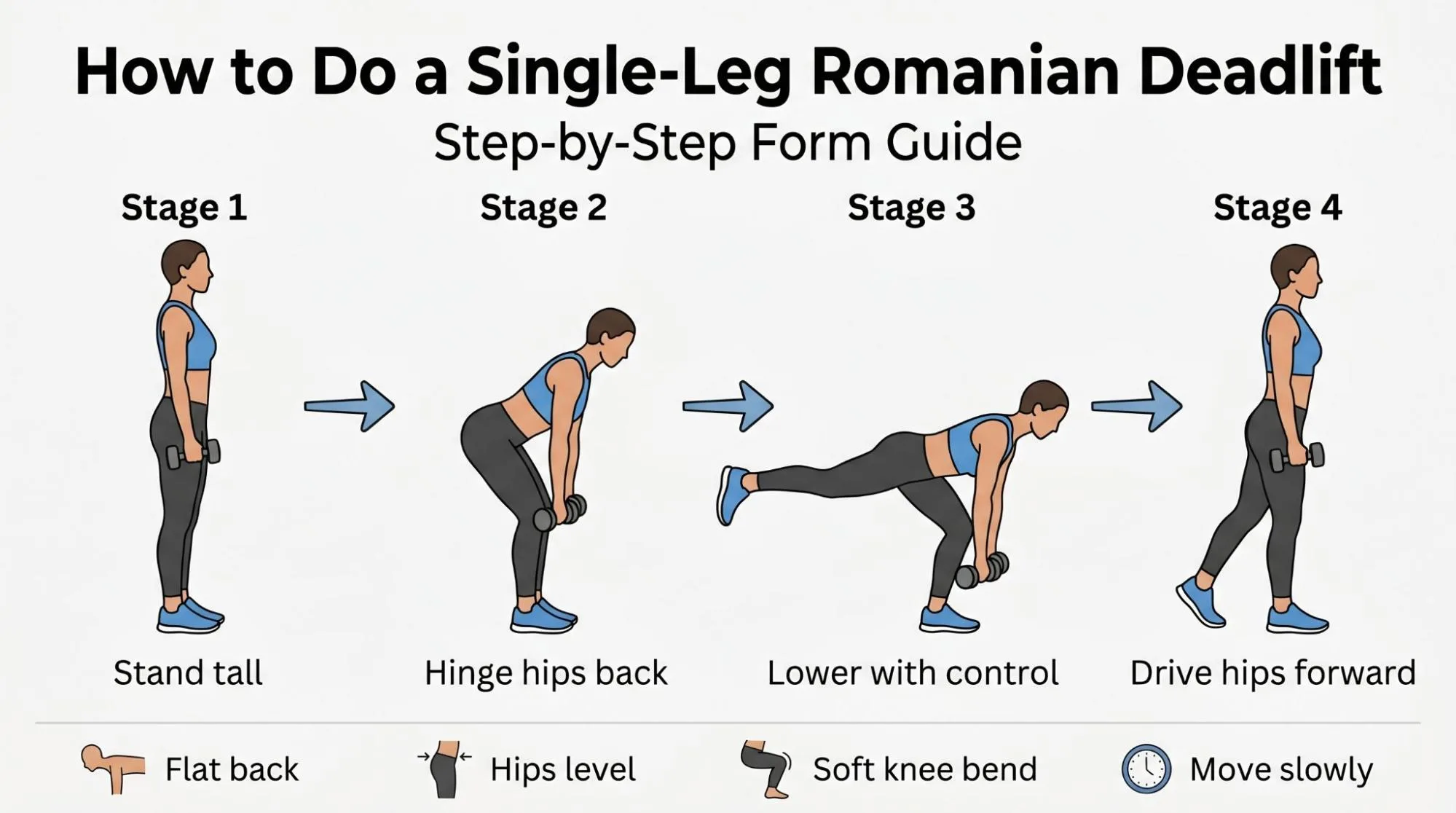
Step 1: Stand Tall and Set Your Position
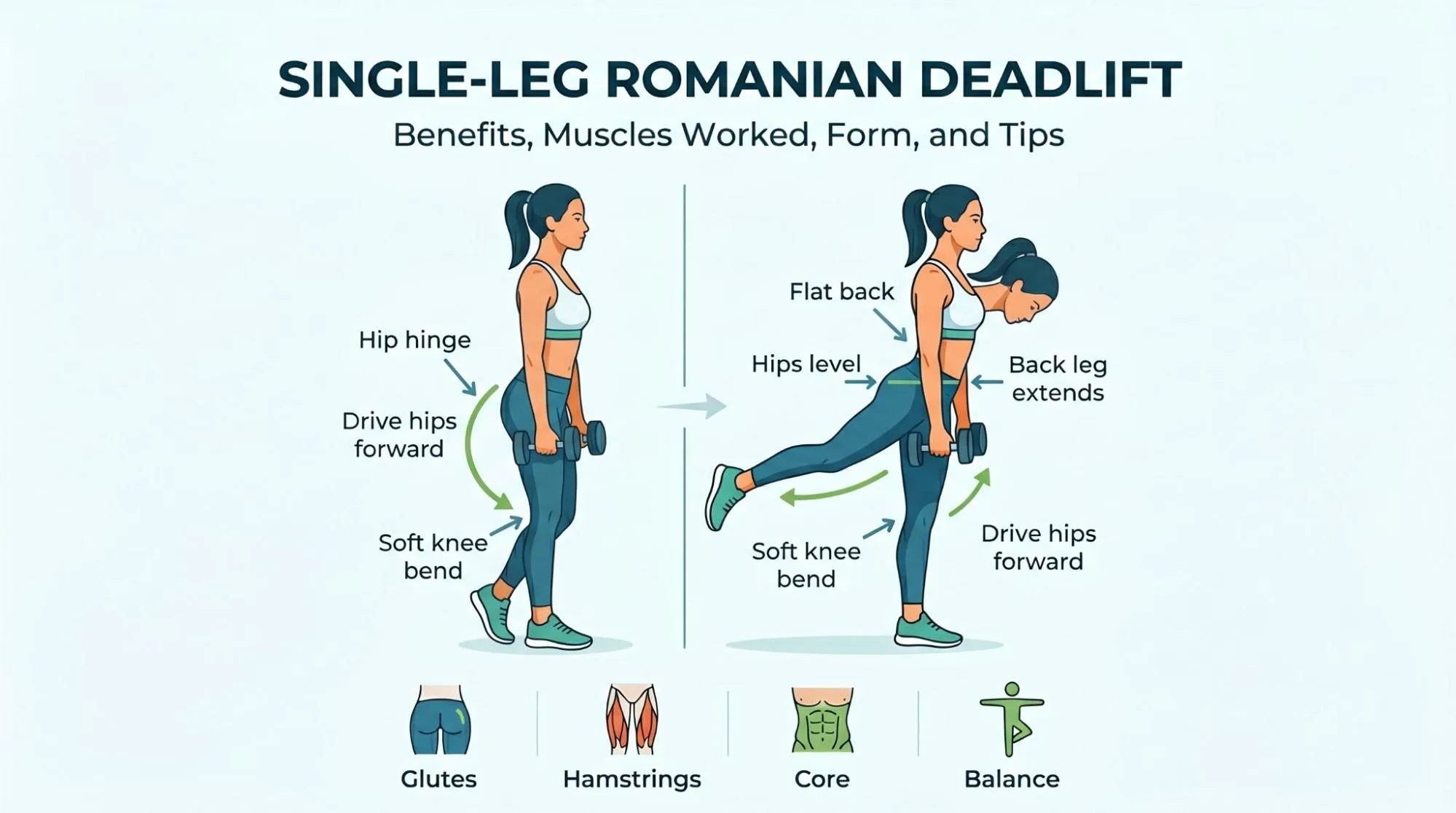
Stand on the feet such that the distance will be about the hip distance. Change the load of weight to one leg. Have a safe flex on your standing knee. Do not bend the knee completely, as that may cause the movement to be uncomfortable and difficult to control. Make your chest wide, shoulders loose and core tightening softly. Find a focal point on the floor a couple of feet in front of you. This can serve to aid balance.
Step 2: Hinge From the Hips
Initiate the movement by moving your hips backwards. This is where your chest will be pushed forward but your free leg will be pushed backward. Imagine your body as a long line, head to heel, stretched up. And not bend down. This motion is supposed to be around the hips. You should keep your back straight and leave the standing knee a little bit bent.
Step 3: Lower With Control
Bend forward and down until you experience a hamstring stretch in the standing leg. There is no necessity to touch the floor. The extent of mobility you experience is a result of your flexibility, balance, and strength. Stop lowering as soon as your hips will begin to twist or your back will start rounding or you will lose control. Good shape is more significant than going down.
Step 4: Keep Your Hips Level
Among the typical issues is the opening of the hip of the raised leg on the side. Attempt to maintain the both hips such that they are facing the ground. This assists the movement to remain uncontaminated and ensure that the tension is applied on the correct muscles. Think that the bones in your hips are headlights turned downwards. They should not turn out to the side during the movement.
Step 5: Return to Standing
Your standing foot is to be pushed and your hips are to be pushed forward to bring you back on your feet. To do this, squeeze the glutes at the top part of the abdomen, yet, do not lean backwards. Stand straight and change position prior to the next repetition. Go slow and maintain balance. The control of each rep should be controlled throughout.
Single-Leg RDL Form Tips for Better Results
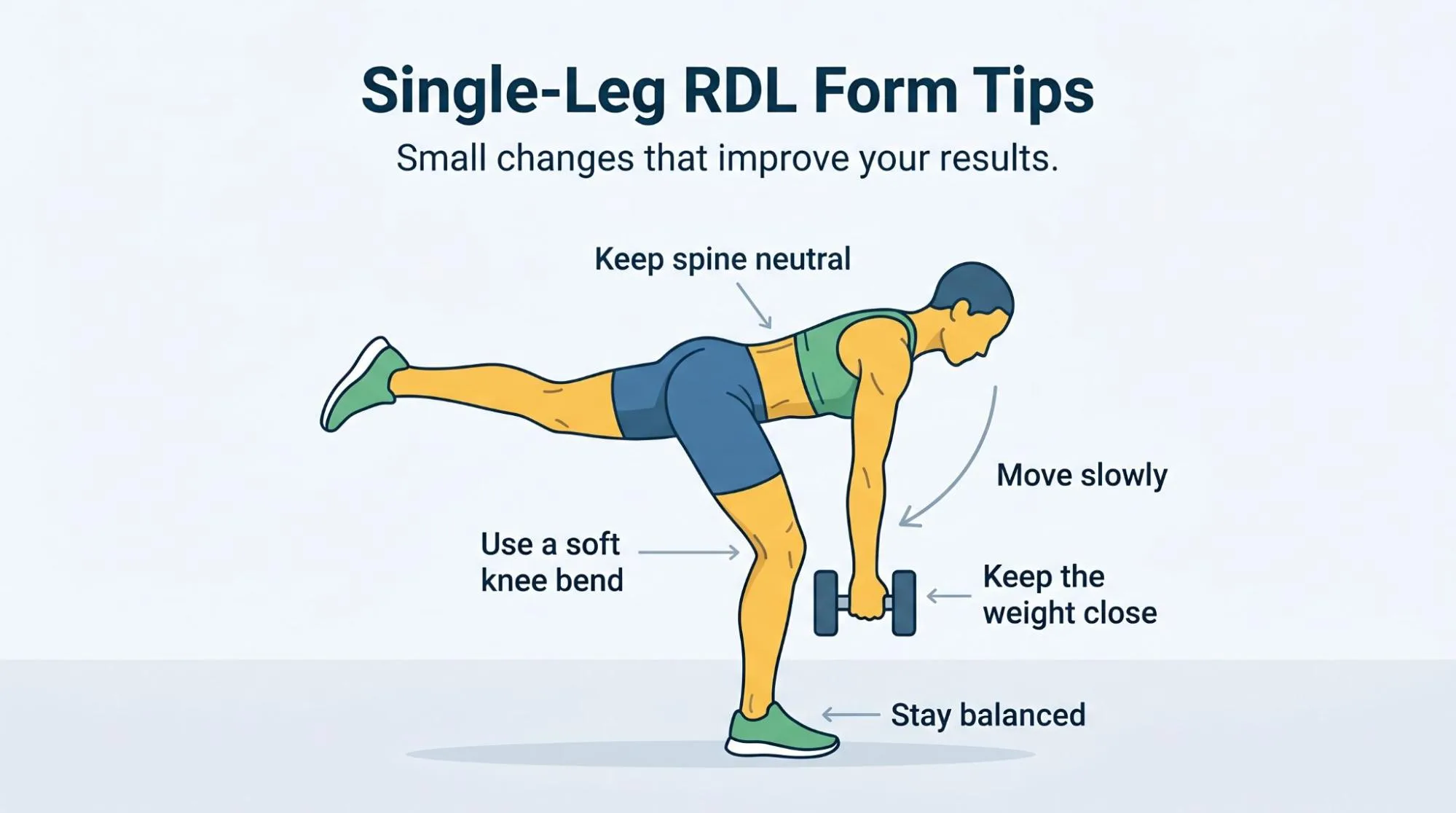
An effective single-leg RDL form will help you to make the most of the exercise and minimise the risk of discomfort. The concept is to work the hips, glutes, hamstrings, and core, with graceful control.
Keep Your Spine Neutral
Keep your back long and straight. Do not round off your upper back or lower back. A rounded back has the capacity to distribute tension off the glutes and ham strings and can cause the exercise to feel uncomfortable. Consider the idea of keeping your chest proud, ribs, and neck relaxed. Your head must be in line with your spine and not look too far up in the air.
Use a Soft Knee Bend
Your standing knee is to be slightly stooped. Excessive bend will make the motion more of a squat. Excessively sharp bend may cause a hamstring to feel overworked and it loses control. The soft knee bend will assist you in bending better and will maintain the fluid movement.
Move Slowly
The Romanian deadlift variant called a one-leg exercise is not a speedy exercise to accomplish. Going excessively fast will cause you to fall out of balance, and decrease muscle tension. Slow repetitions will assist you in feeling the proper muscles operating. Reduce two to three seconds, wait a moment, and perhaps come out of control. This enables the exercise to be safer and more effective.
Keep the Weight Close
When you do it with a dumbbell or kettlebell, make sure that the weight is near your standing leg. Keep it so that it does not swing so far out of you. An intimate weight path assists to defend your back and enables the movement to be stronger. The displacement of the weight must occur as intuitively as freedom of movement of hips.
Dumbbell Single-Leg Romanian Deadlift
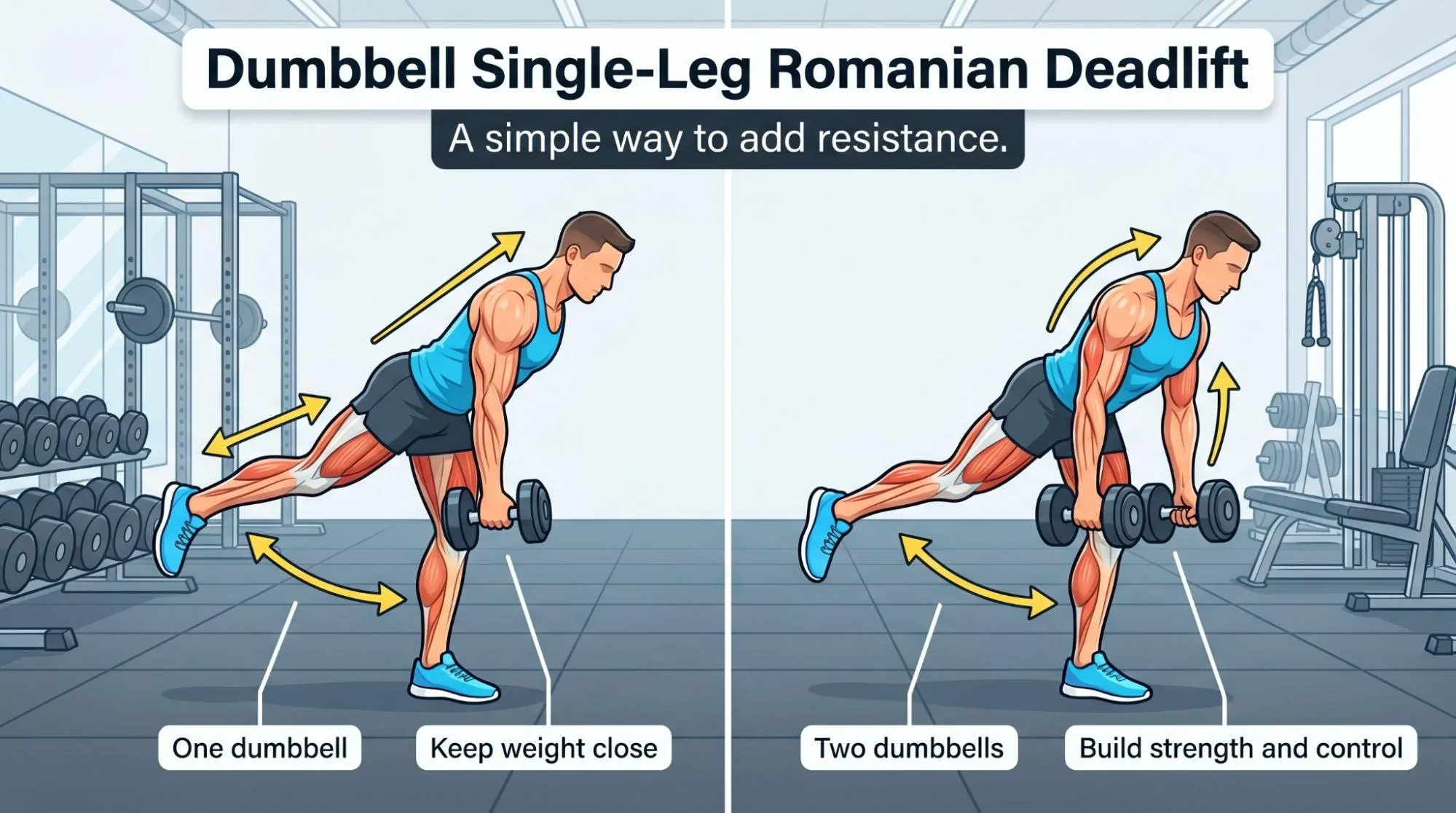
One of the most common types is the dumbbell single-leg Romanian deadlift. You can either hold one dumbbell in one hand or two dumbbells in both hands. Beginners will usually begin by using a single dumbbell due to their less easy handling.
One-Dumbbell Version
Grasp the dumbbell in the hand lying opposite on the leg in which you are standing. To take an example, when you stand on your right leg, but in your left hand, you have in your left hand the dumbbell. This may assist in defying your very being and prevent your body from spinning. Move slowly and ensure that the dumbbell remains near your leg. This version is excellent with regard to balance, glute strength, and hamstring control.
Two-Dumbbell Version
Grasps one dumbbell in the hands. This will make the exercise more balanced and could enable you to add more weight. When you can balance and you are more at ease, it comes in handy. Hold the two weights near your leg. Keep your shoulders round back as you bend down.
Kettlebell Single-Leg Romanian Deadlift
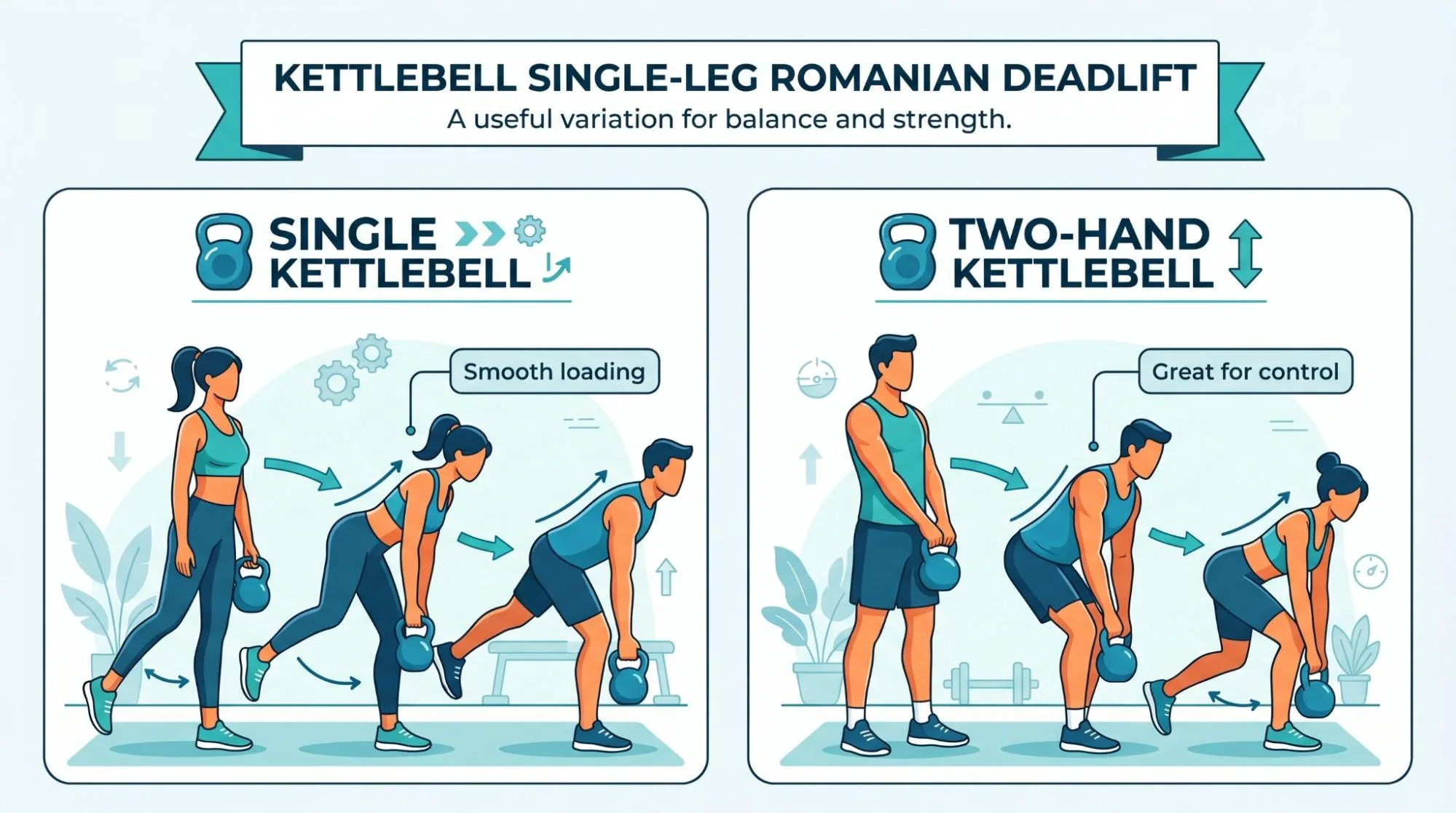
Another variant that proves to be helpful is the kettlebell single-leg Romanian deadlift. Kettlebell is simple to hold, it can be used one in one hand and both hands. A number of individuals prefer it over the fact that the weight is naturally held beneath the hand.
Single Kettlebell Version
In the same opposite hand to your standing leg hold one kettlebell. Get into a position of forward on your knees and hold the kettlebell in a straight and straight line, directly ahead of you. Hold your core tight and the hips even. It is a decent version to learn how to control it as the kettlebell provides clear feedback on this matter. When its action on both ends is too great, you might be going too fast.
Two-Hand Kettlebell Version
In front of your body, use both hands to hold one kettlebell in-between your legs. This can be more comfortable to the beginners. It is an excellent alternative when you feel that you want to learn the movement then add a larger balance challenge. Hold on to the kettlebell and concentrate on pushing your hips away.
Single-Leg Romanian Deadlift Mistakes and How to Fix Them
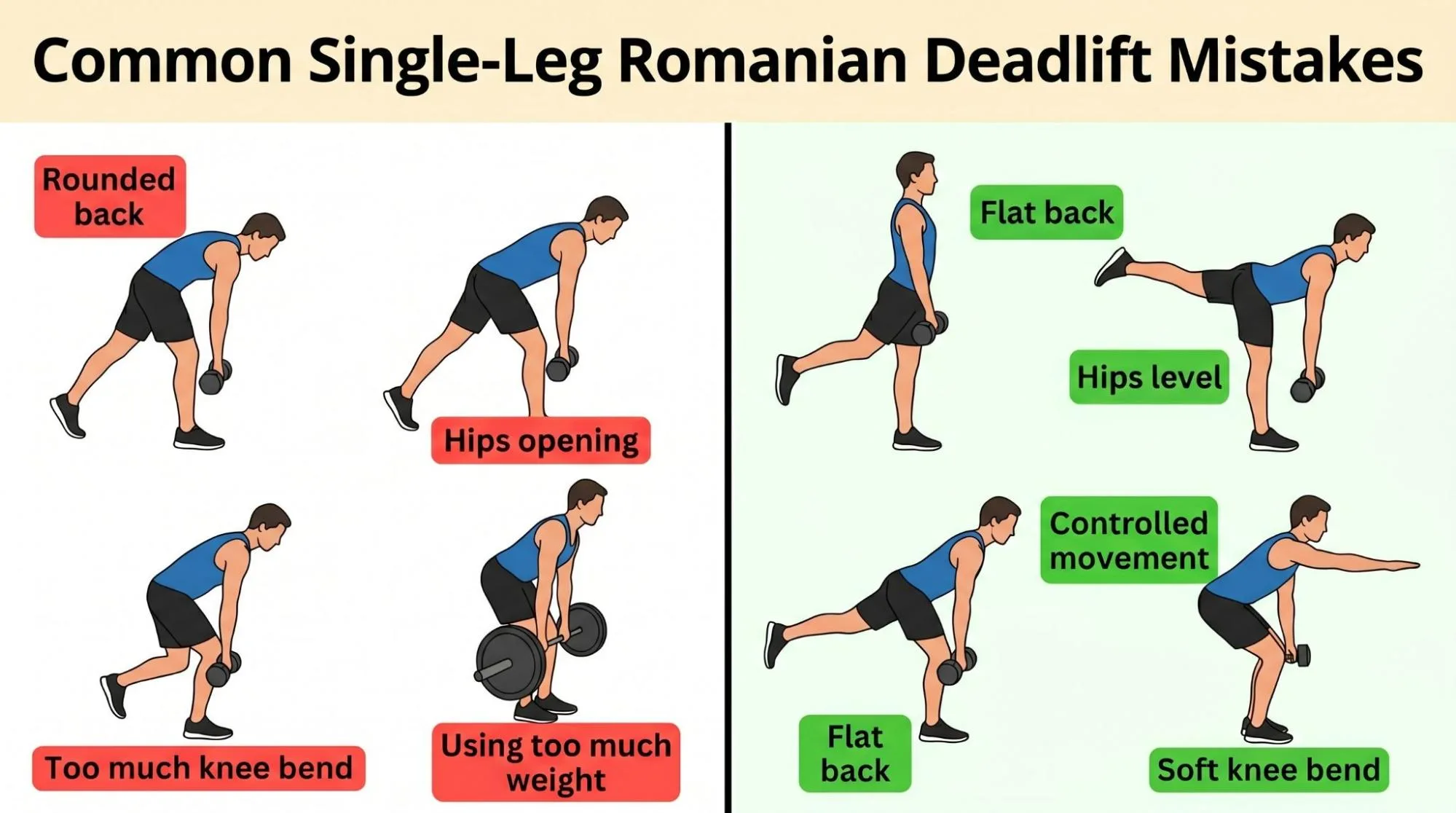
Lots of single-leg Romanian deadlift errors occur as individuals attempt to go too low or with too much weight too quickly. The most effective method of improvement is by slackening and concentrating on clean form.
Rounding the Back
One of the most widespread errors is that of rounding the back. It normally occurs when you pull yourself up on the floor rather than leaning with the hips flexed. This may minimise the impact on the hamstring and the glutes. To correct it, have your chest open and discontinue movement before your back rounds. Check with a mirror or video fragment of yourself to verify your shape.
Opening the Hips
Most humans have the tendency of letting the leg raise outwards. This increases the range of motion and makes the range appear less stable. It also minimises attention on the leg that is working. To correct this, maintain your hips on the ground. Should proceed more gradually, and should visualise his back foot as being directly downwards.
Bending the Knee Too Much
When your standing knee bends too far, you begin doing the movement more of an action of a single-leg squat. That would not be a mistake, however, it would shift the intent of the exercise. The only way to fix it is to have just a gentle bend in the knee and to draw the hips further back.
Using Too Much Weight
Too much weight can result in degeneration of your shape. You may twist, rush or lose balance. Single-leg RDL is not a simple issue of lifting heavy. Control is even worrying. Start light. Add weight only when you are able to do all the reps with ease.
Losing Balance on Every Rep
A little wobbling is to be expected, particularly in novices. However, when you find yourself out of position at each rep, then the exercise might be too difficult at your present stage. Attempt to hold on to a wall, bench, or rack with one hand. Another option is to use a kickstand version, in which the back toes remain lightly lifted off the floor.
Single-Leg Romanian Deadlift vs Romanian Deadlift
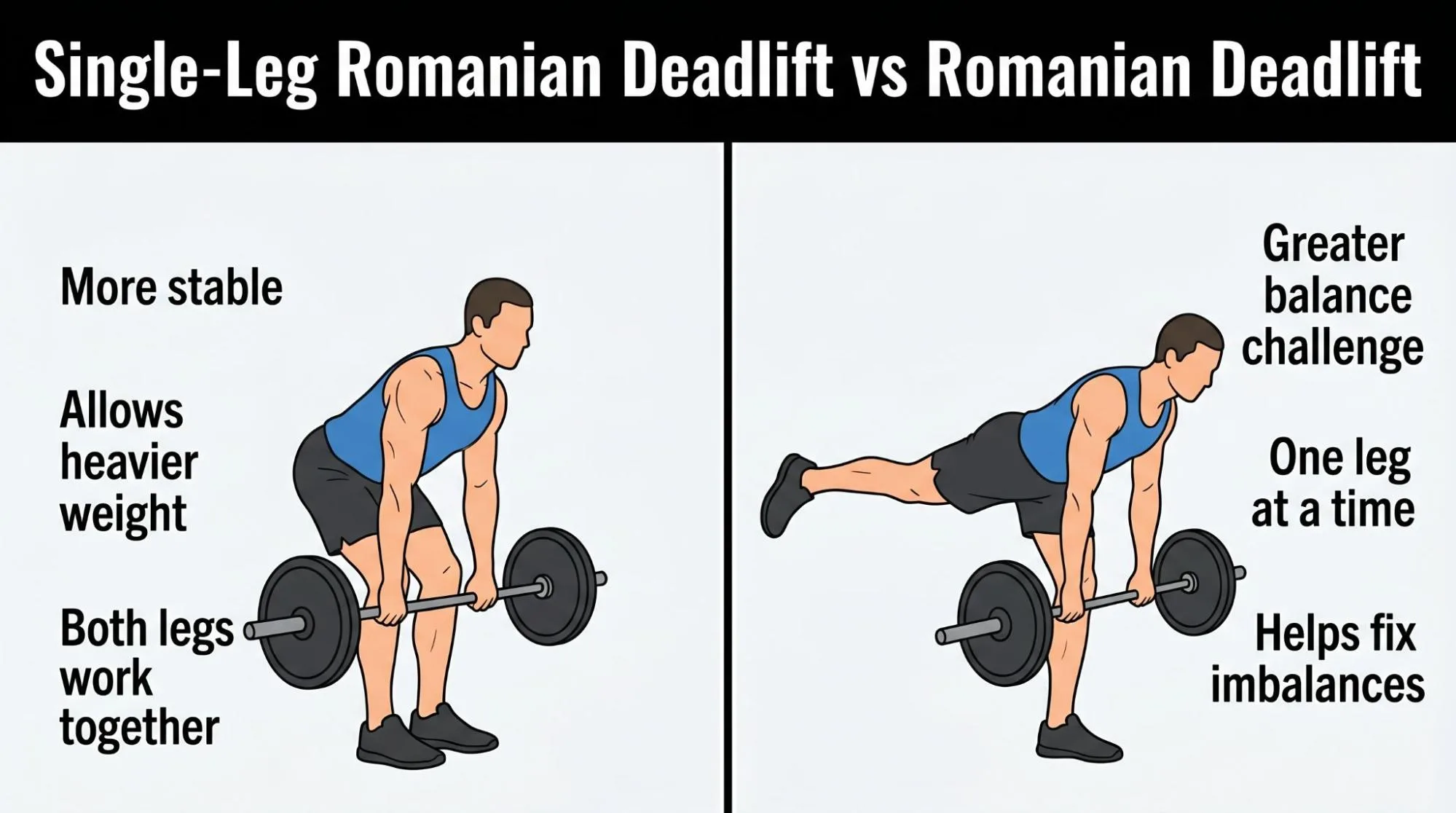
The Romanian deadlift vs single-leg Romanian deadlift comparison is useful as both exercises train the hip hinge, glutes, and hamstrings. The major distinction is that one leg is used by one, and both legs are used by the other.
Romanian Deadlift
The regular Romanian deadlift is done with both feet on the floor. It generally enables you to push heavier weights. It is superb in developing general back chain strength.
Since the two legs are used together, it might be more stable. This simplifies the acquisition of the simple hip-hinge pattern by beginners.
Single-Leg Romanian Deadlift
The single-leg version involves the use of a leg at a time. Balance and control is more difficult. You can work with less weight but the working leg will be put to a serious test.
This is a more appropriate version to enhance side-to-side stability, hip stability and single leg strength. It is also practical to athletes and individuals interested in a more practical lower-body control.
Best Variations for Beginners and Advanced Lifters
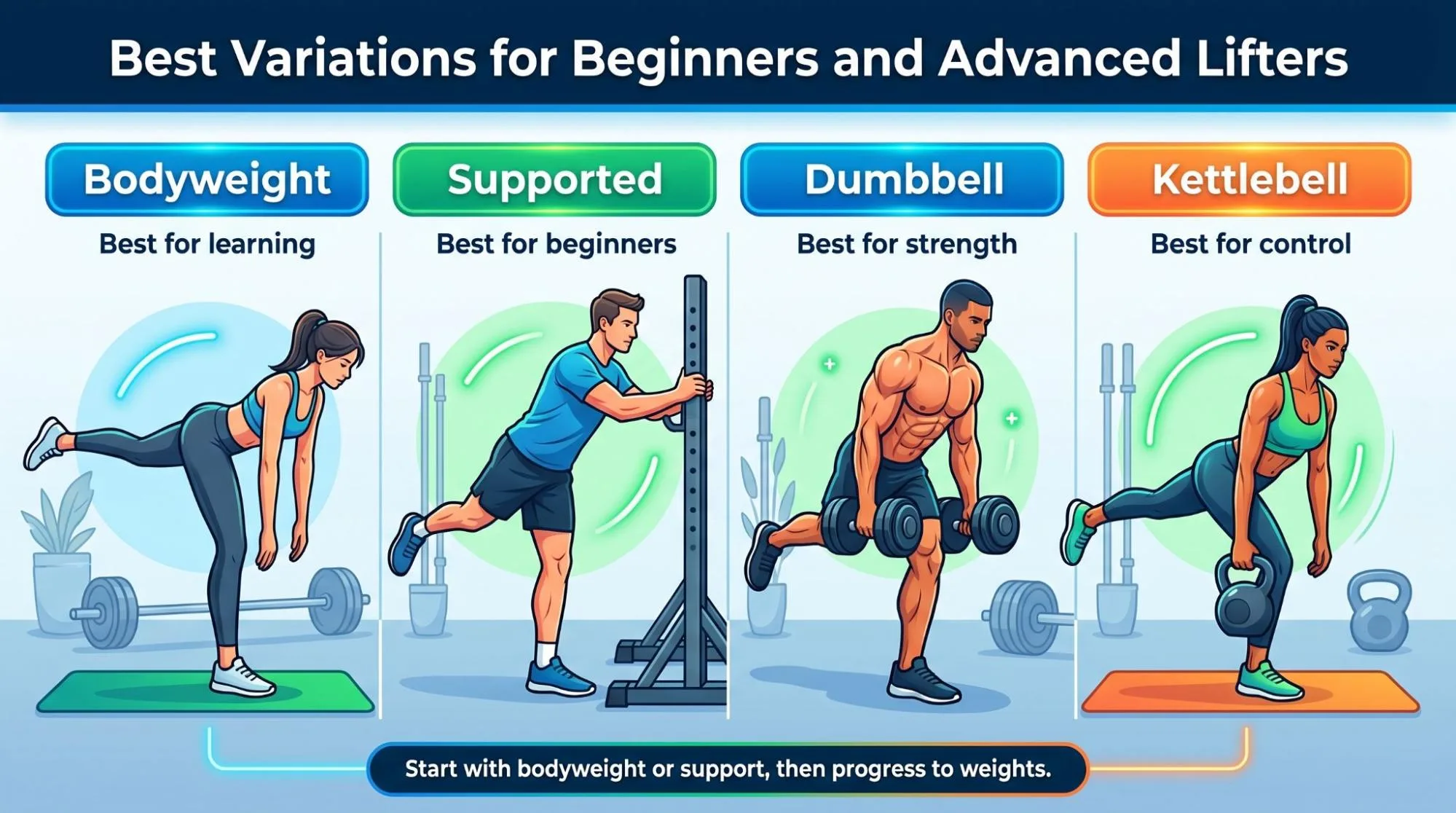
The single-leg Romanian deadlift can be performed in numerous ways. The most appropriate variation is based on your strength, balance and level of experience.
Bodyweight Single-Leg RDL
This would be the most appropriate place to begin. You do not work with weight and are concentrated only on the quality of movement. It helps you to know how to hinge, balance and maintain your hips level. Do very slow reps and make a pause before you lose your form. When you are stable, you can add some light weight.
Supported Single-Leg RDL
Use one hand to hold a wall, chair or rack. This provides you with balance support and at the same time the movement is being trained on by the same leg that you are standing on. It is an excellent choice among the beginners. This variation will enable you to pay more attention to the hamstrings and glutes without being too concerned about falling.
Kickstand Romanian Deadlift
Your back toes in this variation always remain slightly in the air behind you. The major part of your weight remains on the front leg. It is not as difficult as the full single-leg version but still does not train exactly half as much as the other half. It is a nice transition between the more common Romanian deadlifts and all out single-leg RDL.
Weighted Single-Leg RDL
Once your form is good, you may apply a dumbbell, kettlebell or barbell. Started light and then built up. This not only has more weight but still control. The weighted ones are also great to build strength in the glutes, hamstrings and the core.
Safety Tips Before You Add This Exercise to Your Workout
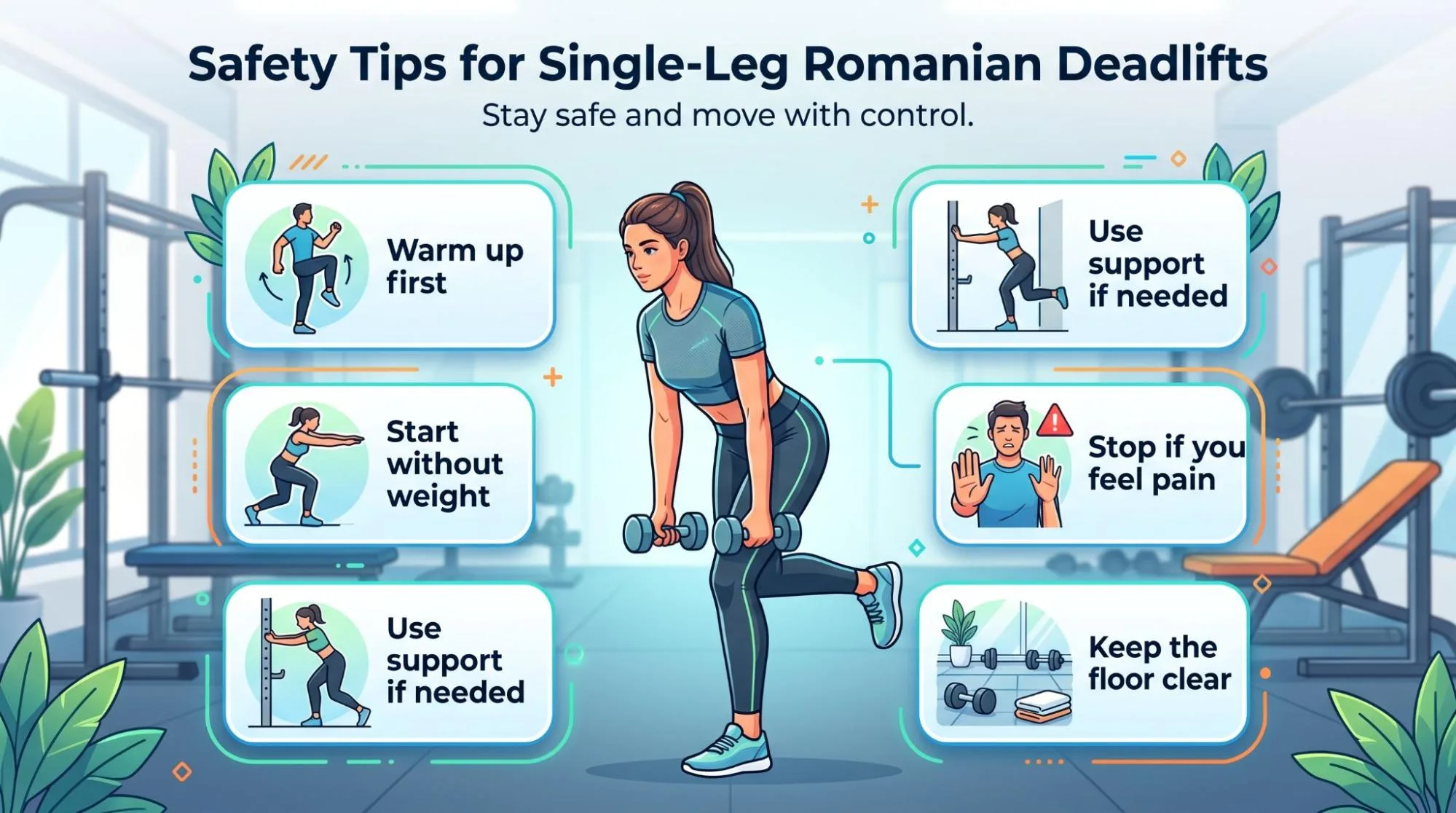
Single-leg Romanian deadlift is not harmful to those who, in good form, can perform the lift, but it must not cause sharp pain. In case you have an existing injury or significant pains, talk about it with a qualified fitness or healthcare professional before doing it.
Warm Up First
Before getting going, gently warm-up your hips, hamstrings, glutes and ankles. Basic exercises, such as glute bridges, bodyweight hip hinges, leg swings, and light lunges will help train your body. Having a warm body can move easier and be more stable.
Start Without Weight
Do not plunge into heavy dumbbells and kettlebells. Get to know the movement. Even a bodyweight single-leg RDL can be a challenge, provided that you take it slow and do it right. When you improve your balance, add light weight.
Stop If You Feel Pain
Stretching of the hamstring is normal. The glutaral and hamstring muscles have normal muscle effort. Back, knee, or hip pain was sharp and was not to be neglected. Stop the exercise and check your form. In case the pain persists, consult a specialist.
Keep the Floor Clear
As this is one of the balance exercises, ensure that your training area is secure. Keep your feet off slippery floors, or loose carpeting or objects. Wear flat shoes or train barefoot in case it feels safe and appropriate in your area.
Sets, Reps, and How Often to Do It
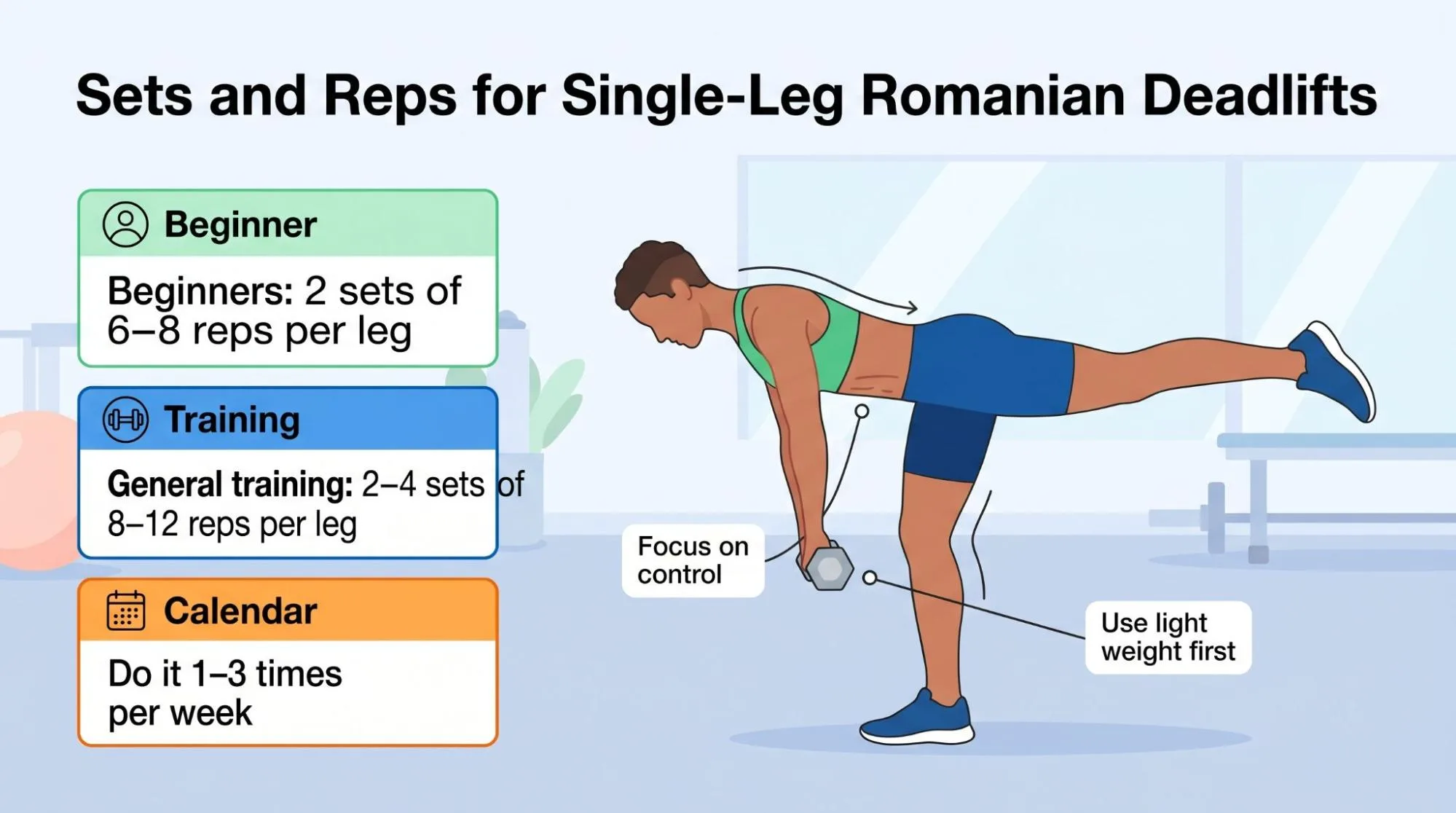
- The sets and reps are best determined by your goal. Novices must learn how to control and move smoothly. More developed lifters have an opportunity of adding weight and volume.
- Generally good strength and form: 2-4 sets of 8-12 reps per leg. Also use slow pace and take long rest so as to maintain good balance.
- To start with, 2 groups of 6 to 8 reps on each leg could be sufficient. When this is used as either a warm-up or balance exercise, it is better applied as light reps with excellent control rather than heavy reps with bad form.
- Depending on your workout plan, you can perform the single-leg Romanian deadlift 1-3 times per week. Too much, too soon is best avoided and in particular when you can feel your hamstrings really sore.
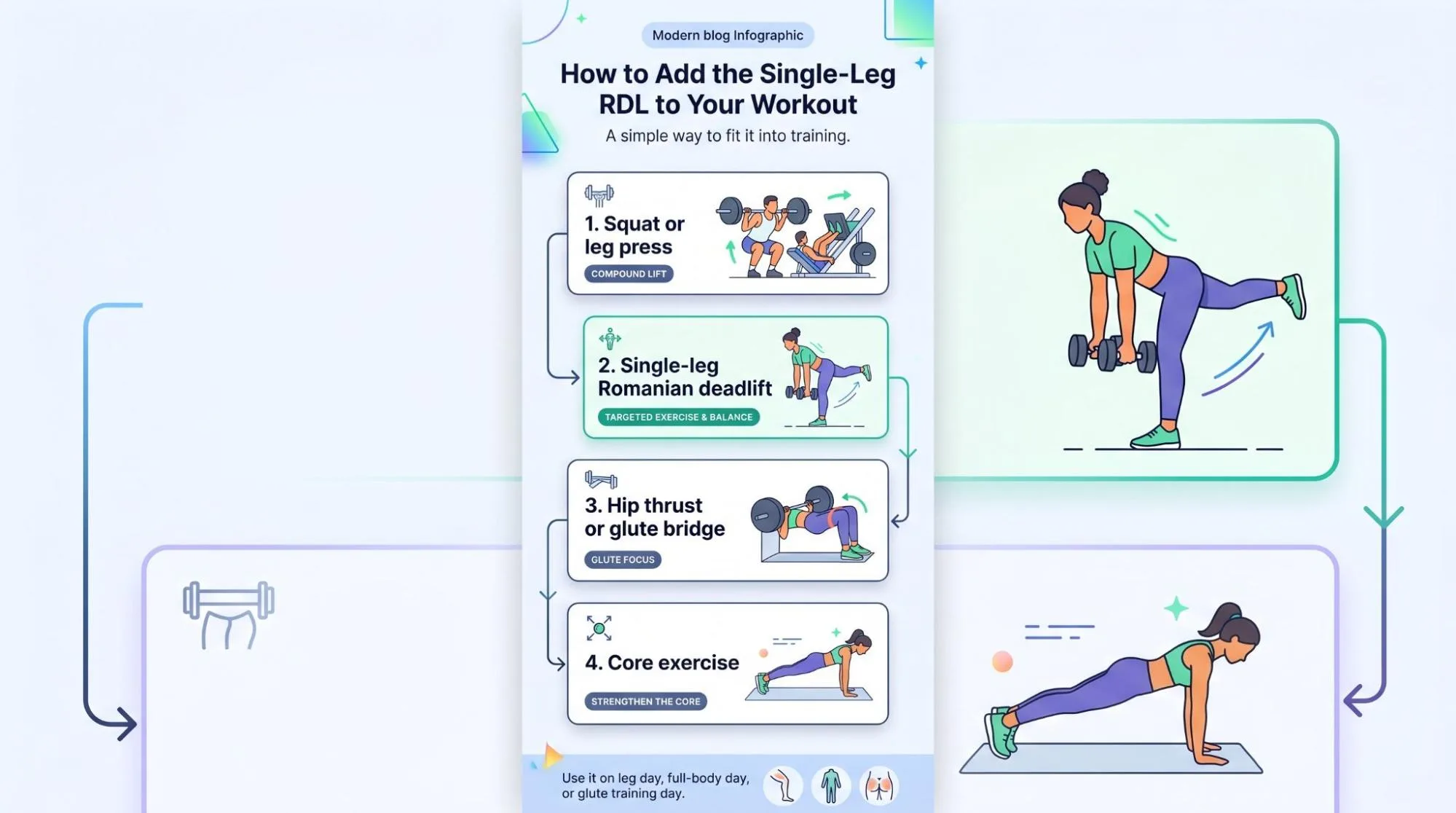
How to Add the Single-Leg RDL to Your Workout
The individual-leg RDL can be added to leg day, full-body exercises, training of the glutes, or athletic workouts. It is effective as a primary accessory workout following squats, deadlift, and along with lunges.
A basic workout of the lower body would resemble as follows:
- Squat or leg press: This will contribute to overall lower-body strength and will prepare the legs to do more demanding work.
- Single-leg Romanian deadlift: This works the glutes, ham strings, balance and hip control on each side.
- Hip thrust or glute bridge: This will further include direct glute and also help in efficient hip strength.
- Core exercise: This aids in achieving balance and manageability of forthcoming exercises.
The single-leg RDL is also a home exercise that you can perform with the use of a single dumbbell or kettlebell. It does not take up much space making it handy in simple home training.
Frequently Asked Questions
What is the single-leg Romanian deadlift good for?
Romanian deadlift on a single leg is effective in the strengthening of the glutes, hamstring, hips and core stability. It improves balance, too, as you are doing the motion with one leg. This will make it applicable in lower body strength, posture, sports performance and movement control of the daily movement.
What muscles does the single-leg Romanian deadlift work?
The muscles that are involved in the single-leg Romanian deadlift include hamstrings, glutes, core, lower back stabilisers, hips, ankles, and feet. Most of this work is performed by the hamstrings and glutes and the core assists in ensuring that your body does not twist or lose balance.
Is the single-leg RDL good for glutes?
Yes, the single-leg RDL is quite good on the glutes. You use your glutes to hinge forward and get back to standing and during the process, you extend the hip. To make it work more in the glutes you have to keep your hips at the same level, push with your standing heel, and squeeze your glutes at the top.
How do you do a single-leg Romanian deadlift correctly?
The proper technique of doing a one leg Romanian deadlift is to stand on one leg with a soft knee bend. Bend your hips backwards, bend your chest in front and allow your other leg to be turned behind you. Your back, hips, and core should be straight, even, and tight. To stand up, tap your hips using your legs.
Should beginners do the single-leg Romanian deadlift?
And novices can indeed perform the single-leg Romanian deadlift, but they must commence with body weight or light aids. The movement can be simplified by holding an object against a wall, chair or rack. After balance and form has improved some beginners can add a dumbbell or kettlebell.
What is the difference between a single-leg Romanian deadlift and a Romanian deadlift?
The only difference is that a regular Romanian deadlift involves both legs whereas, the single leg Romanian deadlift involves the use of either leg. The regular version enables a higher weight, whereas the single-leg version enhances balance, hip stability and side-to-side strength.
Is the dumbbell single-leg Romanian deadlift better than the kettlebell version?
Both the dumbbell single-leg Romanian deadlift and kettlebell single-leg Romanian deadlift are effective. Some people can find it easier to control a dumbbell, whereas a kettlebell is natural and feels more natural. The most suitable option is based on the comfort, structure, and equipment available.
Why do I lose balance during single-leg RDLs?
You will be unbalanced when performing single-leg RDL movements because you are not yet adept or accustomed to stabilizing the combination of movement between the motor and the body part. This is to be expected among novices. Move slowly, ensure that your eyes are at one point, and use light support until you are well balanced.
How low should I go in a single-leg Romanian deadlift?
One must only stoop as close as you can, and at the same time have a good form. You need to have no need to touch the floor. Quit when you experience that stretch in the hamstring or when your back is beginning to round, back, hips are turning or balance is getting out of hand.
What are the most common single-leg Romanian deadlift mistakes?
Some frequently occurring errors in common single-leg Romanian deadlift include rounding the back, opening the hips, excessively bending the knee, using excess weight, and moving too fast. Such errors can decrease outcomes and complicate the movement.
How many reps should I do for single-leg Romanian deadlifts?
The optimal number is 2-4 sets of 8-12 reps per leg. Novices can commence with 2 sets of 6 to 8 reps in each leg. Concentrate on slow, clean reps in place of rushing or using heavy weight too soon.
Can I do single-leg Romanian deadlifts at home?
Yes, you can perform a single-leg Romanian deadlift at home. You can apply body weight, a dumbbell, a kettlebell or even a loaded backpack. Ensure that the floor is level and that it is firm so that you can safely balance.
Conclusion
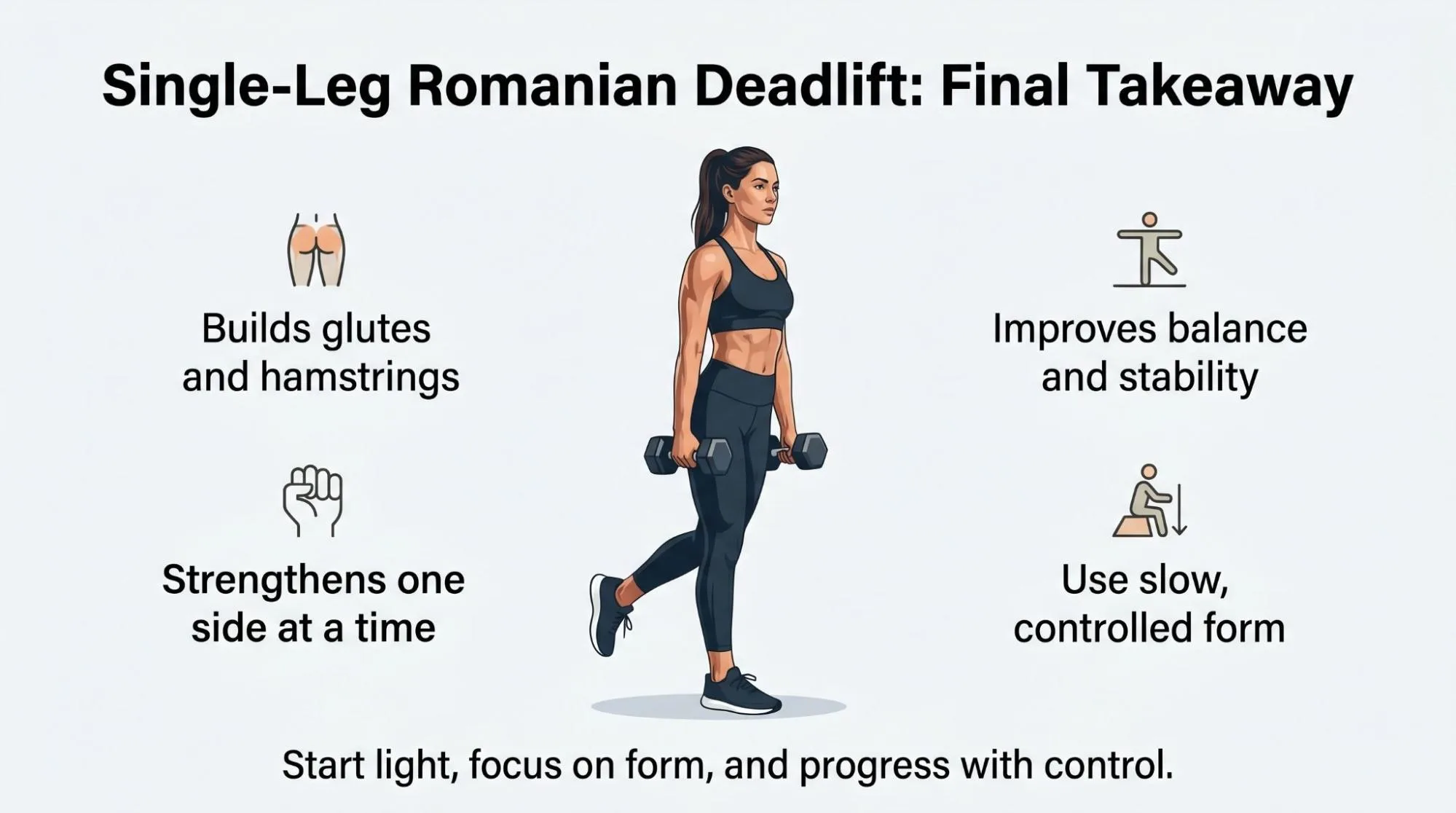
A Romanian single-leg deadlift is one of the exercises that are very effective in developing strong glutes, hamstring, hips, and core control. It might seem easy, but it is a workout that trains several crucial parts of the body simultaneously. It will assist in enhancing balance, stability, posture and single-leg strength. The trick to this exercise is proper form. You are to hinge at the hips, maintain a neutral spine, control the standing knee, and maintain a level hip. Take no fear of the movement, nor of running after the floor. The limited amount of movement with good control is far superior to the deep rep with bad form. It is the same in the choice of the dumbbell single-leg Romanian deadlift, the kettlebell single-leg Romanian deadlift, which is a bodyweight version, or a supported version, the primary goal remains the same: move slowly, maintain stability, and feel the glutes and hamstrings working. When properly executed, the single-leg RDL can be one of the most useful exercises to add to your lower-body exercise. It develops power that seems to be practical, raises body awareness, and enhances your movement in workouts, sports, and daily life.