
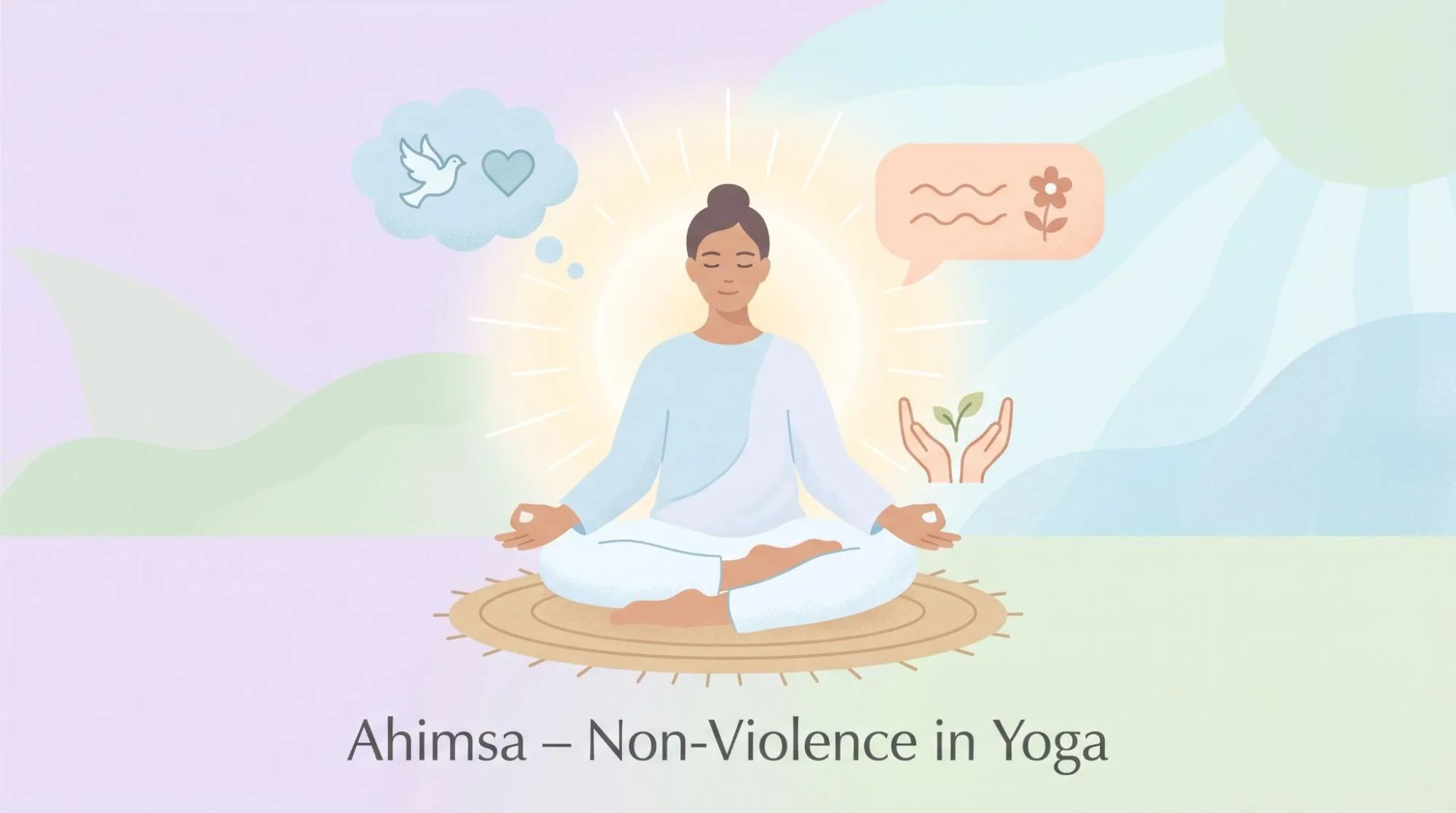
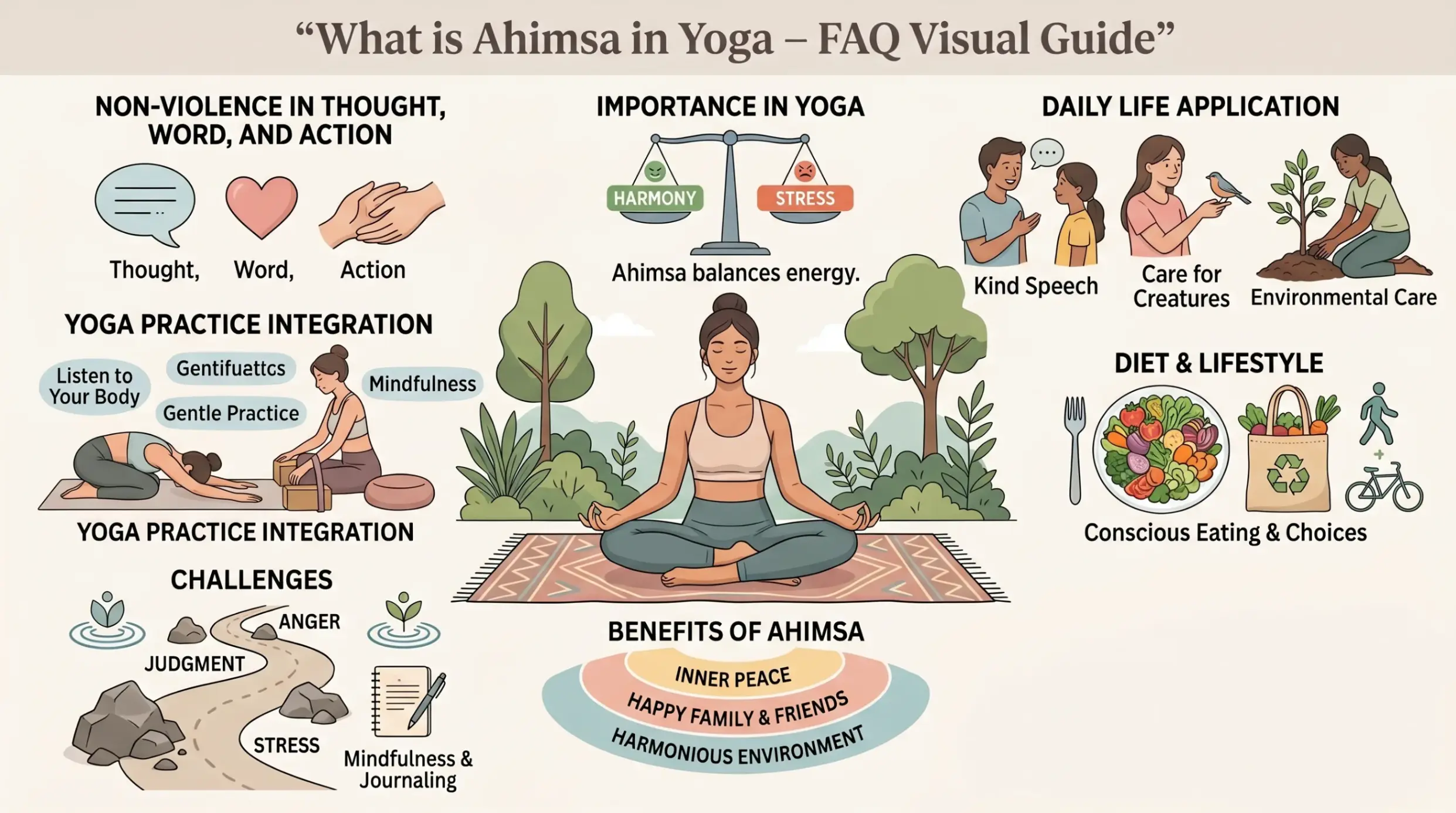
What is ahimsa in yoga? Ahimsa is the practice of non-violence in thought, speech, and action. It teaches us to avoid harm toward ourselves, other people, animals, and every living being including the world around us. When people ask what is ahimsa in yoga, the simple answer is that it is the yogic practice of living with kindness, compassion, and awareness.
 alt=”Ahimsa symbol and yoga philosophy concept” title=”Ahimsa symbol and yoga philosophy concept”
Quick answer: Ahimsa is the yogic principle of reducing harm in thought, speech, and action. It includes kindness toward yourself, other people, animals, and the wider world, while still allowing honest boundaries and responsible choices.
Practical note: Ahimsa is not the same as avoiding every difficult conversation. In daily life it can look like speaking clearly without humiliating someone, resting before overtraining, and correcting a mistake without attacking yourself.
Historical and Philosophical Background
Origins in Yoga and Spiritual Traditions
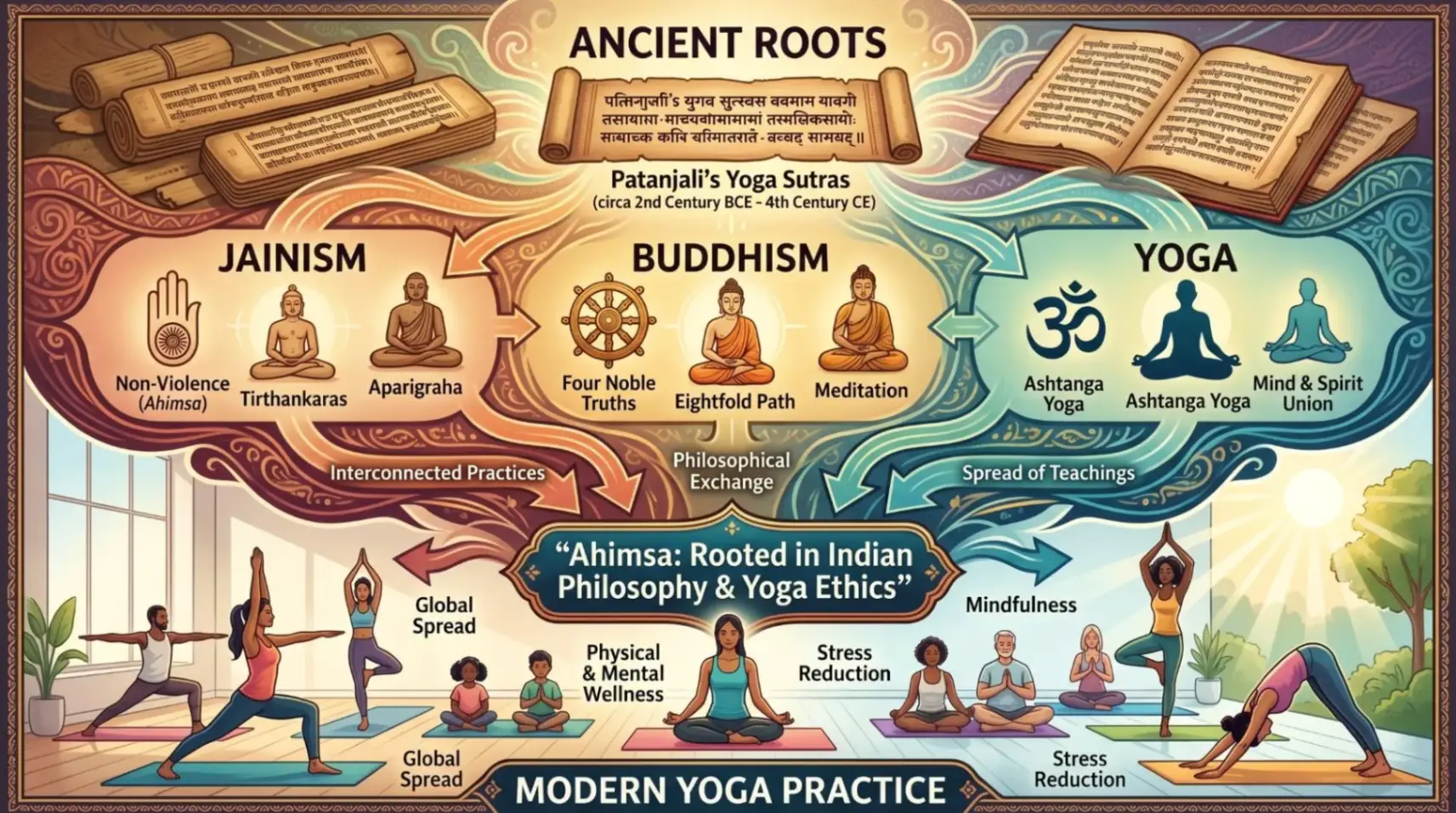
Ahimsa is a Sanskrit word that means non-harming or non-violence. It has deep roots in Indian spiritual traditions, especially Hinduism, Buddhism, and Jainism.
In yoga, ahimsa is one of the Yamas, which are ethical guidelines found in the Yoga Sutra of Patanjali. The Yamas guide how a person should live with others and with the world.
Ahimsa comes first among these ethical guidelines, which shows how important it is in yoga philosophy. Before advanced poses, breathing techniques, or meditation, yoga begins with how we treat life. Understanding ahimsa in yoga in yoga helps beginners see that yoga is not only about body movement. It is also about how we think, speak, act, and treat life around us.
Connection with Moral and Ethical Living
Yoga is not only about flexibility or strength. It is a complete way of living with awareness. Ahimsa helps connect the mind body relationship with moral behavior.
When someone has practiced yoga for a long time, they often begin to notice that yoga changes more than the body. It changes reactions, habits, and choices.
Ahimsa asks simple but powerful questions:
- Am I being kind in this moment?
- Am I causing harm through my words?
- Am I forcing my body too much?
- Am I treating others with respect?
- Am I living in a way that reduces unnecessary harm?
These questions make ahimsa useful in daily lives, not just during practice.
 alt=”Ahimsa practice of kindness in daily life” title=”Ahimsa practice of kindness in daily life”
The Core Principle: Non-Violence
Beyond Physical Harm
Ahimsa non violence is not limited to avoiding physical injury. It includes harm in thought, speech, and behavior.
For example, you may never physically hurt someone, but harsh words can still wound deeply. Constant criticism can damage confidence. Jealousy, anger, and resentment can quietly disturb your own peace.
This is why ahimsa is often called a path toward the highest form of love. It teaches kindness compassion not as a soft idea, but as a daily discipline. So, ahimsa in yoga in yoga beyond physical non-violence? It means becoming aware of subtle harm in thought, speech, habits, and reactions.
Examples of Subtle Violence
Subtle violence is often easy to miss. It may look normal on the surface, but it creates tension inside or around us.
Some examples include:
- Speaking badly about yourself
- Comparing your body to others in yoga class
- Forcing a yoga pose because of ego
- Using sarcasm to hurt someone
- Ignoring another person’s pain
- Judging people too quickly
- Wasting food or resources without care
- Holding anger for too long
Ahimsa invites us to slow down and notice these patterns without becoming harsh with ourselves.
How Non-Violence Promotes Inner Peace
When you reduce harm, you naturally create more peace. The mind becomes less restless when it is not filled with guilt, anger, or conflict.
Practicing ahimsa does not mean you never feel upset. You are human. Anger, frustration, and fear still come. But ahimsa helps you respond with awareness instead of reacting blindly.
This is one reason many people find peace through yoga philosophy. The practice slowly teaches the nervous system that calm is possible.
 alt=”Yoga meditation for non-harming and awareness” title=”Yoga meditation for non-harming and awareness”
 alt=”Yoga meditation for non-harming and awareness” title=”Yoga meditation for non-harming and awareness”
Learn More : Yama and Niyama: Meaning, Principles, Benefits, and Daily Practice
Ahimsa and Self-Care
Importance of Self-Compassion
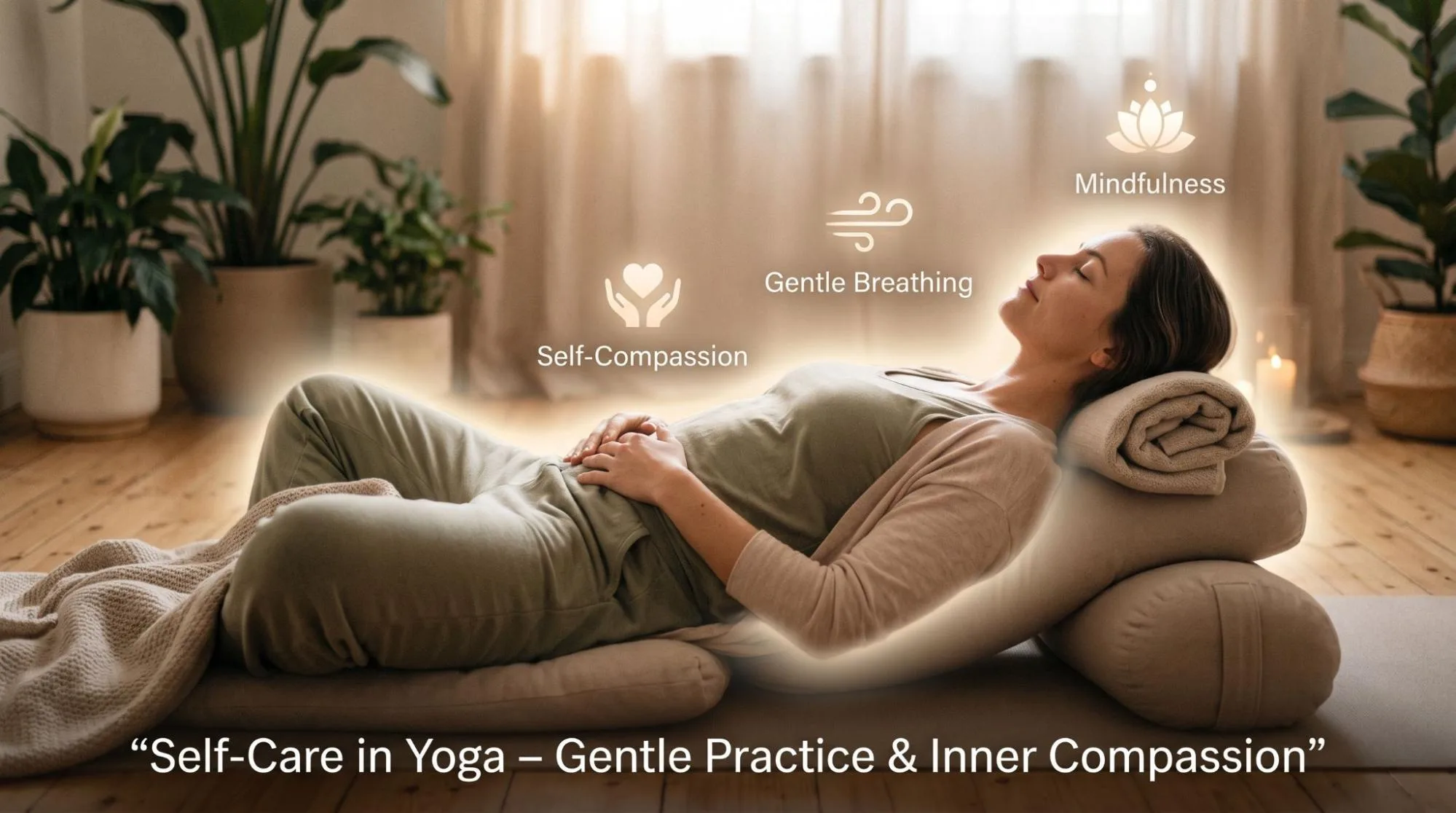
One of the most overlooked parts of ahimsa is self-compassion. Many people are kinder to others than they are to themselves.
You may say things to yourself that you would never say to a friend:
- “I am not good enough.”
- “My body is weak.”
- “I should be better by now.”
- “Everyone else is ahead of me.”
This is also a form of harm in thought.
Ahimsa reminds you that your inner voice matters. A peaceful life begins with the way you speak to yourself. Another important part of ahimsa in yoga in yoga is learning not to harm yourself through harsh self-talk, comparison, or forcing the body during asanas.
Avoiding Self-Harm in Asanas
In yoga asanas, ahimsa means practicing without force. You do not need to push your body into pain to prove progress.
A responsible yoga teacher will often remind students to listen to their bodies. Pain is not a sign of success. Shaking, discomfort, or tightness may happen, but sharp pain is a clear signal to stop or adjust.
Ahimsa on the mat may look like:
- Bending the knees when needed
- Using props without shame
- Resting in Child’s Pose
- Choosing a simpler variation
- Skipping a pose that does not feel safe
- Moving slowly instead of rushing
This is not weakness. It is wise practice.
Benefits of Gentle Practice
Gentle yoga practice can be deeply powerful. It builds trust between the body and mind. It also helps prevent injury and makes yoga sustainable for years.
When you practice with kindness, your body becomes more open over time. The breath becomes smoother. The mind becomes softer. You stop fighting your body and start working with it.
That is ahimsa in action.
 alt=”Compassionate communication as an Ahimsa practice” title=”Compassionate communication as an Ahimsa practice”
Applying Ahimsa in Daily Life
Choosing Kind Words and Compassionate Behavior
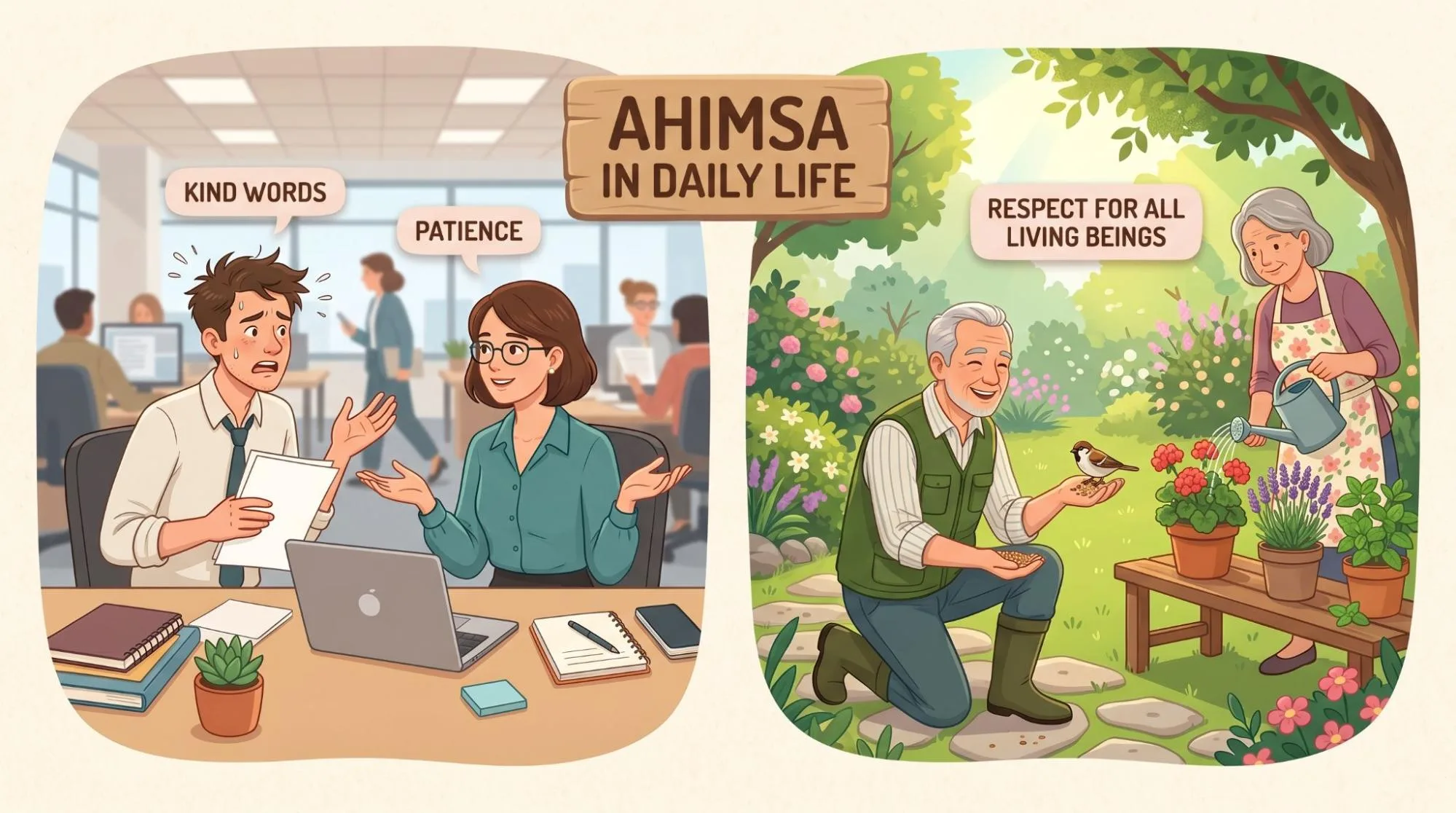
Ahimsa is practiced every time you choose words carefully. Speech has energy. It can heal, or it can hurt.
Kind words do not mean fake sweetness. Sometimes honesty is needed. But honesty can still be respectful.
When we understand ahimsa in yoga in yoga, daily life becomes a place to practice patience, kind words, mindful choices, and respectful behavior.
For example, instead of saying:
- “You never listen.”
- You might say:
- “I feel unheard, and I would like us to talk calmly.”
- The second sentence still tells the truth, but it creates less harm.
Responding with Patience Instead of Anger
Daily life gives many chances to practice ahimsa. Traffic, family stress, work pressure, online comments, delays, and misunderstandings can all test patience.
Practiced ahimsa does not mean you never feel anger. It means you pause before letting anger control your response.
A simple practice is to take one breath before replying. That tiny pause can change the whole conversation.
Ask yourself:
- Is my response helpful?
- Am I reacting from ego?
- Can I say this with more patience?
- Do I need silence right now?
Sometimes ahimsa means speaking gently. Sometimes it means walking away before causing damage.
Respect for All Living Beings
Ahimsa also includes respect for animals, nature, and the environment. Yoga teaches connection, not separation.
A living being including a person, animal, insect, plant, or natural space has value. You do not need to live perfectly to respect life. Small conscious choices matter.
This may include feeding animals with care, avoiding cruelty, reducing waste, or simply being more mindful of how your lifestyle affects others.
 alt=”Self-kindness and mindful rest” title=”Self-kindness and mindful rest”
Ahimsa in Food and Lifestyle Choices
Vegetarianism and Mindful Consumption
- Many people connect ahimsa with vegetarianism because it reduces harm toward animals. In some yoga traditions, a vegetarian lifestyle is encouraged as part of non-violence.
- But ahimsa is not about judging others. Food choices are personal and may depend on health, culture, access, and individual needs.
- A more balanced way to understand it is this: eat with awareness. Notice where your food comes from. Avoid waste. Choose what supports your body without unnecessary harm.
- For many people, ahimsa in yoga in yoga also connects with food, consumption, and lifestyle choices that reduce unnecessary harm.
Reducing Harm Through Ethical Choices
Ahimsa can also guide everyday buying decisions. You may begin to think about how products are made, who made them, and whether they cause harm to people, animals, or the environment.
Ethical choices may include:
- Buying only what you need
- Avoiding wasteful habits
- Choosing cruelty-free products when possible
- Supporting fair and responsible brands
- Reusing items instead of throwing them away quickly
- Being mindful of plastic and pollution
These choices may seem small, but they shape a more compassionate lifestyle.
Small Lifestyle Changes
You do not have to change your whole life overnight. Ahimsa grows through small steps.
You can start with:
- Speaking more gently at home
- Resting when your body is tired
- Eating one more plant-based meal each week
- Reducing gossip
- Avoiding online arguments
- Donating unused items
- Taking care of plants or animals
- Practicing gratitude before meals
Small changes become powerful when they are consistent.
Why Lifestyle Choices Matter
Your lifestyle affects your mind. When your actions match your values, you feel less inner conflict.
For example, if you care about kindness but often speak harshly, something feels unsettled inside. If you value peace but constantly overwork your body, stress builds.
Ahimsa helps bring your choices closer to your values. That alignment creates calm.
 alt=”Ahimsa and care for animals and nature” title=”Ahimsa and care for animals and nature”
Learn More : Tapas Yoga Meaning Self Discipline
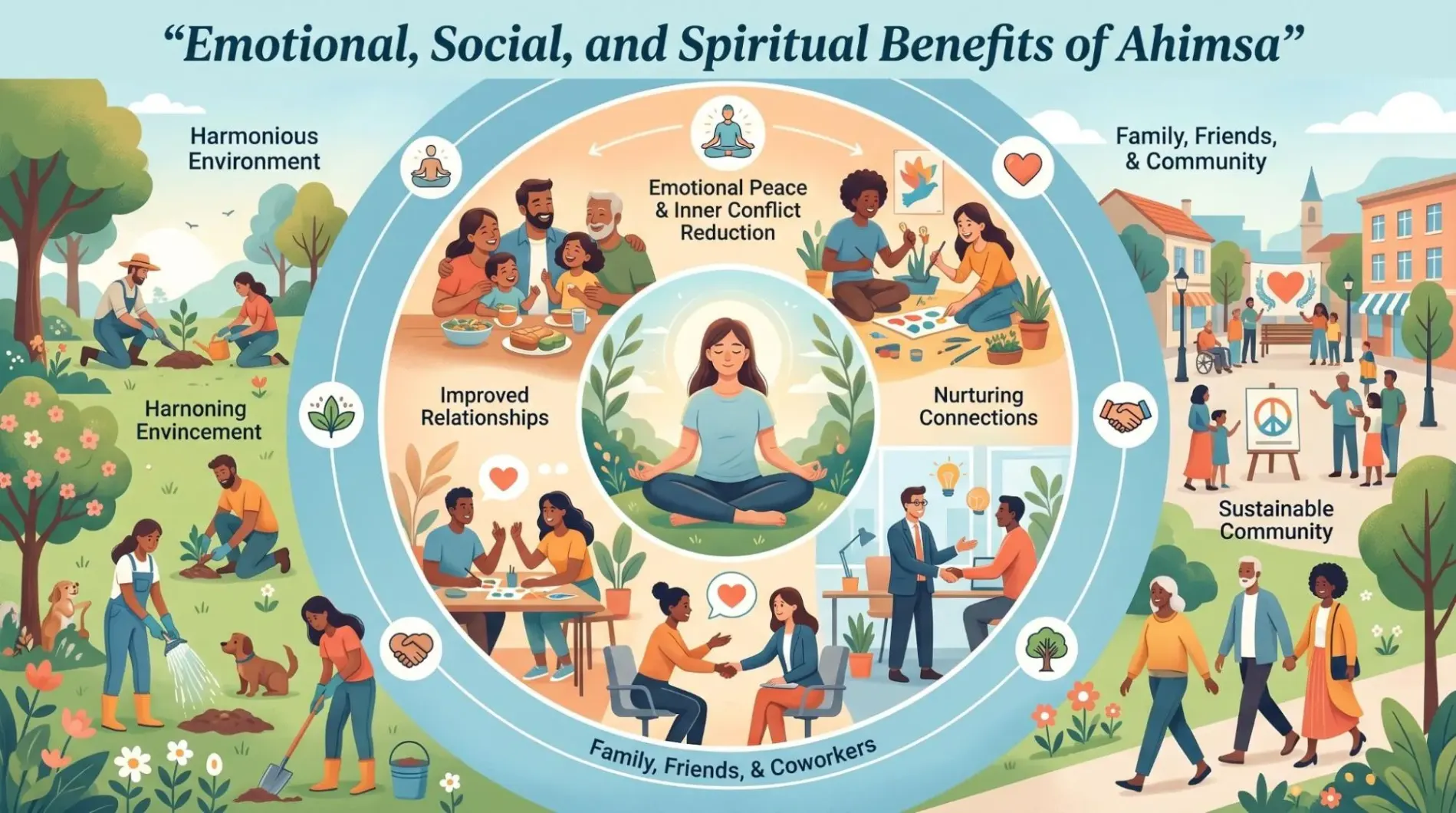
Benefits of Practicing Ahimsa
Emotional and Mental Peace
Ahimsa reduces the emotional weight of anger, guilt, regret, and resentment. When you stop feeding harmful thoughts, the mind becomes lighter.
You may still face problems, but your inner reaction begins to change. You become less controlled by irritation and more connected to awareness.
Improved Relationships
Relationships improve when ahimsa becomes part of thought speech and behavior.
People feel safer around someone who listens, speaks kindly, and responds with patience. Trust grows. Conflicts become easier to handle.
Ahimsa does not mean avoiding difficult conversations. It means having them without cruelty.
Reduced Stress and Inner Conflict
A harmful lifestyle creates tension. Harsh thoughts, angry words, unhealthy competition, and forced routines all increase stress.
Ahimsa helps reduce that pressure. It teaches softness without laziness and discipline without aggression.
That balance is one of the most useful lessons in yoga.
Spiritual and Personal Growth
Ahimsa supports spiritual growth because it clears the heart. When you reduce harm, you create space for compassion, forgiveness, and understanding.
Personal growth also becomes more natural. You stop trying to improve yourself through punishment. Instead, you grow through awareness.
That is a healthier path.
Summary
Ahimsa in yoga means non-violence in thought, speech, action, and lifestyle. It is one of the key ethical guidelines in yoga philosophy and appears in the Yoga Sutra as the first Yama.
It teaches us to avoid harm toward ourselves, other people, animals, and nature. On the yoga mat, ahimsa means practicing with care instead of force. In daily life, it means choosing kind words, patient responses, mindful food choices, and compassionate behavior.
Ahimsa is not about perfection. It is about becoming more aware of how we live.
 alt=”Yoga journal reflection on non-violence” title=”Yoga journal reflection on non-violence”
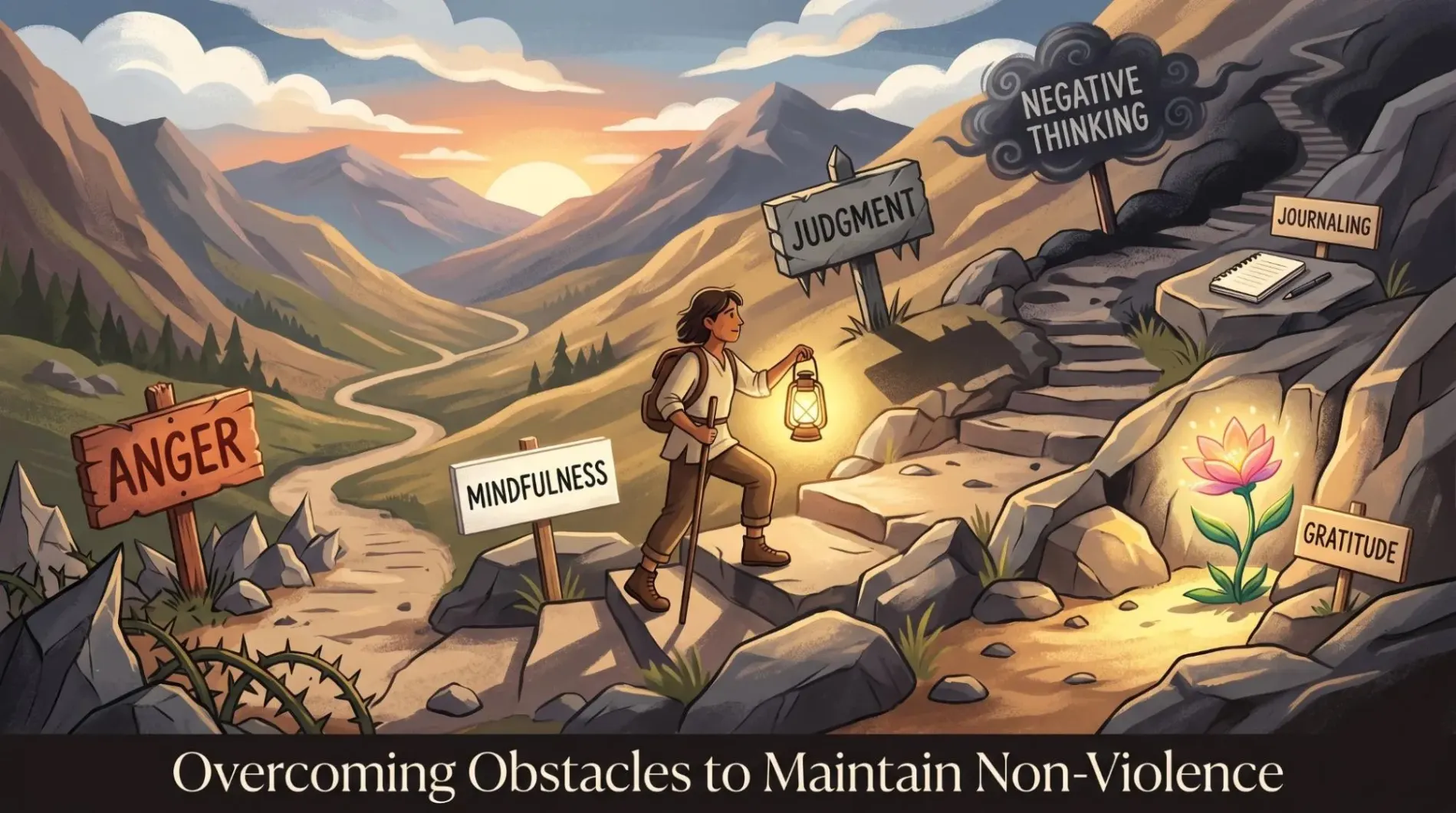
Challenges in Practicing Ahimsa
Common Obstacles
Practicing ahimsa sounds simple, but it can be difficult.
Some common obstacles include:
- Quick anger
- Old habits of criticism
- Stressful environments
- Ego in yoga practice
- Negative self-talk
- Social pressure
- Lack of patience
- Desire to be right all the time
These challenges are normal. Nobody practices ahimsa perfectly every day.
Strategies to Cultivate Awareness
The first step is noticing. You cannot change what you do not see.
Try observing your thoughts and reactions during the day. Notice when your words become sharp. Notice when your body feels tense. Notice when you are forcing something.
You can also ask:
- What am I feeling right now?
- Am I about to cause harm?
- Can I respond more gently?
- What would compassion look like here?
Awareness creates choice. Choice creates change.
Maintaining Consistency Without Self-Criticism
This part matters. Do not use ahimsa as another reason to judge yourself.
If you lose patience, speak harshly, or push too hard in practice, notice it and learn from it. Then return to kindness.
Self-criticism is not the same as growth. Real growth feels honest but not cruel.
 alt=”Mindful speech and respectful conversation” title=”Mindful speech and respectful conversation”
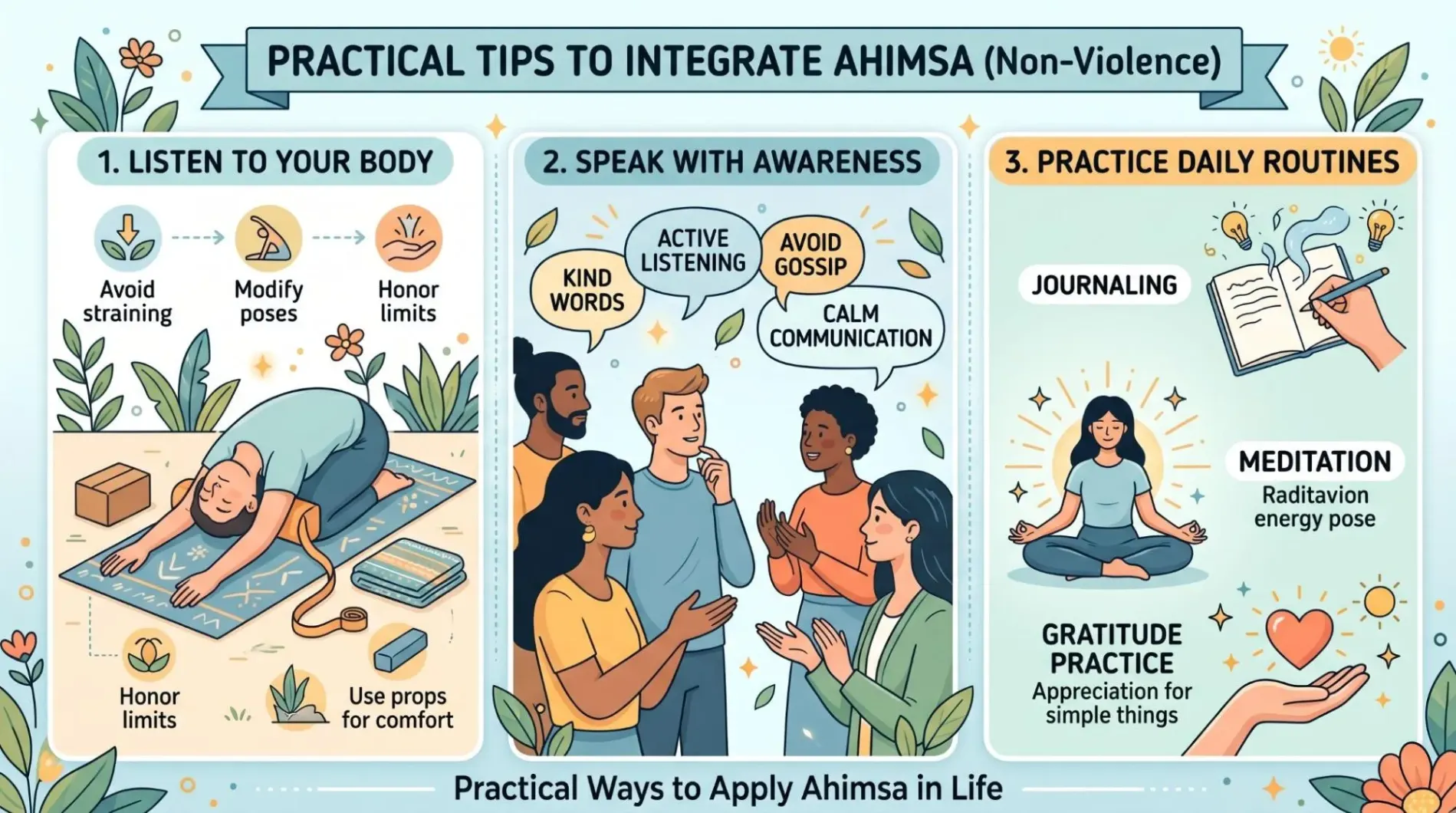
Practical Tips to Integrate Ahimsa
On the Yoga Mat
Use ahimsa in your yoga practice by listening carefully to your body.
Helpful habits include:
- Warm up slowly
- Breathe steadily
- Stop before pain
- Use blocks, straps, or cushions
- Avoid comparing yourself to others
- Respect your energy level
- Take rest when needed
A peaceful yoga class is not about doing the hardest pose. It is about practicing with awareness.
In Interactions
Ahimsa in relationships begins with small choices.
Try to:
- Listen before replying
- Speak honestly but gently
- Avoid gossip
- Apologize when needed
- Give people time to explain
- Set boundaries without cruelty
- Choose patience over blame
Kindness does not mean allowing disrespect. You can protect your peace and still practice non-violence.
Daily Rituals
Simple rituals can help you practiced ahimsa more naturally.
You may try:
- Morning breathing for 3 minutes
- A short gratitude note
- Eating one meal without rushing
- Saying one kind thing to yourself
- Checking your tone before replying
- Ending the day by reflecting on one peaceful action
These small rituals train the mind toward compassion.
 alt=”Ahimsa-inspired ethical daily choice” title=”Ahimsa-inspired ethical daily choice”
Frequently Asked Questions
1. ahimsa in yoga in yoga?
Ahimsa in yoga means non-violence or non-harming in thought, speech, action, and lifestyle.
2. Is ahimsa only about not hurting others?
No. Ahimsa also includes not harming yourself through negative self-talk, overwork, forced yoga poses, or unhealthy habits.
3. Why is ahimsa important in yoga philosophy?
Ahimsa is one of the main ethical guidelines in the Yoga Sutra. It helps build kindness, compassion, inner peace, and responsible living.
4. How can I practice ahimsa in a yoga class?
Practice gently, avoid forcing poses, listen to your body, use props, and stop when something feels painful or unsafe.
5. Does ahimsa mean I must be vegetarian?
Not always. Many people connect ahimsa with vegetarianism, but the deeper idea is mindful consumption and reducing harm where possible.
6. Can ahimsa help with stress?
Yes. Ahimsa can reduce stress by helping you respond with patience, release harsh self-judgment, and create less inner conflict.
7. What are examples of subtle violence?
Subtle violence includes gossip, harsh self-talk, sarcasm, judgment, jealousy, forcing the body, and speaking in anger.
8. How does ahimsa improve relationships?
It encourages kind speech, patience, better listening, and more respectful conflict. This helps build trust and emotional safety.
9. Can beginners practice ahimsa?
Yes. Beginners can practice ahimsa by being gentle with their bodies, speaking kindly, and making small mindful choices in daily life.
10. What is the easiest way to start practicing ahimsa?
Start by noticing your thoughts and words. Try to pause before reacting, speak more gently, and treat your body with respect.
 alt=”Calm meditation representing inner kindness” title=”Calm meditation representing inner kindness”
Learn More : Sphinx Pose Yoga for Beginners
Conclusion
Ahimsa is one of the most meaningful teachings in yoga because it touches every part of life. It begins with non-violence, but it grows into kindness, compassion, self-respect, and mindful living.
You do not need to be perfect to practice ahimsa. You only need to become more aware.
Be gentle with your body in yoga. Choose words that do not harm. Treat other living beings with care. Make small lifestyle choices that reduce harm. And when you make mistakes, return to compassion instead of self-criticism.
In the end, ahimsa in yoga in yoga is not just a question about philosophy. It is a practical reminder to live with more kindness, compassion, patience, and care.
 alt=”Yoga philosophy reading and reflection” title=”Yoga philosophy reading and reflection”
